Best Dual Monitor Arm for CAD Work at a Desk

Five dual monitor arms compared on the specification that actually matters for a CAD desk: how much weight each arm holds, and how far it reaches before it sags.

By Lamar CalhounUpdated 15 min read
On this page
- Best dual monitor arm for CAD at a glance
- How I screened these dual monitor arms
- Does a dual monitor arm for CAD need anything special?
- Weight limits: the number that decides this purchase
- 1. ErGear Dual Monitor Arm — Best overall
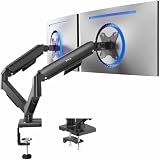
- 2. WALI Adjustable Dual Monitor Arm for 13-32 inch Screens — Best budget pick
- 3. MOUNTUP Dual Monitor Stand for Desk — Most versatile
- 4. VIVO Dual Monitor Stand — Best for families
- 5. HUANUO 17-32 Inch Dual Monitor Stand — Best premium
- C-clamp or grommet: which mount fits your desk?
- What the listings do not tell you
- The verdict
- FAQ
The best dual monitor arm for CAD is the ErGear Dual Monitor Arm, because it pairs a 19.8 lb load rating with a 5-year warranty and a tool-free VESA plate, which is the combination that keeps two heavy panels locked in place through years of nudging. If either of your screens is heavier or wider, the WALI Adjustable Dual Monitor Arm rates 22 lbs per arm and reaches 19.3 inches out. Most buyers compare tilt and swivel numbers. Those barely differ across this set.
Best dual monitor arm for CAD at a glance
| Pick | Load per arm | Screen range | Price |
|---|---|---|---|
Best overall ErGear Dual Monitor Arm |
19.8 lbs total claim | 13"–32" | Check Price |
Best budget pick WALI Adjustable Dual Monitor Arm |
22 lbs per arm claim | 13"–32" | Check Price |
Most versatile MOUNTUP Dual Monitor Stand for Desk |
4.4–17.6 lbs claim | 17"–32" | Check Price |
Best for families VIVO Dual Monitor Stand |
4.4–19.8 lbs claim | 17"–32" | Check Price |
Best premium HUANUO 17-32 Inch Dual Monitor Stand |
19.8 lbs max claim | 17"–32" | Check Price |



How I screened these dual monitor arms
I started with the published specifications and threw out everything I could not compare. Five arms survived, all in the monitor arms category, all dual-screen, all VESA.
Here is what I looked at, in order:
- Stated load capacity per arm. This is the first number that rules a product in or out for a CAD desk, because professional panels run heavy.
- Screen size range. Three of the five start at 17 inches. Two go down to 13 inches, which matters if one of your screens is a small reference display.
- Published warranty term. Only four of the five list one. That gap is real, and I weighted it.
- Mounting options. C-clamp, grommet, or both, and the desk thickness each accepts.
- Reach and rise figures, where the listing states them.
What got cut: single-screen mounts, laptop tray combos, and any arm whose listing gave a screen range without a weight figure. An arm with no stated load limit is an arm you cannot size to your monitors, and a CAD setup is exactly where that guess goes wrong.
I did not rank on motion range. Every pick here claims 90-degree tilt, 180-degree swivel, or 360-degree rotation in some combination, and those numbers stopped being a differentiator in this category years ago.
Does a dual monitor arm for CAD need anything special?
Partly, and less than the marketing implies. Nothing in these listings is engineered for drafting software specifically, so treat any pitch that claims otherwise as noise.
What CAD work actually changes is the physical demand. Two things drive it:
- Panel weight. CAD users tend to run larger, brighter, higher-refresh monitors, and those weigh more than a basic office screen. A 32-inch panel can push past 17 lbs before you add the stand plate.
- Position stability. You reposition a screen once and then leave it for months. An arm that creeps downward over weeks is worse than one with a narrower motion range.
So the specification to chase is load rating with a margin, not flexibility. Check your monitor's weight without its factory stand, then pick an arm rated above that per screen. Do not use the box weight.
The other thing that matters is VESA pattern. The ErGear listing specifies a maximum of VESA 100x100mm. The VIVO, MOUNTUP and HUANUO listings all name 75x75mm and 100x100mm. If your monitor uses the smaller pattern, that single line eliminates one of the five picks before you compare anything else.
Weight limits: the number that decides this purchase
Lay the load claims side by side and the field splits cleanly.
WALI states 22 lbs per arm, the highest figure published in this set. ErGear, VIVO and HUANUO all land at 19.8 lbs. MOUNTUP tops out at 17.6 lbs, the lowest ceiling here, and it also sets a 4.4 lb floor.
That floor is not a typo, and it catches people out. Gas-spring and mechanical-spring arms need a minimum weight to counterbalance against. Hang something too light and the arm springs upward on its own. VIVO publishes the same 4.4 lb minimum. If one of your two screens is a small 13-inch reference panel, that is a genuine compatibility problem.
Short version of the ranking on load alone:
- 22 lbs per arm: WALI
- 19.8 lbs: ErGear, VIVO, HUANUO
- 17.6 lbs ceiling with a 4.4 lb floor: MOUNTUP
Now the part most guides skip. Load capacity is stated at a given extension. Every one of these arms reaches further than a foot from its post, and the leverage at full reach is what tests the clamp. WALI claims 19.3 inches of extension and 17.3 inches of rise. MOUNTUP claims 17.3 inches of extension. ErGear claims height adjustment up to 17 inches. Reach far with a heavy panel and you are asking more of the joint than the headline number suggests.
1. ErGear Dual Monitor Arm — Best overall
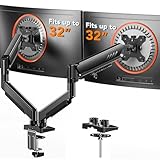
The ErGear is the balanced pick: a 19.8 lb rating, the widest screen range in this set at 13 to 32 inches, and a 5-year warranty that outlasts three of its rivals.
Best for: a two-screen CAD desk with 27-inch panels and a long warranty Skip it if: your monitors use a VESA 75x75 pattern
What sets the ErGear apart in this group is the pairing of a long warranty with a low price position. It is the second-cheapest of the five and sits in the entry tier, yet it carries a 5-year warranty term. Only WALI publishes longer. VIVO lists three years, MOUNTUP two, and HUANUO publishes no term at all.
The 13 to 32 inch span is the broadest here. That matters on a CAD desk where the second screen is often a smaller reference or palette display rather than a matched twin. ErGear says the VESA plate installs tool-free in three steps, and that the upgraded head closes the VESA gap by 50 percent for a tighter fit. Treat both as the manufacturer's claims, but the design intent is clear enough: less play at the joint, which is where sag starts.
The listing gives dimensions of 18.1 x 30.7 x 5.91 in and a black finish. Height adjustment is claimed up to 17 inches, with independent positioning for each screen.
The trade-off is the VESA ceiling. Where three rivals name both 75x75mm and 100x100mm, ErGear's listing specifies a maximum of 100x100mm, so smaller-pattern monitors are a compatibility question you need to settle first. Only one seller lists it, too.
Pros:
- 5-year warranty, second-longest in this set
- Widest screen range here at 13"–32"
- 19.8 lb rating in the entry price tier
- Tool-free VESA plate per the listing
- Independent height adjustment up to 17"
Cons:
- Listing names a VESA 100x100mm maximum, no 75x75 confirmation
- Only one seller lists it
- No published minimum monitor weight
- Load figure is stated as a total, not per arm
2. WALI Adjustable Dual Monitor Arm for 13-32 inch Screens — Best budget pick
WALI is the cheapest of the five and still publishes the highest load figure here, 22 lbs per arm, plus a 10-year warranty.

Best for: heavier 32-inch panels on a tight budget Skip it if: you want the shortest possible desk footprint
This is the value outlier, and the numbers are not close. WALI is the cheapest pick in the group, yet its 22 lbs per arm beats every other published rating, and its 10-year warranty is more than three times MOUNTUP's two-year term. It is also the only pick here with a stated release year of 2024.
For a CAD desk, that load headroom is the whole argument. If you are running two 32-inch panels, WALI is the only arm in this set whose stated capacity gives you real margin rather than a number you are hoping is conservative. The claimed reach is 19.3 inches with 17.3 inches of rise, the longest extension figure published across the five.
WALI states two mounting routes, a C-clamp or a grommet base, both for desks 0.39 to 2.76 inches thick. The unit weighs 8.16 lb and comes in a black dual configuration, model GSMP002N. The listing also claims a wider VESA head and a tighter-fitting panel for stability.
Where it gives ground: the desk thickness range tops out at 2.76 inches, the narrowest window in this set, so a thick butcher-block top could rule it out. Three sellers list it, which means the exact listing you land on may vary.
Pros:
- Cheapest of the five picks here
- 22 lbs per arm, highest published rating
- 10-year warranty, longest in this set
- 19.3" claimed extension, longest reach here
- Both C-clamp and grommet mounting included
Cons:
- Desk thickness capped at 2.76", narrowest of the group
- Overall dimensions not published
- Long reach means more leverage on the clamp at full extension
- Three sellers list it, so the listing you get may differ
3. MOUNTUP Dual Monitor Stand for Desk — Most versatile
MOUNTUP is the mid-priced pick with the most published detail on its footprint, and pneumatic arms that hold position without re-tightening.

Best for: a desk that gets rearranged often Skip it if: either monitor tops 17.6 lbs
MOUNTUP sits roughly mid-range for this set, and it is the pick I would choose if the layout changes. It publishes the fullest dimensional data here: 5.75 x 16.7 x 8.35 in, weighing 8.51 lb. That 5.75-inch depth figure is useful because it tells you how much of your desk the base actually occupies, which none of the other four listings makes as clear.
MOUNTUP calls these pneumatic arms and claims 17.3 inches of extension with independent positioning of each screen. Gas-spring arms are the ones you can nudge with a fingertip and leave, which is why the versatility label fits. The listing also says cables conceal inside the arms, and that both a C-clamp and a grommet base ship in the box.
The catch is the load window: 4.4 to 17.6 lbs, the lowest ceiling in this group. Two large CAD panels can exceed that, and the 4.4 lb floor rules out very light secondary screens. The screen range starts at 17 inches, so a 13-inch reference display is out too.
Compared with ErGear, you get better-documented dimensions and pneumatic movement. You give up 2.2 lbs of headroom per screen and three years of warranty coverage.
Pros:
- Fullest published dimensions, 5.75 x 16.7 x 8.35 in
- Pneumatic arms per the listing, easy repositioning
- Cable routing inside the arms
- C-clamp and grommet base both included
- 17.3" claimed arm extension
Cons:
- 17.6 lb ceiling, lowest in this set
- 4.4 lb minimum rules out very light screens
- 2-year warranty, shortest published term here
- Screen range starts at 17", no small-panel support
4. VIVO Dual Monitor Stand — Best for families
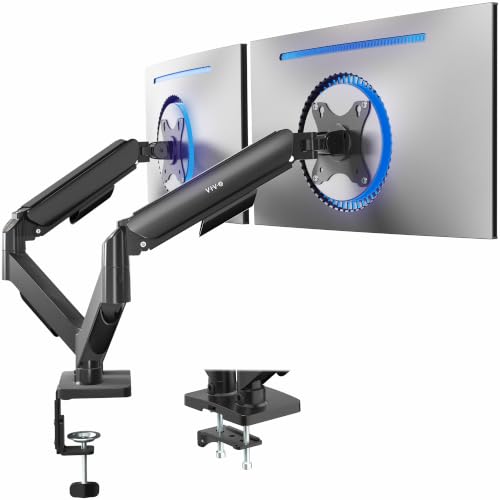
VIVO uses mechanical spring counterbalance rather than gas, which makes height changes quick when two people share one desk.
Best for: a shared desk where two people swap seats and screen heights Skip it if: your desk sits flush against a wall
VIVO is one of two premium-tier picks here, and it is the fourth-cheapest of the five. The case for it is the mechanical spring system: VIVO describes toolless placement with counterbalance in all directions, which is the behaviour you want when a desk gets handed between a tall adult and a shorter one twice a day. No knob-turning between users.
The bracket motion is fully specified: +90 to -90 degrees of tilt, 180 degrees of swivel, and 360 degrees of rotation. Screen support runs 17 to 32 inches at 4.4 to 19.8 lbs each, and both VESA 75x75mm and 100x100mm patterns are named, so it clears the compatibility hurdle ErGear leaves open. The warranty is three years. Mounting is by heavy-duty C-clamp, model STAND-V002O.
One line in the listing deserves your attention, because VIVO flags it themselves: the back of the arms extends past the edge of your desk. If your desk is pushed against a wall, that overhang is a real installation constraint.
The other gap is data. VIVO publishes no weight and no dimensions, so you cannot check the footprint before it arrives. For a premium price position, that is thin documentation next to MOUNTUP's full figures.
Pros:
- Mechanical spring counterbalance, toolless height changes
- Both VESA 75x75mm and 100x100mm named
- Full motion spec: 90° tilt, 180° swivel, 360° rotation
- 19.8 lb per-screen support with a 3-year warranty
Cons:
- Arms extend past the desk edge, per the listing
- No published weight or dimensions
- Premium price position without extra published capability
- 4.4 lb minimum per screen
5. HUANUO 17-32 Inch Dual Monitor Stand — Best premium
HUANUO is the only stacked mount here, putting one screen above the other and reaching 25.19 inches of elevation.

Best for: stacking one screen above the other in a narrow bay Skip it if: you need a published warranty term
This is the structural outlier, and the reason to consider it has nothing to do with price. HUANUO is a stacked mount, not a side-by-side one. For CAD work in a narrow bay, or where a wall or partition limits horizontal room, vertical stacking is the only layout that fits. The listing claims a 17-inch extension pole elevating monitors to 25.19 inches, the tallest figure in this set.
It is the most expensive pick here. Motion is stated at 90 degrees of tilt, 180 degrees of swivel and 360 degrees of rotation, with a 19.8 lb maximum and VESA 75/100mm support. Published dimensions are 17 x 6.9 x 8 in, and the count field lists 2, matching the two-screen design. Both C-clamp and grommet mounting are offered, for desks 0.39 to 3.54 inches thick, which is the widest desk range in the group.
The HUANUO listing opens by telling you to verify compatibility against three conditions before buying, which is unusual candour and worth acting on. Stacked mounts are fussier about panel geometry than side-by-side arms.
Two real gaps. No warranty term is published anywhere in the listing, the only pick here without one. And no unit weight is stated. For the highest price position in this set, that is less documentation than the cheapest pick provides.
Pros:
- Only stacked mount here, works in narrow bays
- 25.19" claimed elevation, tallest in this set
- Widest desk thickness range, 0.39"–3.54"
- Published dimensions of 17 x 6.9 x 8 in
- VESA 75mm and 100mm both supported
Cons:
- No published warranty term, the only pick without one
- Most expensive pick here
- No stated unit weight
- Stacked layout does not suit every CAD workflow
- Screen range starts at 17"
C-clamp or grommet: which mount fits your desk?
Before load capacity matters, the arm has to attach. Measure your desk thickness with a ruler, at the exact spot the clamp will sit, and check it against these published ranges.
- WALI: C-clamp or grommet, 0.39"–2.76"
- HUANUO: C-clamp or grommet, 0.39"–3.54"
- MOUNTUP: C-clamp or grommet base, both included
- VIVO: heavy-duty C-clamp, desk tops up to 3 inches
- ErGear: tool-free VESA plate, desk mounting method not specified in the listing
Grommet mounting means drilling a hole through the desktop, or using an existing cable hole. It is more secure than a clamp and it survives a heavy panel at full reach better. It also permanently marks the desk, so renters and shared-office users usually stay with the clamp.
One thing worth checking on a CAD desk specifically: whether the clamp lands on a solid rail or on unsupported laminate. A thin particleboard top can dent under clamp pressure even when the thickness is technically in range. If your desk has a steel frame member near the back edge, clamp there.
The VIVO note about the arms projecting behind the desk edge applies to more than VIVO, incidentally. Any post-mounted arm sits behind the clamp point. Leave two inches of clearance from the wall.
What the listings do not tell you
A few gaps are worth naming, because the listing pages will not name them for you.
Nobody publishes a per-arm figure consistently. WALI and MOUNTUP state load per screen. ErGear's 19.8 lbs reads as a system figure in the listing title. That distinction matters a lot when you are sizing two heavy CAD panels.
Load ratings are quoted without an extension. A 19.8 lb rating measured with the arm folded in is a different engineering claim from the same rating at 19 inches out. None of the five specifies which.
Only ErGear publishes overall dimensions of the assembled unit, and MOUNTUP and HUANUO publish theirs. VIVO and WALI leave the footprint partly blank, so you are guessing at desk clearance.
Warranty coverage terms are unstated. Four picks give a length. None of the listings explains what a warranty covers, so a sagging gas cylinder in year four is an unknown.
Cable routing capacity is never quantified. Three listings mention cable management. None says how many cables the channel takes. A CAD workstation with two DisplayPort runs, two power bricks and a USB hub feed can exceed what a slim arm channel swallows.
The verdict
The best dual monitor arm for CAD is the ErGear Dual Monitor Arm. It is the second-cheapest of the five, it carries a 5-year warranty, it holds 19.8 lbs, and it covers 13 to 32 inch screens, which is the broadest range in this set. Nothing else here matches that spread of strengths at that price position.
Two conditions flip it.
First, monitor weight. If either panel approaches 20 lbs, buy the WALI instead. Its 22 lbs per arm is the highest published figure in this group, it is the cheapest pick here, and it carries a 10-year warranty. The only reason not to lead with WALI is its narrower 2.76-inch desk thickness limit and its thinner published dimensional data.
Second, VESA pattern. If your monitors mount on 75x75mm, ErGear's listing does not confirm support, and the VIVO Dual Monitor Stand does, with mechanical spring counterbalance that suits a shared desk. Check the back of your screen before you order.
WALI's exact advantage over ErGear comes down to two numbers: 2.2 more pounds of stated capacity per arm, and five more years of warranty. What it gives up is a documented footprint and a wider desk-thickness window.
FAQ
Is a dual monitor arm for CAD worth the money?
A dual monitor arm for CAD is worth it if you reposition screens or need desk space back under two large panels. Lifting both monitors clears room for a keyboard, a tablet and a docking station. The entry-tier picks here, ErGear and WALI, both hold 19.8 lbs or more, so the capability is not restricted to the expensive end.
How much weight can each of these dual monitor arms hold?
Weight capacity across these dual monitor arms ranges from 17.6 lbs to 22 lbs. WALI publishes the highest at 22 lbs per arm. ErGear, VIVO and HUANUO all state 19.8 lbs. MOUNTUP tops out at 17.6 lbs and also sets a 4.4 lb minimum, which rules out very light secondary screens. Weigh your monitor without its factory stand.
Which is better, the ErGear or the WALI dual monitor arm?
Better between ErGear and WALI depends on panel weight. WALI wins on raw numbers: 22 lbs per arm, a 10-year warranty, 19.3 inches of reach, and the lowest price of the five. ErGear wins on documentation and desk fit, with published dimensions of 18.1 x 30.7 x 5.91 in and a 13-inch minimum screen size WALI matches but MOUNTUP does not.
Will these arms fit my monitor's VESA mounting pattern?
Whether these arms fit your VESA pattern depends on the pick. VIVO, MOUNTUP and HUANUO all name both 75x75mm and 100x100mm. ErGear's listing specifies a maximum of VESA 100x100mm, so 75mm support is unconfirmed. Check the four holes on the back of your screen and measure the spacing in millimetres before ordering anything.
What mistake do people make buying a dual monitor arm?
The mistake people make is buying on motion range rather than load capacity. Every pick here claims roughly 90-degree tilt and 360-degree rotation, so those numbers separate nothing. Weight limit and desk thickness are what cause returns. Two others catch buyers out: the 4.4 lb minimum on spring arms, and arms projecting behind the desk edge.
Start by weighing one monitor without its stand and measuring your desk at the clamp point. Those two numbers decide four of the five picks here on the spot. If both come in comfortably, the ErGear is the sensible default, and not because it is the flashiest arm in the group. It is the one that documents its footprint, spans the widest screen range, and backs a 19.8 lb rating with five years of warranty from an entry-tier price position. That combination is what you notice in year three, when nothing has drooped and you have not thought about the mount once.