Best Budget WiFi Router for Students by Bandwidth
Six routers compared on published bandwidth, coverage claims, port count and warranty length, with a named winner and the exact conditions that flip the pick to something else.

By Lamar CalhounUpdated 18 min read
On this page
- Best budget wifi router for students at a glance
- How I cut the field down to six routers
- What does the bandwidth number on the box actually mean?
- 1. TP-Link AX1800 WiFi 6 Router — Best overall
- 2. TP-Link AC1200 WiFi Router Dual Band Wireless Internet — Best budget pick
- 3. GL.iNet GL-SFT1200 Opal Travel Router — Best for small spaces
- 4. ASUS RT-AX1800S Dual Band WiFi 6 Extendable Router — Best for heavy use
- Can a router legally live in a dorm room?
- 5. NETGEAR WiFi 6 Router 4-Stream — Best for beginners
- 6. NETGEAR Nighthawk Dual-Band WiFi 7 Router — Best premium
- What does spending more on a budget wifi router for students actually buy?
- When a different pick wins
- The verdict
- FAQ
The best budget wifi router for students is the TP-Link Archer AX21, because 1.8 Gbps of total bandwidth across two bands and four high-gain antennas cover a shared apartment without costing what the premium picks here cost. If your whole world is one room and a laptop, the Archer A54 is the cheaper, sensible answer at 1200 Mbps total.
Price tiers in this category buy specific things, and they're easy to map. The entry tier gets you dual-band WiFi 5 and roughly 1,000 sq. ft. of claimed coverage. The middle tier moves you to WiFi 6 and a bandwidth figure near 1.8 Gbps. The top tier adds ports, a faster WAN connection, and a newer wireless standard. Nothing more mysterious than that.
Best budget wifi router for students at a glance
| Pick | Total bandwidth | Wireless standard | Price |
|---|---|---|---|
Best overall TP-Link AX1800 WiFi 6 Router |
1.8 Gbps claim | WiFi 6 | Check Price |
Best budget pick TP-Link AC1200 WiFi Router Dual Band Wireless Internet |
1200 Mbps claim | WiFi 5 | Check Price |
Best for small spaces GL.iNet GL-SFT1200 Opal Travel Router |
1167 Mbps claim | WiFi 5 | Check Price |
Best for heavy use ASUS RT-AX1800S Dual Band WiFi 6 Extendable Router |
AX1800 class | WiFi 6 | Check Price |
Best for beginners NETGEAR WiFi 6 Router 4-Stream |
1.8 Gbps claim | WiFi 6 | Check Price |
Best premium NETGEAR Nighthawk Dual-Band WiFi 7 Router |
3.6 Gbps claim | WiFi 7 | Check Price |




How I cut the field down to six routers
Three things knocked listings out before I compared a single specification.
First, tri-band and mesh kits. A two-pack or three-pack costs more than a student needs to spend to cover one bedroom, and the extra 6 GHz band on a tri-band unit does nothing unless your laptop is new enough to use it. Out.
Second, listings with no published warranty term. Every pick here states one, from 1 Year Limited on the two NETGEAR units up to 3 years on the ASUS RT-AX1800S. A router that dies in month fourteen is a real risk in this price range, so a stated term is a hard requirement.
Third, anything with a single Ethernet port or none at all. A wired connection is the one reliable fix when campus WiFi congestion ruins a video call, and you need somewhere to plug in.
What survived is six dual-band routers, all sold as router-only units that pair with a separate modem or gateway. Coverage claims run from a single compact room up to 2,000 sq. ft. Weights run from 0.66 lb to 1.45 lb. That spread is narrow enough that the comparison is meaningful and wide enough that the picks genuinely differ.
One note on the search itself. "For students" is not a specification any manufacturer publishes, and none of these six is built or certified for dorm use. I'll cover why that matters in its own section below.
What does the bandwidth number on the box actually mean?
Most guides to the best budget wifi router for students compare the big number on the box and stop. AX1800. AC1200. BE3600. Treated as a speed you'll see, those figures mislead badly.
Here's what the number is. It's the two bands added together. TP-Link states the Archer AX21's 1.8 Gbps as up to 1200 Mbps on 5 GHz plus up to 574 Mbps on 2.4 GHz. Your laptop connects to one band at a time. It never sees 1.8 Gbps, and no device does.
So the number is a capacity figure, not a speed figure. That's still useful, because capacity is what matters when four people are online. It just isn't the thing your speed test reports.
Three figures deserve more of your attention:
- The 5 GHz ceiling on its own. 1200 Mbps on the Archer AX21 versus 867 Mbps on the Archer A54. That gap is real and it's the one your laptop feels.
- Coverage in square feet. NETGEAR claims 1,500 sq. ft. for the R6700AX and 2,000 sq. ft. for the RS90. TP-Link claims 1,000 sq. ft. for the A54.
- Device count. NETGEAR publishes 20 devices for the R6700AX and 50 for the RS90.
Your internet plan is the other half. If your building delivers 300 Mbps, every router here has bandwidth to spare, and the deciding factor moves to coverage and port count instead.
1. TP-Link AX1800 WiFi 6 Router — Best overall
The Archer AX21 lands WiFi 6 and a 1200 Mbps 5 GHz ceiling at a middle price position, and it's the one buyers choose most often in this set.

Best for: a shared apartment where six or more devices are online at once Skip it if: you only ever connect a phone and one laptop
What separates this pick inside the set is the combination it manages at a mid price position. It's third-cheapest of the six, yet it publishes the same 1.8 Gbps class figure as the R6700AX and pairs it with a 2-year warranty rather than 1 Year Limited. That's a straightforward advantage over the NETGEAR unit sitting one rank above it in price.
TP-Link splits the bandwidth as up to 1200 Mbps on 5 GHz and up to 574 Mbps on 2.4 GHz. The company says four high-gain antennas plus Beamforming focus signal toward distant devices, and that OFDMA lets it talk to more devices at once. Those are the manufacturer's claims, not measured results, but the antenna count is a published figure and it's the highest tied count here.
Physically it's the flattest pick, at 1.61 x 10.3 x 5.3 in and 1.1 lb. It sits on a shelf without dominating it. TP-Link also notes it signed CISA's Secure-by-Design pledge, which is a commitment rather than a feature.
The trade-off against the ASUS is ports and software. The RT-AX1800S publishes five Gigabit ports and a 3 years warranty; this one doesn't state a port count at all.
Pros:
- 1200 Mbps on the 5 GHz band, highest of the WiFi 6 picks here
- 2-year warranty, double the NETGEAR terms
- Four high-gain antennas with Beamforming claim
- Flattest body of the six at 1.61 in tall
- Sells faster than any other pick in this set
Cons:
- No published Ethernet port count on the listing
- Warranty is a year shorter than the ASUS
- 2020 design, the oldest WiFi 6 unit here
- Only two sellers list it
2. TP-Link AC1200 WiFi Router Dual Band Wireless Internet — Best budget pick
The cheapest of the six, and the only pick that pairs an entry price with a 2 year manufacturer warranty.

Best for: a single room or studio on a slower internet plan Skip it if: you want WiFi 6 or a warranty longer than 2 years
The Archer A54 is the value floor of this comparison, and its case is simple. TP-Link publishes 867 Mbps on 5 GHz and 300 Mbps on 2.4 GHz for 1200 Mbps total, plus coverage up to 1,000 sq. ft. from four external antennas. On a plan under 500 Mbps, that 5 GHz ceiling is not your bottleneck.
It's the only entry-priced pick here that also carries a 2 year manufacturer warranty, matching the Archer AX21 and beating both NETGEAR units. For the cheapest unit in a set, that's unusual.
The listing calls out three things beyond speed: WPA3 security, IGMP Proxy and Snooping with VLAN tagging for IPTV, and an Access Point mode that turns an existing wired connection into a wireless network. That AP mode matters if your room already has a live Ethernet jack in the wall, which many student buildings do.
At 1.45 lb it's the heaviest pick despite being the cheapest, and its 1.5 x 5.7 x 9.1 in footprint is close to the Archer AX21's. The real cost of saving here is the wireless standard. This is WiFi 5, so you lose the OFDMA efficiency the WiFi 6 picks claim when a dozen devices compete. In a one-room setup, that rarely bites.
Pros:
- Cheapest of the six picks
- 2 year manufacturer warranty at an entry price
- Access Point mode for rooms with a live Ethernet jack
- WPA3 security and IPTV optimisation both listed
- 1,000 sq. ft. coverage claim from four antennas
Cons:
- WiFi 5, so no OFDMA when devices pile up
- 867 Mbps 5 GHz ceiling, lowest of the six
- Heaviest unit here at 1.45 lb
- Lowest coverage claim in the set
3. GL.iNet GL-SFT1200 Opal Travel Router — Best for small spaces
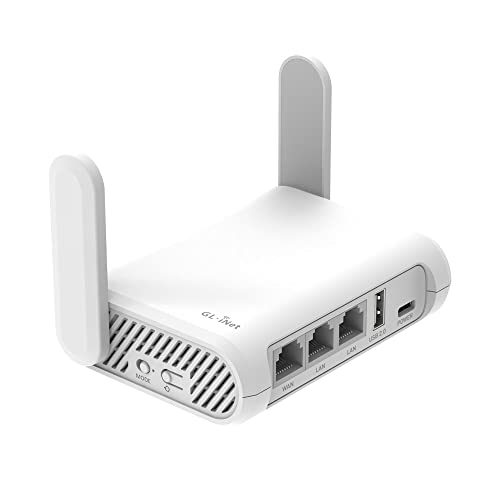
At 3.35 x 4.65 x 1.18 in and 0.66 lb, it's the only pick that fits in a jacket pocket and still gives you three Gigabit ports.
Best for: one desk, one bed, and a bag you carry between two addresses Skip it if: you need coverage past a single room
Nothing else here comes close on size. The Opal weighs 0.66 lb, less than half the Archer A54's 1.45 lb, and its longest side is 4.65 in. GL.iNet describes it as pocket-friendly at 145g and built for travel. If you move between a dorm and a family home twice a year, that's the practical difference.
The specifications are respectable for the second-cheapest pick. AC1200 dual-band gives up to 867 Mbps on 5 GHz and 300 Mbps on 2.4 GHz, matching the Archer A54's numbers. It publishes three Gigabit ports: two LAN and one WAN. GL.iNet also says OpenVPN and WireGuard come pre-installed with support for 30-plus VPN providers, plus IPv6 and Cloudflare encryption. No other pick here lists VPN clients as standard.
The warranty is 2 Years, matching the two TP-Link units.
Two honest limits. There are no external antennas, and the listing publishes no coverage figure, so treat it as a one-room device rather than an apartment device. And only one seller lists it, the thinnest availability in this set.
Pros:
- Lightest pick at 0.66 lb, smallest footprint here
- Three Gigabit ports on a pocket-sized body
- OpenVPN and WireGuard pre-installed
- 2 Years warranty at the second-cheapest price
- Same 867 Mbps 5 GHz ceiling as the Archer A54
Cons:
- No published coverage figure anywhere on the listing
- No external antennas, unlike four on both TP-Link picks
- WiFi 5 only
- Just one seller lists it
4. ASUS RT-AX1800S Dual Band WiFi 6 Extendable Router — Best for heavy use
Five Gigabit ports and a 3 years warranty, the longest coverage term and the highest published port count in this comparison.

Best for: wired desktops, a NAS, and someone who wants filtering built in Skip it if: you never plug anything in with a cable
The RT-AX1800S wins on the two numbers nobody puts on the front of the box. It publishes five Gigabit ports, one WAN and four LAN, which is more wired capacity than any other pick here states. And it carries a 3 years warranty, a full year longer than the TP-Link pair and two years longer than either NETGEAR.
ASUS lists a dual-core processor with 4 VPE, four external antennas, 1024-QAM, and both MU-MIMO and OFDMA. The listing also names AiProtection Classic powered by Trend Micro as subscription-free network security, along with parental controls, a built-in VPN, and AiMesh compatibility so you can add a second ASUS unit later. Software that doesn't ask for a monthly fee is worth noting when the budget is thin.
At 0.82 lb it's the second-lightest pick, and 2.2 x 9.06 x 5.28 in makes it slightly taller than the Archer AX21 but shorter end to end.
The trade-off is price position. This sits in the premium tier, second-priciest of the six, and its AX1800 class bandwidth matches the mid-priced Archer AX21 and R6700AX. You're paying for the ports, the warranty and the software, not for more wireless throughput. If your setup is entirely wireless, that's money spent on capability you won't touch.
Pros:
- Five Gigabit ports, the highest published count here
- 3 years warranty, longest in this set
- Subscription-free AiProtection security and parental controls
- AiMesh compatible for adding a second unit later
- Second-lightest pick at 0.82 lb
Cons:
- Premium price for AX1800 bandwidth that mid-tier picks match
- No published coverage figure in square feet
- Sells more slowly than the two TP-Link picks
- Router-only, so a modem is still required
Can a router legally live in a dorm room?
This is the question the search phrase hides, and no specification on any of these six listings answers it.
Amazon's search doesn't filter for student housing rules, so none of these routers is certified, approved or built for dorm use. That's a decision your building makes, not a manufacturer. Check before you buy, because two policies are common and they lead to different picks.
- Personal routers banned outright. Some networks block them to keep the airwaves clean. A router you can't switch on is dead weight, and the answer is a wired Ethernet adapter instead.
- Personal routers allowed in Access Point mode only. You plug into the wall jack and broadcast your own network without doing your own routing. The Archer A54 lists AP mode explicitly.
- No policy either way, own modem required. Every pick here is router-only and pairs with a separate modem or gateway over Ethernet. NETGEAR notes some gateways and modem-router combos need bridge mode first.
The practical move is to read your housing IT page before you order, then match the pick to what it says. An apartment or house share has no such restriction, and that's where the full set applies.
5. NETGEAR WiFi 6 Router 4-Stream — Best for beginners
A 1.8 Gbps WiFi 6 router with a published 1,500 sq. ft. coverage figure and app-guided setup, aimed squarely at a first-time buyer.

Best for: a first router, set up by phone in ten minutes Skip it if: you want the longest warranty in this set
The R6700AX earns its label on published numbers rather than vibes. NETGEAR states coverage up to 1,500 sq. ft. and up to 20 devices, which is the kind of concrete figure a first-time buyer can actually check against their own apartment. Only the RS90 publishes higher, at 2,000 sq. ft. and 50 devices.
Bandwidth is 1.8 Gbps across 2.4 GHz and 5 GHz, the same class as the Archer AX21 and the ASUS. NETGEAR lists WPA3 encryption, automatic firmware updates and a guest network, and says setup runs through the free Nighthawk app on iOS, Android or any web browser. Automatic updates are the underrated one here, because a router nobody patches is the security problem in most homes.
It weighs 1.41 lb, close to the Archer A54, and it's a 2025 release. The listing also mentions free expert help.
Two clear losses. The warranty is 1 Year Limited, half the TP-Link terms and a third of the ASUS. And at fourth in price it costs more than the Archer AX21 while publishing the same bandwidth class, a shorter warranty and no antenna count. You're buying the coverage figure, the app and the newer release date, not extra throughput.
Pros:
- Published coverage of 1,500 sq. ft. and 20 devices
- 1.8 Gbps WiFi 6 across both bands
- Automatic firmware updates and WPA3 listed
- App or browser setup, plus free expert help
- 2025 release, one of the two newest picks here
Cons:
- 1 Year Limited warranty, shortest tied in this set
- Costs more than the Archer AX21 for the same bandwidth class
- No published Ethernet port count or antenna count
- No dimensions listed, so shelf fit is a guess
6. NETGEAR Nighthawk Dual-Band WiFi 7 Router — Best premium
The only WiFi 7 pick here, with a 3.6 Gbps claim, a 2.5 Gig internet port and 2,000 sq. ft. of stated coverage.

Best for: a house share on a multi-gig plan with 50-ish devices Skip it if: your internet plan tops out under a gigabit
The RS90 is the most expensive pick here, and it's the only one whose headline specifications sit in a different class. WiFi 7 dual-band, up to 3.6 Gbps across 2.4 GHz and 5 GHz, and NETGEAR says that's 1.2x faster than WiFi 6. Coverage is stated at up to 2,000 sq. ft. for up to 50 devices, both the highest figures in this comparison.
The specification I'd actually pay for is the 2.5 Gig internet port. Every other pick here tops out at Gigabit on the WAN side, which caps you at roughly 1 Gbps no matter what your provider sells you. If your house share is on a plan above a gigabit, this is the only pick in the set that can carry it.
NETGEAR lists MU-MIMO and OFDMA, Nighthawk app setup with speed tests, device pausing and guest networks, plus compatibility with most cable, fibre, DSL and satellite providers.
Now the honest part. At 5.2 x 10.8 x 7.09 in it's the bulkiest unit here by a wide margin, and the listing publishes no weight. The warranty is 1 Year Limited, the shortest term in the set on the priciest product. It's also the slowest seller of the six. On a 300 Mbps plan in one bedroom, none of this changes your speed test.
Pros:
- Only WiFi 7 pick, 3.6 Gbps claimed total
- 2.5 Gig internet port, unique in this set
- Highest published coverage at 2,000 sq. ft.
- Rated for up to 50 devices
- Nighthawk app with remote management and guest networks
Cons:
- Most expensive pick here
- 1 Year Limited warranty despite the top price
- Bulkiest body at 10.8 in on its longest side
- No published weight, so wall or shelf mounting is unclear
- Slowest seller of the six
What does spending more on a budget wifi router for students actually buy?
The six picks span three tiers, and the jump between them buys specific, nameable things.
Entry tier: the Archer A54 and the Opal. Both are WiFi 5, both publish 867 Mbps on 5 GHz, both carry 2 year coverage. What you give up is the OFDMA efficiency the WiFi 6 units claim under load. What you keep is a full warranty term and, on the Opal, three Gigabit ports in a 0.66 lb body.
Middle tier: the Archer AX21 and the R6700AX. The step up is the wireless standard and roughly a 50% higher bandwidth figure, from 1200 Mbps to 1.8 Gbps. TP-Link gives you 1200 Mbps on 5 GHz and a 2-year warranty; NETGEAR gives you a published 1,500 sq. ft. coverage figure and a 1 Year Limited term. Same class of speed, different guarantees.
Premium tier: the RT-AX1800S and the RS90. These split in two directions. The ASUS spends the money on wired capability and support, with five Gigabit ports and 3 years warranty, while keeping AX1800 bandwidth. The NETGEAR spends it on the radio and the WAN port, with WiFi 7, 3.6 Gbps and 2.5 Gig in.
The honest summary is that bandwidth stops mattering once it exceeds your internet plan. Beyond that point, extra money buys ports, warranty length and coverage area.
When a different pick wins
Four thresholds flip the recommendation away from the Archer AX21.
- Your plan is under 500 Mbps and you use one room. Take the Archer A54. Its 867 Mbps 5 GHz ceiling already clears your plan, and it's the cheapest pick with a 2 year manufacturer warranty.
- Your plan is above 1 Gbps. Take the RS90. It's the only pick with a 2.5 Gig internet port, so every other option here caps you at Gigabit on the WAN side regardless of wireless speed.
- You have three or more wired devices. Take the RT-AX1800S. Five Gigabit ports beat everything else in this set, and the 3 years warranty is the longest here.
- You move between two addresses. Take the Opal. At 0.66 lb and 3.35 x 4.65 x 1.18 in, it's the only pick that travels without a second bag.
One more: if this is your first router and you want a coverage number you can check against your floor plan, the R6700AX publishes 1,500 sq. ft. and 20 devices. Just know you're accepting a 1 Year Limited warranty to get it.
The verdict
If you share an apartment with three or four people and roughly six to ten devices, the TP-Link Archer AX21 is the best budget wifi router for students in this set. It publishes 1200 Mbps on the 5 GHz band, four high-gain antennas, and a 2-year warranty, all at a middle price position rather than a premium one. It's also the pick buyers choose most often here, which tells you something about how well it lands on that combination.
If you live in one room on a plan under 500 Mbps, the TP-Link Archer A54 is the better buy. Its 867 Mbps 5 GHz ceiling already exceeds what your provider delivers, it matches the winner's 2 year manufacturer warranty, and it's the cheapest pick of the six. Paying for WiFi 6 you can't saturate is the classic mistake in this category.
The cutoff is your internet plan against the 5 GHz figure, not the number on the box. Above 500 Mbps, or with more than six active devices, go WiFi 6 and take the Archer AX21. Below that, in a single room, take the A54 and spend the difference elsewhere.
The runner-up's exact advantage over the winner is price and nothing else. The Archer AX21 beats it on 5 GHz ceiling, wireless standard and antenna technology, and ties it on warranty length.
FAQ
Is a budget wifi router for students worth it over campus WiFi?
A budget wifi router for students is worth it when your building allows one and your room sits far from the campus access point. Your own router gives you a network you control, a guest network for visitors, and Ethernet ports for a desktop. If personal routers are banned in your housing, a wired adapter is the better spend instead.
How much bandwidth do I actually need for a student setup?
The bandwidth you actually need is set by your internet plan, not the router. Match the 5 GHz figure to your plan and stop there. The Archer A54 publishes 867 Mbps on 5 GHz, which clears any plan under that. The Archer AX21 publishes 1200 Mbps, which gives you headroom for a plan near a gigabit.
Archer AX21 or Archer A54: which should I pick?
Between the Archer AX21 and Archer A54, device count decides it. The AX21 is WiFi 6 with 1.8 Gbps total and 1200 Mbps on 5 GHz, better when eight or ten things are online at once. The A54 is WiFi 5 with 1200 Mbps total, cheaper, and covers up to 1,000 sq. ft. Both carry 2 year warranties.
Do these routers work with my internet without a separate modem?
These routers work with your internet only alongside a modem or gateway. TP-Link states plainly that all WiFi routers require a separate modem, and NETGEAR says the RS90 pairs with an existing modem over Ethernet. Some gateways and modem-router combos need bridge mode enabled first. If your provider gave you one box, check that before ordering.
What's the most common mistake buying a router on a budget?
The most common mistake buying on a budget is chasing the combined bandwidth number and ignoring the WAN port. Every pick here except the RS90 tops out at Gigabit on the internet side, so a multi-gig plan gets capped regardless of wireless speed. The second mistake is ignoring warranty length, which ranges from 1 Year Limited to 3 years across these six.
Start with your internet plan and your housing policy, in that order. Those two facts eliminate four of these six picks in about a minute, and what's left is usually obvious. For most people in a shared apartment, the Archer AX21 is the right default because it's the only pick that pairs a 1200 Mbps 5 GHz ceiling with a 2-year warranty without a premium price. That's a rare combination in this category, and it's the reason it outsells everything else here rather than the reason it merely looks good on a table.