Best Compact Outdoor WiFi Extender for Small Mounts
Seven outdoor extenders compared on published size, weight, weatherproof rating and power options, with a named winner and the conditions that flip it.

By Lamar CalhounUpdated 18 min read
On this page
- Best compact outdoor wifi extender at a glance
- How I screened these seven listings
- How compact is a compact outdoor wifi extender, really?
- Why PoE decides more than WiFi generation
- 1. TP-Link Deco 7 Outdoor BE5000 Dual-Band Wi-Fi 7 Mesh — Best overall
- 2. TP-Link Deco X20-OUTDOOR AX1800 Dual-Band Wi-Fi 6 Outdoor — Best for beginners
- 3. Amazon eero Outdoor 7 dual-band mesh wifi router — Best premium
- 4. 2026 WAVLINK AX1800 Outdoor WiFi 6 Extender Long Range — Best for pros
- 5. CINAMON AX3000 Outdoor WiFi Extender — Best for heavy use
- 6. WAVLINK AC600 Outdoor WiFi Extender — Best budget pick
- 7. ywstan WiFi Extender Signal Booster for Home — Runner-up
- IP65 vs IP67: does the higher number matter?
- When a different pick wins
- The verdict
- FAQ
The best compact outdoor wifi extender is the TP-Link Deco 7 Outdoor BE5000, an IP65-rated brick measuring 8.5 x 4.3 x 4.3 in and weighing 2.03 lb, with two 2.5 Gbps PoE+ ports for a single-cable install. If you want the widest published outdoor coverage instead of the smallest footprint, the eero Outdoor 7 claims 15,000 sq. ft. and an IP66 rating.
This category isn't for everyone. If your dead zone is inside the house, a plug-in indoor repeater is cheaper and easier, and nothing here helps you. Outdoor units assume a mounting surface, a cable route, and a willingness to drill. Renters with no exterior access should stop here. Everyone else: the deciding factor is smaller than you think, and it isn't WiFi 7.
Best compact outdoor wifi extender at a glance
| Pick | Size / weight | Weather rating | Price |
|---|---|---|---|
Best overall TP-Link Deco 7 Outdoor BE5000 |
8.5 x 4.3 x 4.3 in 2.03 lb |
IP65 claim | Check Price |
Best for beginners TP-Link Deco X20-OUTDOOR AX1800 |
8.5 x 4.8 x 4.3 in 1.98 lb |
IP65 claim | Check Price |
Best premium Amazon eero Outdoor 7 |
2.54 x 8.17 x 6.34 in 2.43 lb |
IP66 claim | Check Price |
Best for pros WAVLINK AX1800 Outdoor WiFi 6 |
17.6 x 3.5 x 13 in 4.97 lb |
IP67 claim | Check Price |
Best for heavy use CINAMON AX3000 Outdoor |
Not published | IP67 claim | Check Price |
Best budget pick WAVLINK AC600 Outdoor |
1.08 lb | IP67 claim | Check Price |
Runner-up ywstan WiFi Extender Signal Booster |
Not published | None stated | Check Price |




How I screened these seven listings
I started with the published specifications, not the marketing headlines. Four numbers mattered: dimensions, weight, the weather rating, and how the unit gets power. Everything else is negotiable.
That screen produced a clear split. Four of the seven publish full dimensions. Three publish a weather rating of IP67, two claim IP65, one claims IP66, and one publishes no rating at all. Six of the seven mention Power over Ethernet somewhere in their listing.
Here's the wrinkle. Search for a best compact outdoor wifi extender and Amazon returns units that are neither compact nor outdoor. Two of the seven picks here are not small by any reading of the published figures, and one has no outdoor rating in its listing at all. That's not a fault in the products, it's how the search behaves. I kept them, labelled them honestly, and told you exactly where they belong.
What I cut from consideration:
- Anything with no published dimensions and no published weight and no weather rating, since there's nothing left to judge.
- Indoor-only plug-in repeaters marketed with outdoor square-footage claims.
- Multi-packs, since this comparison is unit-to-unit.
Six of the seven publish a warranty term. Five of those six state two years, one states one year, and the eero listing states none. That gap is worth knowing before you drill into siding.
How compact is a compact outdoor wifi extender, really?
Compact means something specific here: it fits on the surface you have. That's usually a fascia board, a soffit edge, a downspout bracket or a fence post, and those surfaces are narrow.
Only four picks publish dimensions, so start there. The two TP-Link Deco units are near-identical bricks at 8.5 x 4.3 x 4.3 in and 8.5 x 4.8 x 4.3 in. The eero Outdoor 7 is flatter and wider at 2.54 x 8.17 x 6.34 in, which suits a flat wall better than a round post. The WAVLINK AX1800 is a different animal entirely: 17.6 x 3.5 x 13 in, a panel nearly a foot and a half on its long edge.
Weight follows the same pattern. The WAVLINK AC600 is the lightest at 1.08 lb. The Deco X20-Outdoor is 1.98 lb, the Deco 7 Outdoor is 2.03 lb, the eero is 2.43 lb, and the WAVLINK AX1800 is 4.97 lb. That last figure changes the install. Five pounds hanging off vinyl siding wants a proper anchor, not a screw into the panel.
Measure your spot before you buy. Then measure the clearance around it, because an antenna panel needs air and a bracket needs elbow room.
Why PoE decides more than WiFi generation
Every listing here shouts about WiFi 6 or WiFi 7. Almost none of that matters outdoors, where distance and obstruction cap your real throughput long before the radio does. Power over Ethernet is what actually decides whether the install happens.
PoE sends data and power down one cable. No outdoor outlet, no weatherproof box around a plug, no extension cord snaking across the patio. One run of Ethernet from an injector inside the house to the unit outside, and you're done.
Six picks reference PoE. The Deco 7 Outdoor lists two 2.5 Gbps PoE+ ports, the Deco X20-Outdoor lists two Gigabit PoE+ ports, and the eero listing states it includes a 30W PoE+ adapter in the box. That last detail is worth more than a spec sheet line, because a PoE injector you have to buy separately is a second purchase and a second point of confusion.
- Find your mounting spot outside.
- Trace a cable route back inside to your router or switch.
- Confirm the unit accepts PoE at the standard your injector supplies.
- Only then compare radios.
Get step three wrong and the fastest radio in this set is a paperweight.
1. TP-Link Deco 7 Outdoor BE5000 Dual-Band Wi-Fi 7 Mesh — Best overall
The smallest published footprint here paired with the fastest wired ports, which is the combination that makes an outdoor install painless.

Best for: a small mounting spot on a wall or post with a PoE run available Skip it if: your router isn't a Deco and you want mesh roaming
At 8.5 x 4.3 x 4.3 in, this is the tightest published footprint in the set, and 2.03 lb is light enough for a standard bracket. That combination is why it wins. The 4.3 in square cross-section sits on a post or a narrow board where the eero's 8.17 in width and the WAVLINK panel's 13 in height won't.
The wired side is where it separates from its own sibling. TP-Link lists two 2.5 Gbps PoE+ ports against the X20-Outdoor's Gigabit pair, so a multi-gig internet plan isn't throttled at the box. The listing describes Wi-Fi 7 with Multi-Link Operation and 4K-QAM, and claims IP65 protection against rain, dust and vibration. Model number is Deco BE25-Outdoor, released in 2025, with a stated 2 Year Manufacturer warranty.
The trade-off is real. It's the second-priciest pick here, and it's the slowest seller of the three picks that report popularity at all. It also assumes you're inside the Deco ecosystem, since the mesh roaming pitch only pays off with matching indoor units.
Pros:
- Smallest published dimensions of any pick here
- Two 2.5 Gbps PoE+ ports, fastest wired spec in the set
- 2.03 lb, easy on a light bracket
- Stated 2 Year Manufacturer warranty
- IP65 weatherproof claim covering rain, dust and vibration
Cons:
- Second-highest price position in this group
- Mesh roaming benefit depends on owning Deco indoor units
- Only two sellers list it
- Dual-band only, no dedicated backhaul band
2. TP-Link Deco X20-OUTDOOR AX1800 Dual-Band Wi-Fi 6 Outdoor — Best for beginners
Three included mounting options and app-guided setup make this the least intimidating compact outdoor wifi extender to install yourself.

Best for: first-time installers already running a Deco mesh indoors Skip it if: you need multi-gig wired speed
This is the same brick shape as the winner, 8.5 x 4.8 x 4.3 in and 1.98 lb, which is actually the lightest of the four picks that publish weight alongside dimensions. What earns the beginner label is the included mounting kit. TP-Link states it covers pole, wall and tabletop setups, so you don't discover mid-job that you bought the wrong bracket.
The radio is a step down and that's fine for most yards. TP-Link claims AX1800 four-stream Wi-Fi 6 at up to 1200 Mbps on 5 GHz and 574 Mbps on 2.4 GHz, plus an additional 2,200 sq. ft. of outdoor coverage for up to 150 devices. Two Gigabit PoE+ ports handle power and data on one cable. IP65 is the stated weather rating, the model is Deco X20-Outdoor, and the warranty is 2 Year Manufacturer.
It's the third-cheapest pick here and the faster seller of the two Deco units. The catch: those Gigabit ports cap you at roughly a gigabit no matter what your internet plan does, and the claimed coverage area is the smallest published figure in the set.
Pros:
- Pole, wall and tabletop mounts all in the box
- 1.98 lb, lightest unit with full published dimensions
- Two Gigabit PoE+ ports for single-cable install
- Third-cheapest of the seven picks
- Stated 2 Year Manufacturer warranty
Cons:
- Gigabit wired ports limit multi-gig plans
- Claimed 2,200 sq. ft. is the smallest coverage figure here
- Slightly wider at 4.8 in than the winner
- Needs a Deco indoor system for the roaming pitch to land
3. Amazon eero Outdoor 7 dual-band mesh wifi router — Best premium
The widest published outdoor coverage claim in this group, with the PoE+ adapter already in the box.
Best for: someone covering a large yard who wants app-guided setup Skip it if: you want a published warranty term before you buy
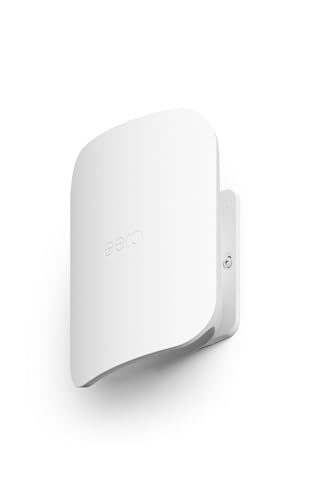
eero states up to 15,000 sq. ft. of outdoor mesh coverage, described as a 70 foot radius, and 100+ connected devices. That's the largest published figure here by a wide margin. The listing claims Wi-Fi 7 speeds up to 2.1 Gbps and an operating range tested between -40°F and 131°F, with an IP66 rating for dust, rain and snow.
The shape is the interesting part. At 2.54 x 8.17 x 6.34 in it's the flattest pick, only 2.54 in deep, so it hugs a wall better than the Deco bricks do. It's also wider and taller than them, which makes it a wall unit rather than a post unit. Weight is 2.43 lb, the heaviest of the compact group. Model SN10001, released 2024. The included 30W PoE+ adapter removes a purchase most rivals leave you to make.
Two honest problems. It's the most expensive pick here, and its listing publishes no warranty term at all, which is the only such gap in this set. Only one seller lists it.
Pros:
- Largest published outdoor coverage claim at 15,000 sq. ft.
- 30W PoE+ adapter included, no separate injector needed
- IP66 rating, highest of the three ratings in the compact group
- Flattest body at 2.54 in deep, sits close to a wall
- Claimed operating range of -40°F to 131°F
Cons:
- Most expensive pick in this comparison
- No warranty term published in the listing
- Heaviest of the four picks with full dimensions
- Only one seller lists it
- 8.17 in width won't suit a narrow post
4. 2026 WAVLINK AX1800 Outdoor WiFi 6 Extender Long Range — Best for pros
A full antenna panel with six operating modes, for long open-air runs where footprint stops mattering.

Best for: long open-air runs where a big antenna panel is fine Skip it if: your mounting spot is under about a foot wide
This is the pick that doesn't fit the brief, and I'm saying so plainly. At 17.6 x 3.5 x 13 in and 4.97 lb, it's more than twice the weight of any Deco here and its long edge is over twice the winner's. Nobody calls that compact. What it buys you is antenna area, which is what carries a signal down a driveway or across a paddock.
WAVLINK claims dual-band AX1800 speeds up to 1800 Mbps, split as 1201 Mbps on 5 GHz and 574 Mbps on 2.4 GHz, plus Starlink compatibility. The listing states IP67 sealing, a heat-resistant enclosure, and flexible PoE power options. Mode flexibility is the professional draw: mesh, AP, router, repeater and AP+repeater are all listed, so one unit adapts to whatever the site needs. Model WL-WN573HX1, with a stated 2 Year Warranty.
It's mid-range on price and the fourth-cheapest of the seven. The costs are physical. Five pounds needs a real anchor, the panel needs clearance, and only one seller lists it.
Pros:
- Largest antenna area of any pick here
- Five listed operating modes including mesh and bridge
- IP67 sealing claim, higher than either Deco
- Stated 2 Year Warranty
- Listing claims Starlink compatibility
Cons:
- 4.97 lb and 17.6 in long, the opposite of compact
- Needs a substantial mount and clearance around it
- Only one seller lists it
- Mode-heavy interface is more than a beginner needs
5. CINAMON AX3000 Outdoor WiFi Extender — Best for heavy use
The highest claimed throughput and the longest claimed range here, aimed at sites with a lot of devices on one link.

Best for: farms, RV parks and camps with many devices on one link Skip it if: you want published size and weight figures
CINAMON claims dual-band AX3000 performance, 574 Mbps on 2.4 GHz plus 2402 Mbps on 5 GHz, for up to 3 Gbps combined. That's the highest claimed wireless figure in this group. The listing also claims up to 300 metres of coverage from six high-gain antennas, plus anti-lightning protection and PoE power. Four modes are listed: AP, router, repeater and AP+repeater.
The listing names farms, camping and RV use directly, and that's the right read. Wide open ground with nothing to obstruct the signal is where a claim like 300 metres has any chance of meaning something, and it's also where you'd want the headroom of a 2402 Mbps 5 GHz channel shared across many devices.
Now the problems, and they're not small. The listing publishes no dimensions and no weight, so you cannot check it against your mounting spot before it arrives. The weather rating is inconsistent inside its own copy, headed IP67 in one place and described as IP65-rated in another. The warranty is stated as 1 Year Manufacturer, half what most rivals here offer. It's also the second-priciest pick.
Pros:
- Highest claimed combined throughput at up to 3 Gbps
- Six high-gain antennas behind a 300 metre range claim
- Anti-lightning and dustproof claims in the listing
- Four operating modes including bridge and repeater
- PoE powered, single-cable install
Cons:
- No published dimensions or weight, so you can't pre-check the mount
- Weather rating stated inconsistently as IP67 and IP65
- Only 1 Year Manufacturer warranty, shortest here
- Second-highest price position in the set
6. WAVLINK AC600 Outdoor WiFi Extender — Best budget pick
The cheapest and lightest pick here, sized for a single camera or shed rather than a whole yard.

Best for: a camera or a shed that only needs a stable 2.4 GHz link Skip it if: you plan to stream video outdoors
At 1.08 lb this is the lightest unit in the comparison, and it's the cheapest of the seven. That combination has a real use. A driveway camera, a gate intercom or a shed workbench needs a reliable link, not a fast one, and paying premium money for Wi-Fi 7 to serve a 2 megapixel camera is money burned.
WAVLINK states 802.11n at up to 300 Mbps on 2.4 GHz, a maximum coverage range of 150 metres, support for up to 32 devices, and a 100m Ethernet port. Four working modes are listed, including repeater mode to extend an existing network. The enclosure is claimed IP67 and heat-resistant, rated by the listing for extreme cold and heat. Model 570HA1-B, with a stated 2-Year Warranty. PoE is supported, so the install stays a one-cable job.
The ceiling is the point of the pick and also its limit. 300 Mbps on a single band, shared 32 ways, is not a video streaming platform. The 100 Mbps Ethernet port is the slowest wired spec here by a wide margin, and the listing publishes no dimensions.
Pros:
- Cheapest of the seven picks
- Lightest published weight at 1.08 lb
- IP67 enclosure claim with cold and heat resistance
- Stated 2-Year Warranty despite the low price position
- PoE supported for single-cable mounting
Cons:
- 2.4 GHz only, up to 300 Mbps claimed
- 100 Mbps Ethernet port, slowest wired spec here
- Device support capped at 32 in the listing
- No published dimensions
7. ywstan WiFi Extender Signal Booster for Home — Runner-up
Four high-gain antennas and one-tap WPS setup, but no weather rating anywhere in the listing.
Best for: a covered porch or garage where nothing gets rained on Skip it if: the unit will sit in the open
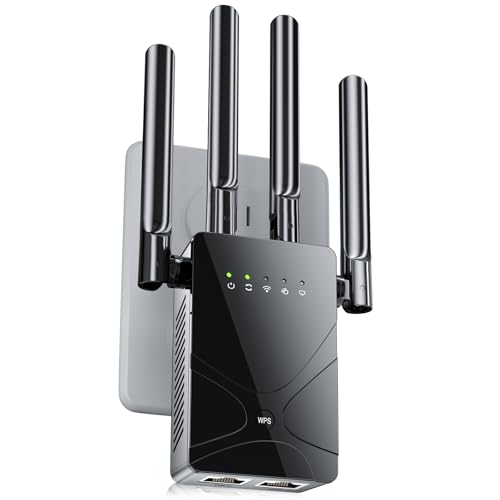
I'll be direct: this is the one pick in the set with no stated ingress protection rating, and that shapes everything. It surfaces in searches for a compact outdoor wifi extender because of its coverage claims, not because of a sealed enclosure. Put it on a covered porch, in an attached garage, or in a screened room, and it does a job. Put it in the rain and you own a warranty claim.
The listing claims four high-gain antennas with a smart IC chip for 360° extension and multi-floor coverage up to 18888+ sq. ft., which is the largest number quoted anywhere in this comparison. It also claims five operating modes, two LAN ports, and WPS one-tap setup for non-technical users. Colour is black, warranty is stated as 1 YEAR.
That WPS setup is genuinely the simplest here. Press one button on the router, press one on the extender. No app, no account. It's also the second-cheapest pick. But no dimensions, no weight, no weather rating and the shortest warranty in the set is a lot of blanks to accept for a unit going anywhere near weather.
Pros:
- Second-cheapest pick in this comparison
- WPS one-tap setup, no app or account required
- Four high-gain antennas and two LAN ports
- Five listed operating modes
Cons:
- No ingress protection rating stated anywhere
- No published dimensions or weight
- 1 YEAR warranty, tied for shortest here
- Coverage claim of 18888+ sq. ft. is unverifiable marketing copy
IP65 vs IP67: does the higher number matter?
Both digits mean something. The first covers solids, the second covers water. IP65 and IP67 share the same 6 for dust, so the difference is entirely in the water figure.
IP65 means protection against water jets from any direction. IP67 means the enclosure survives temporary immersion. Mounted under an eave or on a wall, an extender never gets immersed, so IP65 is enough. Mounted on a fence post in an area that floods, or on a boat dock, or anywhere snow drifts and sits, the higher rating starts earning its keep.
Here's how the seven split:
- IP67 claimed: WAVLINK AX1800, WAVLINK AC600, CINAMON AX3000
- IP66 claimed: eero Outdoor 7
- IP65 claimed: Deco 7 Outdoor, Deco X20-Outdoor
- None stated: ywstan Signal Booster
Note that the CINAMON listing says IP67 in one bullet heading and IP65 in the body of another. When a listing contradicts itself, treat the lower number as the one you're buying.
When a different pick wins
The winner is a default, not a law. Four conditions flip it, and each one is something you can check in five minutes.
- Your mounting spot is wider than a foot and you need distance. The WAVLINK AX1800's 17.6 x 3.5 x 13 in panel puts far more antenna in the air than a 4.3 in brick can. On a long driveway, that geometry beats a newer radio.
- Your internet plan is a gigabit or slower. The Deco X20-Outdoor's Gigabit PoE+ ports are then not a bottleneck, and you keep the identical brick shape at a lower price position.
- Your yard is genuinely large. eero's 15,000 sq. ft. claim dwarfs the Deco X20-Outdoor's 2,200 sq. ft. figure. One eero on a wall may replace two smaller units.
- The job is one camera. The WAVLINK AC600 at 1.08 lb and 300 Mbps on 2.4 GHz is the honest answer, and it's the cheapest pick here.
The threshold that matters most: about 12 inches of usable mounting width. Below it, only the Deco pair and the eero fit without a custom bracket. Above it, the whole set is open, and the compact requirement stops driving the decision.
The verdict
Sort this field by price position and the picture gets clear. At the entry end, the WAVLINK AC600 and the ywstan booster are the two cheapest, and neither is a general-purpose outdoor unit. The AC600 is a 2.4 GHz link for a camera or a shed. The ywstan has no weather rating at all and belongs under cover. Buy either for a narrow job, not a whole yard.
The middle tier is where most people should land. The Deco X20-Outdoor is the third-cheapest, publishes full dimensions at 8.5 x 4.8 x 4.3 in and 1.98 lb, ships three mounting options, and carries a 2 Year Manufacturer warranty. The WAVLINK AX1800 sits just above it and trades all compactness for a 17.6 in antenna panel and five operating modes.
At the premium end, three units and three different arguments. The Deco 7 Outdoor takes the win on the strength of the smallest published footprint here plus two 2.5 Gbps PoE+ ports, which is the pairing that survives both a narrow mount and a fast internet plan. The eero Outdoor 7 counters with the largest coverage claim at 15,000 sq. ft. and an included 30W PoE+ adapter, and that's a genuine advantage on a big property. Its cost is a listing with no published warranty term. The CINAMON AX3000 claims the most throughput but publishes no dimensions, and that blank is disqualifying when the whole point is fitting a small space.
FAQ
Is a compact outdoor wifi extender worth it over a cheap indoor one?
A compact outdoor wifi extender is worth it only when the dead zone is genuinely outside. An indoor plug-in unit behind a window loses signal to the glass and the wall, and its enclosure isn't sealed. Sealed units here claim IP65 to IP67 protection and mount where the coverage is needed. If your problem is a back bedroom, buy indoors instead.
What does the best compact outdoor wifi extender cost you beyond the unit?
Beyond the unit, expect an Ethernet run, cable clips, exterior-grade anchors and possibly a PoE injector. The eero Outdoor 7 listing states a 30W PoE+ adapter is included, which removes one purchase. The two Deco units and both WAVLINKs list PoE+ ports but you should confirm what ships in the box. Budget for a drill bit and a weatherproof cable entry too.
Will these units work with a Starlink dish or a non-standard router?
They work with a router in most cases, but check the mode list. The WAVLINK AX1800 and CINAMON AX3000 listings both claim Starlink compatibility and offer repeater, AP, router and bridge modes, which is what makes them flexible. The two Deco units are built around TP-Link's mesh system, so their roaming benefit assumes Deco indoor hardware.
Deco 7 Outdoor or eero Outdoor 7: which should I buy?
Deco 7 Outdoor or eero Outdoor 7 comes down to footprint versus reach. The Deco is 4.3 in square in cross-section and has two 2.5 Gbps PoE+ ports, so it fits a post and won't cap a multi-gig plan. The eero claims 15,000 sq. ft. of outdoor coverage and includes its PoE+ adapter, but publishes no warranty term. Small mount, Deco. Big yard, eero.
What mistake do buyers make with outdoor extenders?
The mistake buyers make is treating claimed coverage numbers as measurements. The figures here range from 2,200 sq. ft. up to 18888+ sq. ft., and they're manufacturer claims made in open conditions, not through walls, trees or metal siding. Check the specification you can verify instead: dimensions, weight, the ingress rating, and the warranty term. Three of these seven publish no dimensions at all.
Start by measuring the spot you plan to mount on, then trace the cable route back to your router. Those two facts eliminate most of this list before you compare a single radio. If your surface is narrow and your plan is fast, the Deco 7 Outdoor's 8.5 x 4.3 x 4.3 in body and 2.5 Gbps PoE+ ports are the combination that gets installed and forgotten, which is exactly what you want from hardware bolted to the outside of your house. Everything else here is a specific answer to a specific constraint, so match the constraint first and the pick follows.