Best UPS Battery Backup When Desk Space Is Tight
Five UPS units compared on published capacity, runtime claims, outlet counts and footprint, with a named winner for desk-side use and clear thresholds for when a 1500VA tower makes more sense.

By Lamar CalhounUpdated 15 min read
On this page
- Best wireless ups battery backup for engineers at a glance
- How I cut this list down to five
- Why VA is the wrong number to shop on
- 1. APC UPS 600VA/330W Battery Backup for Computer — Best overall
- 2. CyberPower CP1500PFCLCD PFC Sinewave UPS Battery Backup — Best premium
- 3. APC UPS 1500VA/900W — Most versatile
- 4. GOLDENMATE 1000VA/800W Lithium UPS Battery Backup & Surge — Best for quiet operation
- 5. CyberPower ST425 Standby UPS Battery Backup and Surge — Best budget pick
- Does a UPS need to be wireless to be useful?
- Sine wave or simulated: which does your rig need?
- What a bigger tower actually buys you
- What the listings leave out
- The verdict
- FAQ
The best wireless ups battery backup for engineers is the APC BE600M1, a 7.5 lb desk unit whose listing claims 23 minutes of runtime at a 100W load across five battery outlets. If your workstation pulls closer to 900W, the CyberPower CP1500PFCLCD is the better buy at 1500VA with a colour LCD. Most shopping guides in this category rank units by VA and stop there. That number tells you almost nothing about how long your files stay safe. Watts and load do, and the gap between the two figures is where people overbuy or, worse, underbuy. So this comparison starts with runtime and footprint, then works back to capacity.
Best wireless ups battery backup for engineers at a glance
| Pick | Capacity | Battery outlets | Price |
|---|---|---|---|
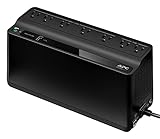
Best overall APC UPS 600VA/330W Battery Backup for Computer |
600VA / 330W | 5 of 7 | Check Price |
| 1500VA | not stated on outlets | Check Price | |
Most versatile APC UPS 1500VA/900W |
1500VA / 900W | 5 of 10 | Check Price |
Best for quiet operation GOLDENMATE 1000VA/800W Lithium UPS |
1000VA / 800W | 8 of 8 | Check Price |
Best budget pick CyberPower ST425 Standby UPS Battery Backup and Surge |
425VA / 260W | 4 of 8 | Check Price |


How I cut this list down to five
Three things knocked candidates out before I compared anything else.
First, no published watt figure. VA alone is a marketing number. The CP1500PFCLCD is the one pick here that publishes 1500VA without a matching wattage in its listing data, and that gap is a real mark against it even though it earns a place on other grounds.
Second, no stated warranty. A sealed lead-acid battery is a wear item. Four of these five publish a three-year term, so a unit with nothing on paper had no case.
Third, a footprint that cannot go where the gear is. Two of the five are around 24 lb and roughly 15 in on their longest side, which is a floor-standing tower, not a desk object.
What survived splits cleanly:
- Two compact units under 8 lb for a desk edge
- One mid-weight lithium unit at 12.4 lb
- Two full towers at 24.2 lb and 24.9 lb
That spread, not the VA column, is the real decision in front of you.
Why VA is the wrong number to shop on
VA is apparent power. Watts are what your machine actually consumes. A 600VA unit rated at 330W and a 425VA unit rated at 260W differ by 70W of headroom, which sounds small until you add a second monitor.
Runtime is the figure that matters, and only two listings here state one. APC says the BE600M1 delivers 23 minutes at a 100W load. APC says the BX1500M delivers up to 68 minutes at the same 100W load. Both figures are quoted at 100W, which is a light load: a router, a modem and a NAS, roughly. Load the same unit to its rated ceiling and runtime collapses to a fraction of that.
So the practical sequence looks like this:
- Add up the wattage of everything that must stay alive during an outage.
- Multiply by 1.4 to leave headroom for startup draw and battery ageing.
- Match that number to the watt rating, not the VA rating.
- Only then compare runtime claims at a load near yours.
Do it in that order and the choice usually makes itself. Most desks land under 200W once you exclude the printer and the speakers, which is exactly why the smallest pick here wins.
1. APC UPS 600VA/330W Battery Backup for Computer — Best overall
The best wireless ups battery backup for engineers working from a normal desk, because 7.5 lb and a 5.47 in width buy you a genuinely placeable unit with a published runtime figure.

Best for: a desk-side router, NAS and single workstation Skip it if: your machine draws well past 330W
Two figures decide this one. It weighs 7.5 lb and measures 5.47 x 10.8 x 4.13 in, which is the second-smallest body in this group and slim enough to stand on a desk edge rather than under it. And APC states 23 minutes of runtime at a 100W load, one of only two runtime claims published across these five listings.
Outlet layout is where it separates from the cheaper ST425. Seven outlets total: five with full battery backup and surge protection, two surge-only for gear that does not need to ride out a blackout. APC also lists a 1.5A USB port that it says keeps working during an outage, so a phone stays alive on the same battery as your files.
The warranty runs three years, repair or replace, and APC names the swap-in battery as APCRBC154, sold separately. That matters more than it sounds. A user-replaceable cell means the unit outlives its first battery instead of going in the bin with it.
The trade-off is ceiling. At 330W it cannot carry a high-draw tower and two large displays, which is where the 900W and 1500VA picks earn their bulk.
Pros:
- 7.5 lb, second-lightest in this group
- 23 minutes claimed at 100W load
- Five battery outlets plus two surge-only
- USB port APC says works during outages
- Named replacement battery, APCRBC154
Cons:
- 330W ceiling rules out heavy workstations
- Only one seller lists it
- Battery sold separately when it ages out
- Simulated output, not a stated sine wave
2. CyberPower CP1500PFCLCD PFC Sinewave UPS Battery Backup — Best premium
The pick for an Active PFC workstation, because it is the only unit here whose listing puts sine wave output in the product name.

Best for: an Active PFC workstation that needs clean output Skip it if: you cannot give up 11 x 14 in of floor
This is the most expensive pick here and the heaviest at 24.9 lb, on an 11 x 14 x 3.9 in footprint. That is a tower that lives on the floor beside the desk, not on it. In exchange you get 1500VA, the joint-highest capacity in the group, and a 2019 model year that makes it the newest of the two big CyberPower and APC towers.
The headline feature is the panel. CyberPower says the multifunction colour LCD shows immediate detail on battery and power conditions, and that the colour display flags potential issues before they cause downtime. If you have ever discovered a dead UPS battery only when the power actually went out, you know why a status readout earns its keep.
Sine wave output is the other reason to pick it. Active PFC power supplies, common in higher-wattage workstation and gaming builds, can behave badly on a stepped approximation of AC. This listing names sine wave output directly.
Its weakness is thin published data. There is no wattage figure, no runtime claim and no outlet count in the listing details, so you are buying on the VA number and the model line rather than on stated capability. Its three-year limited warranty also does not specify battery coverage, which the cheapest pick here does explicitly.
Pros:
- 1500VA, joint-highest capacity in this group
- Sine wave output named in the product title
- Colour LCD status panel for battery and power detail
- Newest model year of the two large towers
Cons:
- Most expensive pick here with the least published detail
- No stated watt rating or runtime figure
- Heaviest at 24.9 lb on an 11 x 14 in footprint
- Warranty does not specify battery coverage
3. APC UPS 1500VA/900W — Most versatile
Ten outlets, 900W and a claimed 68 minutes at 100W make this the pick when a UPS has to cover more than a computer.

Best for: a mixed rack of computer, network and AV gear Skip it if: you want lithium chemistry
This one has the widest published spec sheet in the group. 1500VA and 900W, ten outlets split five battery and five surge-only, and APC's claim of up to 68 minutes of backup at a 100W load. That is roughly three times the runtime claim on the BE600M1, at the same stated load.
It is also the only pick whose listing mentions coaxial and Ethernet surge protection, which is the detail that makes it a home-network unit rather than a desk unit. APC lists automatic voltage regulation too, saying it corrects brownouts from 88V and swings within plus or minus 13% by boosting or trimming to a stable 120V without touching the battery. AVR is the feature that quietly extends battery life in an area with sagging mains.
APC states Active PFC compatibility and ENERGY STAR certification at 92%+ efficiency, plus a user-replaceable APCRBC124 battery and a three-year warranty.
Two things hold it at third. At 24.2 lb and 15 in long it needs floor space, and its 2017 model year makes it the oldest design here. Two sellers list it, which is more choice than the two cheapest picks offer but still a narrow field.
Pros:
- Ten outlets, the joint-highest count in this group
- 68 minutes claimed at 100W load
- AVR listed for brownouts from 88V
- Coaxial and Ethernet surge protection, unique here
- User-replaceable APCRBC124 battery
Cons:
- 24.2 lb and 15 in long, floor-standing only
- Oldest design in this group at 2017
- Lead-acid rather than lithium chemistry
- Only five of ten outlets carry battery backup
4. GOLDENMATE 1000VA/800W Lithium UPS Battery Backup & Surge — Best for quiet operation
Lithium iron phosphate cells and eight backed-up outlets in a 12.4 lb body, roughly half the weight of the towers above it.

Best for: a shared room where fan noise carries Skip it if: you want the longest warranty in this group
This is the outlier, and interestingly so. It is the only lithium pick, the only white unit, and the only one where every outlet carries battery backup. GOLDENMATE lists eight NEMA 5-15P outlets with both surge protection and battery backup, against five of seven on the BE600M1 and five of ten on the BX1500M.
Chemistry is the real story. GOLDENMATE says the LiFePO4 pack delivers a lifespan of over 10 years and more than 5,000 cycles, which is a different maintenance model from a lead-acid cell you expect to swap every few years. That claim is the manufacturer's, not a measurement, but the chemistry difference is real and it is why the unit lands at 12.4 lb while carrying 1000VA and 800W. The two lead-acid towers here weigh around twice that for comparable capacity.
GOLDENMATE also lists pure sine wave output, continuous battery voltage monitoring, an LCD panel and an efficient cooling system.
The catches are concrete. Its two-year warranty is the shortest here, a full year behind the other four, which is an odd pairing with a 10-year lifespan claim. No release year is published either, and it is the second-most expensive pick.
Pros:
- Only LiFePO4 pack in this group
- All eight outlets carry battery backup
- 12.4 lb, roughly half the weight of the towers
- Pure sine wave output listed
- LCD panel with battery voltage monitoring
Cons:
- Two-year warranty, shortest of the five
- No published release year
- Second-highest price position with no runtime figure
- No stated coax or Ethernet protection
5. CyberPower ST425 Standby UPS Battery Backup and Surge — Best budget pick
The cheapest and lightest pick here, and the only one whose warranty explicitly covers the battery.

Best for: protecting a modem, router and one monitor Skip it if: you need to ride out more than a brief flicker
At 3.8 lb and 4.5 x 3.2 x 8.3 in, this is by a wide margin the smallest thing here, half the weight of the BE600M1 and a fifth of the towers. It is the cheapest of the five as well.
Read the fine print on the warranty and it stands out. CyberPower states a three-year term including the battery, plus a 75,000 USD connected equipment guarantee, and says the product is UL safety certified and listed. Every other pick either excludes the battery or stays silent on it. For a wear item, that is the single most useful sentence in any of these five listings.
Eight NEMA 5-15R outlets, four battery-backed and four surge-only, with transformer-spaced spacing and an LED that indicates power-on and wiring fault. Input is a right-angle NEMA 5-15P plug at a 45-degree offset on a five-foot cord, which is a small detail that matters behind a desk pushed against a wall.
The limits are the point of the price. 425VA and 260W is the lowest capacity here, no runtime figure is published, and CyberPower describes the output as a simulated sine wave rather than a true one. That is fine for a modem and a router. It is not what you want under an Active PFC power supply.
Pros:
- Cheapest of the five
- 3.8 lb, lightest here by a wide margin
- Three-year warranty including the battery
- UL safety certified and listed
- Right-angle offset plug and five-foot cord
Cons:
- 260W is the lowest ceiling in this group
- Simulated sine wave, not pure
- No published runtime figure
- Only four of eight outlets carry battery
- Only one seller lists it
Does a UPS need to be wireless to be useful?
Short answer: no, and none of the five picks here removes a cord. Every one of them plugs into a wall socket and your gear plugs into it. That is how a UPS works. The best wireless ups battery backup for engineers is really a question about what you want to control without a cable, and the honest answer from these listings is that they do not publish wireless or app connectivity data at all.
What they do publish is local status reporting, which covers most of what people actually want:
- The CP1500PFCLCD lists a multifunction colour LCD showing battery and power conditions
- The BX1500M lists an LCD panel
- The GOLDENMATE lists an intelligent LCD panel with real-time detail
- The ST425 lists an LED indicating power-on and wiring fault
- The BE600M1 publishes no display detail
If remote monitoring is a hard requirement for you, treat it as a separate check on the live listing rather than something any pick here promises. Nothing in this data supports a claim either way, so I will not make one. A unit that sits within arm's reach of your chair, like the BE600M1 or the ST425, mostly sidesteps the question.
Sine wave or simulated: which does your rig need?
This is the compatibility question that actually causes returns. Two of these five name pure or PFC sine wave output: the CP1500PFCLCD and the GOLDENMATE. The ST425 explicitly says simulated sine wave. The other two do not state output waveform in their listing details.
Here is the rule of thumb. Modern high-wattage power supplies with Active PFC can be picky about stepped waveforms and may refuse to run on battery or drop out during a transfer. Lower-draw gear, routers, modems, NAS boxes and monitors, generally does not care.
So the threshold is your power supply, not your budget. If your tower's PSU is 750W or more and labelled Active PFC, buy sine wave. The BX1500M is the middle path here: APC does not name the waveform in its details but does state Active PFC compatibility outright.
What a bigger tower actually buys you
Money in this group buys capacity and reporting, not much else, and there is a clear step at each tier.
The entry tier covers the ST425 and the BE600M1. Both are compact, both are lead-acid, both use standby topology. Moving up from the cheapest to the second-cheapest gets you 70W more headroom, one more battery outlet, a working USB port and a published runtime figure.
The middle rung is the BX1500M. That step buys 900W instead of 330W, ten outlets instead of seven, AVR, coax and Ethernet surge protection, and a runtime claim nearly triple the BE600M1's at the same 100W load. It costs you 16.7 lb of extra weight and a floor position.
The premium tier splits two ways. The GOLDENMATE spends the money on lithium chemistry and weight savings: 800W in 12.4 lb. The CP1500PFCLCD spends it on capacity and a colour status panel. Neither buys you a longer warranty than the cheapest pick offers.
What the listings leave out
Four gaps worth knowing before you order the best wireless ups battery backup for engineers:
- Runtime at your load. Only two picks state runtime, both at 100W. Nothing here tells you what happens at 400W.
- Noise. No decibel figure appears in any of these five listings. GOLDENMATE mentions a cooling system, which implies a fan.
- Outlet detail on the premium pick. The CP1500PFCLCD lists no outlet count, so confirm the layout suits your plugs.
- Software and shutdown. None of these listings publishes bundled shutdown software details.
Also note availability of resale channels differs. Three picks show a single seller and two show two sellers, which affects little beyond how many listing variants you will scroll past.
The verdict
If you work at a desk with a computer, a monitor, a router and a NAS, buy the APC BE600M1. Its 7.5 lb, 5.47 in-wide body actually fits where you need it, 330W covers that load with room left, and 23 minutes at 100W is enough to close files and shut down properly. The three-year repair-or-replace warranty and the named APCRBC154 replacement battery mean it is a five-year purchase, not a two-year one.
If your tower runs an Active PFC power supply above roughly 750W, buy the CyberPower CP1500PFCLCD instead. Its exact advantage is waveform: it is the only pick with sine wave output in the product name, at the joint-highest 1500VA, with a colour LCD that flags a failing battery before an outage does. You pay for it in floor space at 24.9 lb and in published detail, since its listing states no wattage and no runtime.
The cutoff is your measured wall draw. Under 250W, the compact picks win on placement every time. Over 500W, the towers stop being optional. Between those two numbers, the GOLDENMATE at 800W and 12.4 lb is the compromise, provided the two-year warranty does not bother you.
FAQ
Is a UPS battery backup worth it for a single workstation?
A UPS battery backup is worth it for a single workstation if you ever have unsaved work open, which is always. The BE600M1's claimed 23 minutes at 100W buys enough time to save and shut down cleanly. It also adds surge protection across five outlets and, per APC, a 1.5A USB port that stays live during an outage.
How much runtime do you get from 600VA versus 1500VA?
Runtime from 600VA versus 1500VA depends entirely on load. APC publishes 23 minutes for the 600VA BE600M1 at a 100W draw, and up to 68 minutes for the 1500VA BX1500M at the same 100W. Roughly triple, at a light load. Push either unit toward its watt ceiling, 330W and 900W respectively, and both figures shrink sharply.
Which is better, the APC BX1500M or the CyberPower CP1500PFCLCD?
Between the APC BX1500M and the CyberPower CP1500PFCLCD, pick on what your listing needs answered. The BX1500M publishes more: 900W, ten outlets, AVR from 88V, coax and Ethernet protection, and a 68-minute claim at 100W. The CP1500PFCLCD names sine wave output in its title and adds a colour LCD, and it is newer at 2019 against 2017.
Do I need pure sine wave output for the best wireless ups battery backup for engineers?
You need pure sine wave output if your power supply uses Active PFC, which is common above about 750W. Two picks here name sine wave output: the CP1500PFCLCD and the GOLDENMATE. The ST425 states simulated sine wave, which suits routers, modems and monitors. APC lists the BX1500M as Active PFC compatible without naming its waveform.
What is the most common mistake when buying a UPS?
The most common mistake when buying a UPS is shopping on the VA number alone. VA is apparent power; watts are what your gear draws. A 425VA unit is rated 260W and a 600VA unit 330W, a 70W gap that a second monitor erases. Add your real wattage, multiply by 1.4, then match the watt rating.
Measure before you buy. Plug your setup into a cheap wall meter for a day, note the peak, and take that number shopping instead of a guess. Nine desks out of ten land under 200W once the printer and speakers come off the list, and that is exactly where the APC BE600M1 sits comfortably: enough headroom to matter, small enough at 7.5 lb to live on the desk instead of under it, with a replaceable battery so the unit outlasts its first cell. Buy for the load you actually have, not the tower you might build.