Best Silent Powered USB Hub for a Cluttered Desk
The intpw 9-Port 10Gbps hub wins on port mix and adapter headroom, but four other picks earn a place depending on what you plug in.

By Lamar CalhounUpdated 16 min read
On this page
- Best silent powered USB hub at a glance
- How I screened the field down to six
- 1. intpw Powered USB Hub 10Gbps — Best overall
- 2. TP-Link Powered USB Hub 3.0 (UH720) — Most versatile
- 3. SABRENT 4-Port Powered USB 3.0 Hub (HB-UMP3) — Best budget pick
- 4. SABRENT 10-Port 60W Powered USB 3.0 Hub (HB-BU10) — Best premium
- 5. atolla Powered USB Hub 3.0 — Best upgrade
- 6. Wenter 11-Port USB Splitter Hub — Best minimal setup
- What actually decides a quiet powered hub?
- 10Gbps or 5Gbps: which speed tier do you need?
- Adapter wattage, port count and the math that matters
- What the listings do not tell you about noise
- The verdict
- FAQ
The best silent powered USB hub for most desks is the intpw 9-Port 10Gbps hub, because a 65W adapter and a mixed USB-C plus USB-A port layout cover a modern laptop workflow without splitting the power budget. If you want a longer warranty and can live with 5Gbps ports, the TP-Link UH720 runs seven USB 3.0 data ports plus two 5V/2.4A smart charging ports and carries a 2-year warranty on the listing.
The 30-second shortlist reads like this. The intpw is the winner. The TP-Link UH720 is the safer buy for anyone tied to older peripherals. The SABRENT HB-UMP3 is the cheapest of the six and the right pick when four ports is genuinely enough.
Best silent powered USB hub at a glance
| Pick | Ports | Adapter / speed | Price |
|---|---|---|---|
Best overall intpw Powered USB Hub 10Gbps |
9 (USB-C + USB-A + 2× PD) | 65W / 10Gbps claim | Check Price |
Most versatile TP-Link Powered USB Hub 3.0 |
7 data + 2 charging | 12V/4A / 5Gbps claim | Check Price |
Best budget pick SABRENT 4-Port Powered USB 3.0 Hub |
4 | 2.5A / 5Gbps claim | Check Price |
Best premium SABRENT 10-Port 60W Powered USB 3.0 Hub |
10 | 60W (12V/5A) / 5Gbps claim | Check Price |
Best upgrade atolla Powered USB Hub 3.0 |
7 data + 1 charging | 5V/4A / 5Gbps claim | Check Price |
Best minimal setup Wenter 11-Port USB Splitter Hub |
10 data + 1 charging | Not listed / 5Gbps claim | Check Price |


How I screened the field down to six
I started with the constraint the keyword implies. A best silent powered USB hub has to run without a cooling fan, carry its own power brick, and expose enough ports to justify the desk space. None of these six lists a fan in the product data, because powered hubs at this port count are passively cooled by design. That is where the "silent" question lands: it is a category default rather than a spec any of these listings promises. I address it head-on in the noise section below.
The screening criteria, in order:
- Adapter is included and rated on the listing. Five of six publish a wattage or amperage figure. The Wenter does not, which is a real gap.
- Port count of four or more. Anything smaller stops being a hub and starts being a splitter.
- USB 3.0 or better on the data ports. All six clear this. Only the intpw claims 10Gbps on any port.
- Published dimensions and weight, so the hub can be sized to a specific spot on a desk. Four of six carry both.
- A warranty stated on the listing. Four of six publish one. The atolla and the Wenter do not, and that is a mark against them.
What got cut in the wider search: bus-powered hubs (they cannot supply enough current for external drives), USB-C-only docks with HDMI (a different category), and any hub whose listing failed to state adapter wattage in a form I could copy. The six above are the ones that survived every filter.
1. intpw Powered USB Hub 10Gbps — Best overall
The intpw is the only hub in this set that pairs 10Gbps USB-C data ports with dedicated 45W PD charging, and that combination is what wins it.

Best for: a modern laptop with USB-C peripherals and a phone to charge Skip it if: you only need legacy USB-A and want to spend less
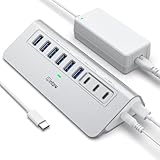
The port mix is what sets the intpw apart from the other five. Nine ports break down as one USB-C 3.2 at 10Gbps, two USB-A 3.2 at 10Gbps, four USB-A 3.0 at 5Gbps, and two USB-C ports rated by intpw at 45W PD for charging only. Nothing else in this set offers a 10Gbps data path or a 45W charging port. The 65W adapter is the largest published in this roundup, giving the hub headroom the SABRENT 60W unit almost matches and the TP-Link 48W unit (12V × 4A) does not.
The body is 7 x 2.5 x 1 in and 1.26 lb of aluminium, with a 32-degree angled base intpw says is made with 50%+ recycled materials. Warranty on the listing is 18 months, which sits between the TP-Link's 2 years and the SABRENT hubs' 1 year limited. The trade-off against the rest of the set is straightforward: it is the second-most expensive pick here, and the PD ports are charge-only, so you do not get nine data ports even though you get nine physical ports.
Pros:
- Only 10Gbps hub in this set
- Largest published adapter at 65W
- Mixed USB-C and USB-A port layout
- Aluminium body with published 32-degree angle
- 18-month warranty on the listing
Cons:
- Second-highest price position in the set
- Two of the nine ports are charging only
- Warranty is shorter than the TP-Link's two years
2. TP-Link Powered USB Hub 3.0 (UH720) — Most versatile
The UH720 is the only hub here with a published 2-year warranty, and it is the cheapest option that still splits data ports from charging ports.

Best for: a mixed Windows and Mac desk with a two-year warranty preference Skip it if: you need 10Gbps transfer speeds
Seven USB 3.0 data ports run at TP-Link's claimed 5Gbps, with two separate 5V/2.4A charging ports that the listing says use TP-Link's charging technology to identify connected devices. That split is the useful part: the charging ports do not consume bandwidth from the data ports, so a phone charging on the end socket does not slow a drive on the middle one. The adapter is 12V/4A, which is 48W of headroom by the numbers on the listing.
Physically it is 2.8 x 7.8 x 5.8 in and 1.1 lb, with a power on/off button on the housing. The UH720 has been in the catalogue since 2015 and it is the only pick here from TP-Link, which matters if you already run their networking gear and want a single vendor for support. The trade-off is speed: none of its ports claim 10Gbps, so a fast external NVMe enclosure will not hit its rated speed through this hub. Against the intpw, it is the safer legacy pick; against the SABRENT 10-port, it is the shorter port count with the longer warranty.
Pros:
- Longest published warranty in this set at 2 years
- Two dedicated smart charging ports at 5V/2.4A
- Physical power on/off button
- Second-cheapest pick here
- Overload and short-circuit protections stated
Cons:
- No 10Gbps or USB-C ports
- Larger footprint than the intpw
- Listing dates to 2015
3. SABRENT 4-Port Powered USB 3.0 Hub (HB-UMP3) — Best budget pick
The HB-UMP3 is the cheapest of the six and the only pick that ships as a 2-pack, which changes the math on a two-desk household.

Best for: adding four switched USB 3.0 ports to a single machine Skip it if: four ports will not be enough in six months
Four USB 3.0 ports, each with its own switch and LED, on a 2.08 x 3.51 x 5.12 in strip. Count on the listing is 2, so you get two hubs in the box, which is unique in this set. The adapter is rated 2.5A on the listing, which is the smallest published figure here, and the trade-off is directly visible: four ports at 5Gbps is what the adapter comfortably supports. Sabrent's HB-UMP3 has been on the market since 2015 and carries a 1 year limited warranty.
Where this pick earns its award: individual power switches let you cut current to a specific peripheral without unplugging it, which is genuinely useful for external drives you want to sleep. The four-port count is the cutoff, though. If you already know you will want a hard drive, a card reader, a keyboard, a mouse, a webcam and a phone, this is the wrong shape. The SABRENT 10-port below is the same idea at 2.5 times the port count.
Pros:
- Cheapest pick here, sold as a 2-pack
- Individual power switch and LED per port
- Compact 5.12 in strip
- Plug and play across Windows, Mac and Linux
- Hot-swap supported
Cons:
- Only four ports
- 2.5A adapter is the smallest published in this set
- No dedicated charging port
4. SABRENT 10-Port 60W Powered USB 3.0 Hub (HB-BU10) — Best premium
The HB-BU10 is the highest port count with a published adapter figure, at 10 USB 3.0 ports fed by a 60W (12V/5A) brick.

Best for: a heavy peripheral load that needs 60W of adapter headroom Skip it if: you want USB-C or PD charging
Ten USB 3.0 ports at 5Gbps, each with a switch and a blue LED, on a 3.3 x 7.4 x 3.7 in housing. The 60W adapter is 12V/5A on the listing, which is the second-largest published figure in this set behind the intpw's 65W. Warranty is 1 year limited, released 2018. Everything about this hub is set up around one idea: a lot of legacy USB-A peripherals, individually controllable, from a single wall socket.
The gap between this and the intpw is easy to describe. The SABRENT has one more port and a slightly smaller adapter, no USB-C, no 10Gbps, but per-port switches the intpw lacks. It is also the most expensive pick here, which is the trade-off you accept for the port count. Against the Wenter's 11-port layout, this SABRENT publishes an adapter figure and a warranty; the Wenter publishes neither. If you are already committed to USB-A peripherals and want the biggest supported adapter, this is the pick.
Pros:
- Ten ports, all with switches and LEDs
- 60W adapter is second-largest here
- Adapter, cable and manual listed in the box
- Backwards compatible with USB 2.0 and 1.1
Cons:
- Highest price position in the set
- No USB-C or PD charging
- Only a 1-year limited warranty
- No 10Gbps ports
5. atolla Powered USB Hub 3.0 — Best upgrade
The atolla is the slimmest published pick at 0.91 in tall, and it packs eight ports into that low-profile strip.

Best for: eight legacy ports in a slim, low-profile strip Skip it if: you want a published warranty on the listing
Seven USB 3.0 data ports plus one dedicated smart charging port, in a housing that measures 0.91 x 6.3 x 1.77 in and weighs 0.56 lb. That low profile is what the pick is for. The atolla will sit under a monitor riser or along the back edge of a desk in a way the SABRENT and Wenter hubs cannot, and the switches face the user rather than the wall. The adapter is 5V/4A on the listing.
The atolla is a mid-price pick and it is the third-cheapest here. Two things weaken the case. First, the listing does not publish a warranty, which puts it at a disadvantage against the TP-Link (2 years), the intpw (18 months) and both SABRENT models (1 year). Second, the feature bullets refer to "7 SuperSpeed" ports in the copy while the title says 8-Port, which is the kind of inconsistency worth resolving with the seller before purchase. If slim profile is the deciding constraint, though, it is the answer.
Pros:
- Slimmest published height at 0.91 in
- Second-lightest pick at 0.56 lb
- Dedicated smart charging port
- Individual on/off switches per port
Cons:
- No warranty listed
- Listing copy is inconsistent about the port count
- No USB-C ports
6. Wenter 11-Port USB Splitter Hub — Best minimal setup
The Wenter offers the highest port count in this set at 11 total ports, but the listing publishes the fewest specifications, which is the trade you are making.

Best for: a big peripheral count with per-port LED switches Skip it if: you need published weight, warranty or adapter figures
Ten USB 3.0 data ports and one smart charging port, each with an individual LED on/off switch. That is the shape of the pick. Wenter says the data ports run at USB 3.0 speeds and lists compatibility with Windows XP through 10, Mac OS and Linux 9. The charging port is described as smart-charging for tablets, cameras and phones.
Here is the honest weakness. The listing does not publish a weight. It does not publish dimensions. It does not publish an adapter wattage or amperage in a form I can copy, and it does not publish a warranty. Every other pick in this roundup gives you at least four of those five figures; the Wenter gives you the port count and the model number and stops. If you value the eleven-port layout with switches and you have already read reviews on the listing to fill the gaps, it can be the right answer. As a data-first pick against the rest of this set, it comes last because there is less to check.
Pros:
- Highest port count in this set at 11
- Per-port LED on/off switches
- Dedicated smart charging port
- Backwards compatible with USB 2.0 and 1.1
Cons:
- No weight, dimensions or warranty on the listing
- No adapter wattage published
- No USB-C or 10Gbps ports
- Fewest published specifications of the six
What actually decides a quiet powered hub?
Port count is what most shoppers compare. That is not what decides it. The deciding specification is adapter wattage divided across the number of ports that can draw current at the same time, because that ratio is what determines whether the hub can supply enough power to a bus-powered external drive without dropping the connection under load.
Here is the math from this set, using the figures the listings publish:
- intpw: 65W across 9 ports, plus dedicated 45W to PD charging.
- SABRENT HB-BU10: 60W across 10 ports.
- TP-Link UH720: 48W across 9 ports (7 data plus 2 charging).
- atolla: 20W (5V × 4A) across 8 ports.
- SABRENT HB-UMP3: 12.5W (5V × 2.5A) across 4 ports.
- Wenter: not published.
A single 2.5-inch external drive draws around 4.5W under load. Four of them at once on the atolla will use most of its adapter budget. The same four on the SABRENT HB-BU10 leave 42W of headroom for everything else. That is the shape of the decision, and it is why the intpw and the two SABRENT hubs sit above the rest.
10Gbps or 5Gbps: which speed tier do you need?
Only the intpw claims 10Gbps on any port. Every other hub in this set caps at 5Gbps on the listing. That gap is real, but it only matters for specific peripherals: NVMe SSD enclosures, some capture cards, and a few high-resolution webcams. A keyboard, a mouse, a printer, a webcam under 4K, a phone and a mechanical hard drive will all saturate long before 5Gbps, so the speed difference is invisible on them.
The rule of thumb is simple. If you own an external SSD enclosure rated USB 3.2 Gen 2 or faster, the intpw is the only pick here that will feed it. If you do not, the best silent powered USB hub for your setup is whichever pick has the port count and layout you need, and 5Gbps is enough.
One more note on the "10Gbps" phrasing. Every speed figure in this roundup is a manufacturer's claim on the listing, not a measured throughput. Real-world speed depends on the cable, the host controller and the peripheral. Treat the numbers as ceilings.
Adapter wattage, port count and the math that matters
The best silent powered USB hub is the one whose adapter can feed everything you plug into it, at once, with headroom. Underspec the adapter and you will see peripherals drop off the bus when a second one wakes up. Overspec it and you have paid for a bigger brick than you need.
Rough guidance based on the published figures in this set:
- Under 20W of adapter: fine for a keyboard, a mouse, a webcam and a phone. The atolla and the SABRENT HB-UMP3 sit here.
- 45 to 60W: fine for the above plus one or two bus-powered external drives. The TP-Link UH720 sits here.
- 60 to 65W: fine for a full peripheral load including a drive and a PD-charged phone. The intpw and the SABRENT HB-BU10 sit here.
The Wenter cannot be placed on this scale because it does not publish a figure. That is not a fatal flaw for the product, but it is a fatal flaw for a data-driven pick, and it is why it lands sixth.
What the listings do not tell you about noise
The keyword asks for a silent powered USB hub. Here is the honest answer. None of these six product listings mentions a fan, and powered hubs at this port count and wattage are conventionally passively cooled. The noise question is really about coil whine from the power adapter, which none of the listings addresses in the specifications, and which varies from unit to unit even within one model.
What that means in practice:
- Do not expect the listing to promise silence, because none of these does.
- Passive cooling is the default here, so audible fan noise is unlikely on any of them.
- Coil whine, when it happens, comes from the wall adapter, not the hub body.
- Place the adapter somewhere you cannot hear it. Under a desk, behind a monitor, or in a cable tray.
I flag this because the phrasing of the keyword suggests noise is a decisive factor, and the product data does not actually let you decide on it. If a truly silent desk is the goal, a bus-powered hub avoids the adapter entirely, but then you lose the power budget that made you want a powered hub in the first place. That is the trade the category asks you to make.
The verdict
The best silent powered USB hub across this set is the intpw 9-Port 10Gbps hub. It is the only pick with 10Gbps data ports, the only one with dedicated 45W PD charging, and the one with the largest published adapter at 65W. On a modern laptop with a mix of USB-C and USB-A peripherals plus a phone to keep topped up, nothing else in this roundup covers as much ground from one wall socket.
Two conditions flip the recommendation. If your peripherals are all USB-A and you value warranty length, the TP-Link UH720 is the better pick. It has the longest published warranty in this set at 2 years, seven USB 3.0 data ports, and two dedicated 5V/2.4A charging ports, and it is the second-cheapest option here. If four ports is enough and you want the cheapest pick in the roundup that still ships as a 2-pack, the SABRENT HB-UMP3 wins on price and gives you a second hub for another desk.
The SABRENT HB-BU10 remains the pick for anyone who needs ten switched USB-A ports and does not want USB-C. It is the most expensive option here, and the 60W adapter is what justifies the price.
FAQ
Is a powered USB hub worth it over a bus-powered one?
A powered USB hub is worth it once you need to run anything with a real current draw: external drives, high-resolution webcams, or multiple devices charging at once. A bus-powered hub shares the host laptop's single USB port budget across every peripheral, which drops connections under load. Five of the six picks here publish adapter figures between 12.5W and 65W, and that headroom is what a powered hub buys you.
What is the difference between the intpw and the TP-Link UH720?
The difference between the intpw and the TP-Link UH720 is speed tier and warranty. The intpw claims 10Gbps on three ports and adds two 45W PD charging ports, backed by a 65W adapter and an 18-month warranty. The TP-Link caps at 5Gbps across seven data ports, adds two 5V/2.4A smart charging ports, and carries a 2-year warranty. Pick the intpw for speed and USB-C, the UH720 for warranty and cost.
How many USB ports do I actually need on a hub?
How many USB ports you need depends on the peripherals already on your desk plus one or two for growth. Count what plugs in today: keyboard, mouse, webcam, headset, drive, phone. Add two spare ports for future devices. That usually lands between six and nine, which is why the intpw at nine ports and the TP-Link at nine total ports are the sweet spot for most desks.
Can these hubs charge an iPhone or iPad quickly?
These hubs charge an iPhone or iPad at different speeds depending on the port. The intpw's two USB-C PD ports are rated by intpw at 45W, which is the fastest charging figure in this set. The TP-Link, atolla and Wenter each publish a 5V/2.4A smart charging port, roughly 12W. The two SABRENT hubs offer standard USB 3.0 charging without a dedicated smart charge port, which is slower for tablets.
What is the biggest mistake buying a powered USB hub?
The biggest mistake buying a powered USB hub is picking on port count and ignoring adapter wattage. A 10-port hub with a 12W adapter cannot run three bus-powered drives at once, even though it has the sockets. Check the wattage figure on the listing, divide it by the number of high-draw peripherals you plan to connect, and confirm each one gets at least 4.5W. The Wenter's missing adapter figure is exactly this risk.
If you already know which side of the port-count line you sit on, the choice comes down to two picks. A modern laptop with USB-C wants the intpw, because nothing else in the category matches its 65W adapter and 10Gbps data path in a body this small. A legacy desk with a longer time horizon wants the TP-Link UH720, because a 2-year warranty on a hub you plan to keep for five is the specification that pays back last. Everything else here is a variation on those two ideas: more ports, a slimmer strip, a cheaper entry. Start with the port count you actually need, check the adapter wattage against the peripherals you actually own, and the pick will follow.