Best Powered USB Hub for CAD Workstations
Seven powered hubs compared for CAD workstations, ranked by port count, transfer speed and power budget. A 10Gbps 9-port model leads.

By Lamar CalhounUpdated 16 min read
On this page
- Best powered USB hub for CAD at a glance
- How I screened these seven hubs
- Does the CAD label actually mean anything here?
- 1. intpw Powered USB Hub 10Gbps — Best overall
- 2. SABRENT 10-Port 60W Powered USB 3.0 Hub — Best premium
- 3. Wenter 11-Port USB Splitter Hub — Best for pros
- 4. atolla Powered USB Hub 3.0 — Best upgrade
- 5. TP-Link Powered USB Hub UH720 — Best minimal setup
- 6. Atolla 4-Port USB 3.0 Hub — Runner-up
- 7. SABRENT 4-Port Powered USB 3.0 Hub — Best budget pick
- What decides a hub for a CAD workstation?
- How many ports do you actually need?
- What more money buys across this set
- Hub pitfalls that bite CAD users
- The verdict
- FAQ
The best powered USB hub for CAD in this set is the intpw Powered USB Hub 10Gbps, a 9-port model with a 65W adapter, one 10Gbps USB-C data port and two more 10Gbps USB-A ports at 7 x 2.5 x 1 in. If you would rather stick to legacy USB 3.0 and want ten identical ports on the desk, the SABRENT 10-Port 60W hub is the alternate pick. A CAD desk pulls dongles, a Space Mouse, a tablet, a mechanical keyboard, external SSDs and a phone in one loop, and the wrong hub browns out under that mix.
Best powered USB hub for CAD at a glance
| Pick | Ports | Top data speed | Price |
|---|---|---|---|
Best overall intpw Powered USB Hub 10Gbps |
9 (7 data + 2 PD) | 10Gbps claim | Check Price |
Best premium SABRENT 10-Port 60W Powered USB 3.0 Hub |
10 data | 5Gbps claim | Check Price |
Best for pros Wenter 11-Port USB Splitter Hub |
11 (10 data + 1 charge) | USB 3.0 claim | Check Price |
Best upgrade atolla Powered USB Hub 3.0 |
8 (7 data + 1 charge) | 5Gbps claim | Check Price |
Best minimal setup TP-Link UH720 Powered USB Hub |
9 (7 data + 2 charge) | 5Gbps claim | Check Price |
Runner-up Atolla 4-Port USB 3.0 Hub |
5 (4 data + 1 charge) | 5Gbps claim | Check Price |
Best budget pick SABRENT 4-Port Powered USB 3.0 Hub |
4 data | 5Gbps claim | Check Price |


How I screened these seven hubs
I started with powered hubs under the Computer Accessories & Peripherals category and cut anything without a bundled adapter, because a bus-powered hub cannot feed a 3D mouse plus a fast SSD plus a phone at the same time. I read the published specifications side by side, then lined the price positions against port counts and transfer speeds to see what more money actually buys.
Three filters did most of the work:
- A stated wall adapter with wattage or amperage in the listing, not just "powered".
- A USB 3.0 or faster data path on the main ports, so a CAD file copy is not stuck at USB 2.0 speeds.
- Enough ports that a CAD desk with a keyboard, mouse, 3D mouse, tablet, dongle and drive still has one free slot.
That left seven picks across three price positions. The cheapest of the set is a four-port SABRENT; the most expensive is a ten-port SABRENT; the intpw sits at the top of the premium tier because it is the only hub here that publishes a 10Gbps figure and a USB-C data port.
Does the CAD label actually mean anything here?
Honestly, only halfway. None of these listings targets CAD as a use case, and the search results reflect that. What CAD really asks of a hub is a stable power budget for a mixed peripheral load: a Space Mouse or SpaceNavigator, a licence dongle that must not disconnect mid-session, a graphics tablet, a mechanical keyboard, a wired mouse, and often an external SSD holding project files. Any powered USB 3.0 hub with a decent adapter can serve that load, so the useful question is which of these hubs handles it best, not which one is stamped for CAD.
Treat the CAD label as a shortlisting hint, not a spec. The picks below are chosen for the mix of peripherals a CAD desk actually carries.
1. intpw Powered USB Hub 10Gbps — Best overall
The only hub here with a 10Gbps data path and a USB-C port, on a 65W adapter big enough for a CAD desk's mixed load.

Best for: a CAD workstation with a 3D mouse, licence dongle and fast external SSD Skip it if: you only need a few slow peripherals and no fast charging
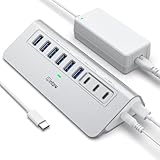
This is the newest-feeling hub in the set, and the specifications back that up. intpw lists one USB-C 3.2 port at 10Gbps, two USB-A ports at 10Gbps, four USB-A at 5Gbps, and two USB-C ports at 45W PD for charging only. That layout matches a CAD desk cleanly: fast lane for the project SSD, middle lane for the dongle and Space Mouse, charge ports for a phone and tablet without stealing bandwidth. The 65W (20V/3.25A) adapter is the largest here, which is the number that decides whether the hub browns out when the SSD and the tablet both draw at once.
Dimensions are 7 x 2.5 x 1 in, weight 1.26 lb, and the body is aluminium with an angled 32-degree face. The published warranty is 18 months, second longest in this set. The trade-off against the SABRENT ten-port is fewer identical data ports, and against the cheaper picks, the highest price position here.
Pros:
- Only hub in the set with a 10Gbps USB-C data port
- Largest published adapter at 65W
- 18-month warranty, longer than most here
- Angled aluminium body with a stated dimensions figure
Cons:
- The most expensive pick in this set
- No per-port on/off switches
- Two of the USB-C ports are charging only
2. SABRENT 10-Port 60W Powered USB 3.0 Hub — Best premium
Ten identical USB 3.0 ports and a 60W adapter, the pick when you want lanes rather than tiers.

Best for: a busy desk running ten legacy USB 3.0 peripherals at once Skip it if: you need USB-C or 10Gbps transfer
The SABRENT ten-port is the second-most expensive hub here and the one that leans hardest into port count. Every port is USB 3.0 at a claimed 5Gbps, each has its own power switch and blue LED indicator, and the bundled adapter is 60W (12V/5A). Dimensions are 3.3 x 7.4 x 3.7 in, and the model dates from 2018. For a CAD desk that has accumulated eight or nine USB-A peripherals over the years, the sameness is the point: no working out which port takes the drive and which takes the dongle.
The compromises are on the other side. There is no USB-C anywhere on the hub, and the top data figure is half what the intpw claims. Warranty is one year, shortest of the picks that publish one. If your peripherals are still all USB-A and you want a switch per port, this is the cleanest match in the set; if you plan to run a 10Gbps SSD, it is the wrong hub.
Pros:
- Ten identical USB 3.0 data ports
- Individual power switch and LED per port
- 60W adapter for a heavy peripheral load
- Backward compatible with USB 2.0 and 1.1
Cons:
- No USB-C port anywhere
- 5Gbps ceiling on every port
- One-year warranty
- Largest footprint of the shortlist
3. Wenter 11-Port USB Splitter Hub — Best for pros
The highest port count here, with ten data ports plus a dedicated smart-charging port and individual LED switches.

Best for: a heavy peripheral load where per-port switches matter Skip it if: you want a published warranty and full dimensions before you buy
The Wenter is the only 11-port hub in the shortlist: ten USB 3.0 data ports and one smart-charging port, each data port with its own on/off switch. On a CAD bench that hosts a 3D connexion device, a graphics tablet, two SSDs, a card reader, a keyboard, a mouse, a licence dongle and a webcam, the switch bank is genuinely useful because you can kill the drives when you leave the desk without unplugging the dongle that your CAD seat is bound to.
The reason it does not lead is thinner data. Wenter publishes the model number and the port count but not weight, dimensions or a warranty term, so you are buying on the port layout and the compatibility list alone. The company describes wide OS support from Windows XP through Windows 10, macOS and Linux 9+. Against the SABRENT ten-port, you gain a charging port and a data port; against the intpw, you lose USB-C and the 10Gbps lane.
Pros:
- Highest port count in this set at eleven
- Dedicated smart-charging port kept off the data bus
- Individual LED switch on every data port
- Broad OS compatibility list
Cons:
- No published weight, dimensions or warranty
- USB 3.0 5Gbps ceiling, no USB-C
- Sits in the premium price tier despite thin published specs
4. atolla Powered USB Hub 3.0 — Best upgrade
A thin, low-profile eight-port bar with a 5V/4A adapter and per-port switches, the tidy-desk pick.

Best for: a tidy desk that needs eight ports on a thin, low-profile bar Skip it if: you plan to attach bus-hungry portable SSDs to every port
The atolla eight-port sits mid-range for this set and does something the SABRENTs do not: it fits at the front edge of a desk without dominating it. Dimensions are 0.91 x 6.3 x 1.77 in and weight is 0.56 lb, which makes it the thinnest hub here. Seven USB 3.0 data ports at a claimed 5Gbps plus one dedicated smart-charging port cover a full CAD peripheral list, and each data port has its own switch.
The adapter is 5V/4A, which is 20W in total. That is enough for a keyboard, mouse, dongle, Space Mouse, tablet and a flash drive together, but it is a smaller power budget than the SABRENTs and the intpw, so a rack of external SSDs is not what this hub is for. The listing mentions an 18-month warranty in one of its bullets, though no dedicated warranty specification is published. Against the TP-Link UH720, you gain a switch per port and lose one charging port.
Pros:
- Thinnest body in the shortlist at 0.91 in
- Per-port switches across all seven data ports
- Dedicated smart-charging port
- Compact 0.56 lb weight for a front-of-desk fit
Cons:
- 20W total adapter is smaller than the SABRENTs
- No USB-C port
- No warranty in the specifications block
5. TP-Link Powered USB Hub UH720 — Best minimal setup
The only hub here with a stated two-year warranty, aimed at a desk that wants set-and-forget over per-port control.

Best for: a workstation that wants a proper warranty and a single on/off switch Skip it if: you want per-port control or a compact footprint
TP-Link's UH720 pairs seven USB 3.0 data ports with two smart-charging ports rated at 5V/2.4A. The adapter is 12V/4A, so 48W in total. The number that separates this pick from the rest is the warranty: two years, the longest published in this set, and the reason to pick it if you are buying gear for a company workstation where support and RMA paperwork actually matter. The listing calls out overheat, overload, overvoltage and short-circuit protection on the circuit board.
The trade-off is control. There is one power button for the whole hub rather than a switch per port, so if you like killing a specific drive without touching the others, the SABRENTs or the atolla will suit you better. Dimensions are 2.8 x 7.8 x 5.8 in, and weight is 1.1 lb, so it takes more desk than the atolla eight-port. Against the SABRENT four-port, you gain three data ports, a fast-charging pair and a much longer warranty.
Pros:
- Two-year warranty, longest in this set
- Two dedicated 5V/2.4A charging ports
- 48W adapter for a mixed peripheral load
- Protection circuitry called out in the listing
Cons:
- Single hub-level power button, no per-port switches
- Larger footprint than the atolla eight-port
- 5Gbps ceiling, no USB-C
6. Atolla 4-Port USB 3.0 Hub — Runner-up
A four-port sibling to the eight-port atolla, better as a secondary hub than as a workstation's only one.
Best for: a secondary hub for a laptop-based CAD setup Skip it if: you need more than four data ports
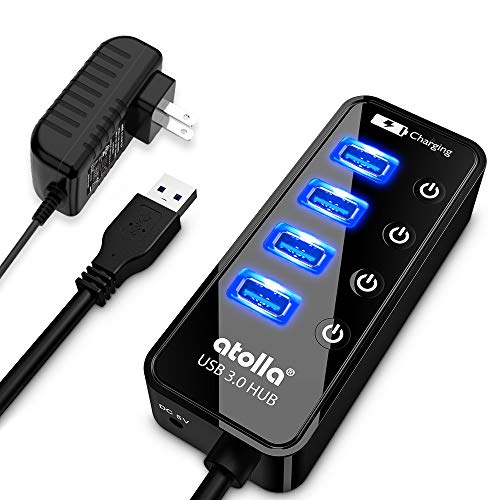
The Atolla four-port sits at the second-cheapest position in this set and shares the design language of the eight-port: individual illuminated switches on each data port, a smart-charging port on the side, and a slim body at 0.91 x 4.25 x 1.69 in with a 6.84 oz weight. The bundled adapter is 5V/3A. For a CAD user who already has a main hub at the desktop and needs a small hub next to a docked laptop for a dongle, a drive and a card reader, this is the right shape.
As a workstation's only hub, four data ports plus one charging port runs out quickly. A typical CAD peripheral list, keyboard, mouse, 3D mouse, tablet, licence dongle, external SSD, already exceeds four. Take it as a companion to one of the eight- or ten-port picks above, not as a replacement. Against the SABRENT four-port, you gain the smart-charging port and per-port switches.
Pros:
- Per-port illuminated switches on all four data ports
- Dedicated smart-charging port
- Compact 0.91 in thin profile
- Entry-tier price position
Cons:
- Only four data ports
- 15W adapter, smallest here
- No published warranty in the specifications
- No USB-C
7. SABRENT 4-Port Powered USB 3.0 Hub — Best budget pick
The cheapest of the seven, built around a 2.5A adapter and per-port LED switches for a very short peripheral list.

Best for: a small parts-list of dongles, keyboard and mouse on a tight budget Skip it if: you plan to run drives or a 3D mouse from it
The HB-UMP3 is the entry point to this shortlist. Four USB 3.0 data ports at a claimed 5Gbps, one LED-lit power switch per port, and a 2.5A power adapter, which is 12.5W if the adapter runs at 5V. The dimensions are 2.08 x 3.51 x 5.12 in and the warranty is one year limited. It is a plug-and-play design that has been on sale since 2015, and for a light peripheral load it does the job cleanly.
The reason it is not higher in the ranking is exactly the number that decides a CAD hub: the power budget. A 12.5W adapter is fine for a keyboard, a mouse and a couple of dongles, but a bus-powered external SSD plus a 3D mouse plus a phone charging is more than it should be asked to feed. Read this as a hub for a lightweight side setup, not the anchor of a workstation.
Pros:
- Cheapest of the seven picks
- Per-port switch and LED on all four ports
- Compact form at 2.08 x 3.51 x 5.12 in
- One-year limited warranty
Cons:
- 12.5W adapter is the smallest bus power here
- Only four data ports
- No USB-C
- No smart-charging port
What decides a hub for a CAD workstation?
Most guides compare port count first. That is not what decides it for CAD. The deciding specification is the wall adapter's power budget, because a CAD desk's peripherals are heterogeneous: some are trickle loads, some are spike loads, and one of them, the licence dongle, must never drop even for a millisecond. When the adapter is undersized, the hub steals from one port to feed another, and the port that gets starved is usually the one you notice last, which in a CAD session is the dongle.
Rank the adapter wattages in this set and the shortlist reorders itself:
- intpw 65W
- SABRENT ten-port 60W
- TP-Link UH720 48W
- atolla eight-port 20W
- Atolla four-port 15W
- SABRENT four-port 12.5W
Port count matters second, and the type of ports third. The intpw wins on all three axes at once, which is why it leads.
How many ports do you actually need?
Count your desk before you buy. A working CAD peripheral list usually runs like this:
- Mechanical keyboard: 1 port
- Wired mouse: 1 port
- 3D mouse or SpaceNavigator: 1 port
- Graphics tablet: 1 port
- Licence dongle: 1 port
- External project SSD: 1 port
- Card reader or webcam: 1 port
- Phone charging: 1 port
Eight ports is the honest baseline, and if you also plug in a wired headset dongle, a second SSD or a plotter cable, ten is safer. That is why the four-port picks in this set are relegated to companion duty and the eight- to eleven-port hubs sit at the top. The intpw's 9-port layout is the tightest fit for a working list, with one lane free for whatever you plug in tomorrow.
What more money buys across this set
Moving up the price tiers in this shortlist buys three concrete things.
From entry to mid, you gain the port count that a CAD desk actually needs, from four to eight, plus a dedicated smart-charging port that keeps a phone off the data bus. The atolla eight-port is the clearest step up from the SABRENT four-port.
From mid to premium, you gain either the ten identical USB 3.0 ports of the SABRENT ten-port, the eleven-port layout of the Wenter, or the 10Gbps USB-C data lane and the 65W adapter of the intpw. Those are three different premium propositions, not one, and which of them you want depends on whether your peripherals are still all USB-A. If they are, the SABRENT and Wenter are the natural picks; if you have modern USB-C peripherals, the intpw is the only hub in this set that speaks to them.
Hub pitfalls that bite CAD users
A few traps show up again and again on CAD forums, and the specifications above tell you which hubs dodge them.
- The dongle drop. A hub with a small adapter under load will disconnect the port with the smallest current draw first, and that is often the licence dongle. The 48W, 60W and 65W picks are the safe bets.
- The USB 2.0 fallback. A 5Gbps or 10Gbps hub connected via a USB 2.0 cable falls back silently to 480Mbps. Use the cable that ships with the hub, not a spare one from a drawer.
- The charging port that is not a data port. The intpw's two 45W USB-C ports are charging only. Do not plug your drive into them expecting to move files.
- The one big switch. The TP-Link UH720 has one hub-level power button. If you want to kill a single drive without touching the others, buy a hub with per-port switches instead.
- Missing dimensions. The Wenter's specifications do not include weight or dimensions, so measure your desk space against the image before you commit.
The verdict
For most CAD workstations, the intpw Powered USB Hub 10Gbps is the right default. It is the only hub in this shortlist with a 10Gbps USB-C data lane, it publishes the largest adapter at 65W, and its 9-port layout leaves exactly one free lane after a full working peripheral list. The 18-month warranty is the second-longest here, and the aluminium body at 7 x 2.5 x 1 in is desk-ready rather than server-shelf ugly.
Two tracks flip that recommendation. If your peripherals are still entirely USB-A and you want ten identical switched ports rather than a tiered layout, the SABRENT 10-Port 60W is the better spend, because you never think about which port takes which device. If you are equipping a company workstation where a documented warranty matters more than the fastest data lane, the TP-Link UH720 is the pick, on the strength of the two-year warranty and the protection circuitry called out in the listing. The cutoff is your peripheral mix: modern USB-C in the loop pushes you to the intpw, a USB-A rack pushes you to the SABRENT, and RMA paperwork pushes you to the TP-Link.
FAQ
Is a powered USB hub worth it for CAD compared with plugging peripherals straight into the tower?
A powered USB hub is worth it for CAD once you pass roughly six peripherals, because a tower's rear ports are usually split across two or three internal controllers and a heavy load on one controller starves the others. Moving the dongle, 3D mouse, tablet and drive onto a hub with its own 48W or 65W adapter isolates the load and stops the dongle from dropping mid-session.
Does the best powered USB hub for CAD need USB-C or is USB-A enough?
The best powered USB hub for CAD needs USB-C only if your peripherals do. Most CAD desks still run all USB-A: keyboard, mouse, Space Mouse, licence dongle, tablet, drives. In that case a hub like the SABRENT 10-Port covers the load. If your project SSD is USB-C at 10Gbps, the intpw is the only hub here with a matching data lane.
How does the intpw hub compare with the SABRENT 10-Port for a CAD desk?
Compared with the SABRENT 10-Port, the intpw wins on data speed and adapter size: 10Gbps against 5Gbps, and 65W against 60W. The SABRENT wins on identical port count with ten USB 3.0 ports and a per-port switch on each. Pick the intpw if a modern SSD or USB-C peripheral is in the loop; pick the SABRENT if every peripheral you own is USB-A.
What specification decides whether a hub can run a licence dongle without dropouts?
The specification that decides dongle stability is the total wall adapter budget divided across the ports under load. The dongle itself draws almost nothing, but it is the first port to be starved when the hub is under-fed. Look for at least 48W on the adapter for an eight-port hub, which is what the TP-Link UH720, the SABRENT 10-Port and the intpw all clear.
What is the biggest mistake CAD users make when picking a USB hub?
The biggest mistake CAD users make is buying on port count alone and ignoring the adapter. A cheap ten-port hub with a small brick will disconnect ports at random when a drive spins up, and the drop that costs you an hour of work is the licence dongle, not the drive. Read the wall adapter's wattage first, port count second, and switch layout third.
The practical move is to count your peripherals tonight, list them by whether they draw power or only data, and then match that list against the adapter wattages ranked above. Nine times out of ten a CAD desk lands on an eight- or nine-port hub with a 48W-plus adapter, and in this shortlist that means the intpw first, the TP-Link UH720 as a warranty-led alternative, or the SABRENT 10-Port when the peripheral rack is still fully USB-A. Buy the hub your peripheral list actually needs, not the one with the biggest number on the box, and the dongle stays put through the render.