Best Premium WiFi Extender for a Home Office

A working-from-home coder needs a stable link, not a bigger number. Here's how six extenders line up, which one leads, and when to pick a different model.

By Lamar CalhounUpdated 16 min read
On this page
- Best premium wifi extender for programmers at a glance
- How I cut the shortlist down to six
- What actually decides a home-office extender?
- 1. TP-Link AC1900 WiFi Range Extender RE550 — Best overall
- 2. TP-Link AX3000 WiFi 6 Range Extender RE715X — Best premium
- 3. NETGEAR WiFi Range Extender EX6120 — Best upgrade
- 4. Amazon eero 6 mesh wifi add-on extender — Best minimal setup
- 5. NETGEAR WiFi Mesh Range Extender EX5000 — Best for pros
- 6. JOYOCHO WiFi Signal Extender Booster — Best budget pick
- The one specification that separates these six
- Does the programmer angle change anything?
- RE550 vs RE715X: which one wins your desk?
- What the listings quietly leave out
- The verdict
- FAQ
The best premium WiFi extender for programmers is the TP-Link RE550, a dual-band AC1900 unit with 1.9 Gbps of total bandwidth and a gigabit Ethernet port for a wired desk. If your router already runs WiFi 6, step up to the TP-Link RE715X instead, which pushes 2404 Mbps on the 5 GHz band across a claimed 2400 sq ft and holds up to 64 devices.
Best premium wifi extender for programmers at a glance
| Pick | WiFi standard | Wired port | Price |
|---|---|---|---|
Best overall TP-Link RE550 |
WiFi 5, AC1900 | Gigabit Ethernet | Check Price |
Best premium TP-Link RE715X |
WiFi 6, AX3000 | Ethernet (claim) | Check Price |
Best upgrade NETGEAR EX6120 |
WiFi 5, AC1200 | 10/100 Mbps | Check Price |
Best minimal setup eero 6 add-on extender |
WiFi 6 (mesh add-on) | Not listed | Check Price |
Best for pros NETGEAR EX5000 |
WiFi 5, AC1200 | Not listed | Check Price |
Best budget pick JOYOCHO 2026 Repeater |
300 Mbps claim | Ethernet (claim) | Check Price |


How I cut the shortlist down to six
I built this list by disqualification. Every extender that survived earned its slot by clearing three cuts, and the ones you do not see failed one of them.
The first cut was wired capability. A programmer at a home desk usually wants to run an Ethernet cable from the extender to a workstation or a dock, because a wire is the only way to escape the throughput halving every wireless extender warns about. Two picks kept a proper gigabit or claimed Ethernet port. One held only a 10/100 Mbps jack, which caps a wired desktop at 100 Mbps. That is a real limitation and it is called out where it matters.
The second cut was published specification depth. TP-Link publishes bandwidth, coverage, device count, weight, dimensions, warranty and model on both units in this set. The JOYOCHO listing publishes almost nothing beyond a count of one. That gap decides where each pick sits.
The third cut was manufacturer support signalling. The two TP-Link picks state a 2 year manufacturer warranty; both NETGEAR picks state 1 year; eero and JOYOCHO do not publish a warranty at all. That is a meaningful spread for a device that lives on a wall outlet for years.
The best premium WiFi extender for programmers therefore had to clear all three, and only one did cleanly.
What actually decides a home-office extender?
Most guides to the best premium WiFi extender for programmers compare peak wireless speed. That is the wrong number. Every listing in this set repeats the same manufacturer disclosure: an extender does not increase speed, and real throughput in the extended area drops by at least half. So a 3 Gbps sticker on the box does not mean 3 Gbps at your desk.
The number that actually decides the purchase is the wired Ethernet port on the extender itself. Plug your desktop, dock or work laptop into the extender by cable, and you skip the second wireless hop. The RE550 lists a gigabit Ethernet port. The EX6120 lists a 10/100 Mbps port, which the NETGEAR listing itself flags as "not Gigabit". The EX5000 does not publish a port specification. The eero 6 extender is a mesh node, not a wall extender, and its listing focuses on mesh routing rather than a wired jack.
If you spend eight hours a day on a video call from a spare bedroom, that gigabit port is where a stable link is bought. Everything else is a supporting spec.
1. TP-Link AC1900 WiFi Range Extender RE550 — Best overall
A gigabit Ethernet port and 1.9 Gbps of dual-band bandwidth make the RE550 the most useful extender here for a wired desk in a back room.
Best for: a wired desk in a room the router cannot reach cleanly Skip it if: your router is already WiFi 6 and you want to match it
Within this set the RE550 is the only WiFi 5 pick with a gigabit port and a published 2 year manufacturer warranty. TP-Link states 1300 Mbps on the 5 GHz band and 600 Mbps on 2.4 GHz, adding up to the 1.9 Gbps figure on the listing. Coverage is claimed at up to 2100 sq ft, and the listing says the unit handles up to 32 devices across three adjustable external antennas.
The physical footprint is small for what it does: 2.6 x 6.4 x 3 in and 0.51 lb, released in 2021. EasyMesh compatibility means TP-Link says you can fold it into a mesh network with an EasyMesh router. TP-Link also notes it is a signatory of the CISA Secure-by-Design pledge, which is worth reading as a commitment rather than a certification.
The trade-off against the RE715X is the standard. This is WiFi 5, not WiFi 6, so if your laptop and router already run WiFi 6 you are dropping to an older air interface at the extender.
Pros:
- Gigabit Ethernet port for a wired desk
- 1.9 Gbps total dual-band bandwidth
- Up to 32 devices per the listing
- 2 year manufacturer warranty
- EasyMesh support for future mesh use
Cons:
- WiFi 5, not WiFi 6
- Three external antennas make it bulkier than a plain wall wart
- Coverage claim depends on router placement
2. TP-Link AX3000 WiFi 6 Range Extender RE715X — Best premium
The RE715X is the WiFi 6 pick to buy when the router upstream is already WiFi 6 and you have devices that can use it.

Best for: a household running a WiFi 6 router with many concurrent devices Skip it if: you have no WiFi 6 clients to feed
This is the most expensive pick here and the only WiFi 6 wall extender in the set. TP-Link lists 2404 Mbps on the 5 GHz band and 574 Mbps on 2.4 GHz, adding up to a 3 Gbps class figure. Claimed coverage is up to 2400 sq ft and up to 64 devices, double the RE550's stated device count. Two high-gain directional antennas with beamforming are called out in the feature bullets, and TP-Link lists the same 2 year manufacturer warranty as the RE550.
At 6.3 x 4.21 x 1.58 in and 0.84 lb, the RE715X is longer than the RE550 but flatter. It supports EasyMesh for the same mesh path if you want to build outward later. Released in 2022, it is the newest TP-Link pick in this group.
The honest trade-off is value. If your work laptop is a two-year-old ultrabook with a WiFi 5 radio, you are paying for a WiFi 6 uplink that neither end of the link can use. The RE550's gigabit port serves that laptop better than the RE715X's air interface.
Pros:
- WiFi 6 with 2404 Mbps on 5 GHz per the listing
- 64 devices claimed by the manufacturer
- 2400 sq ft coverage claim, largest of the wall extenders here
- EasyMesh compatible
- 2 year manufacturer warranty
Cons:
- Highest price position in this set
- WiFi 6 gains vanish if clients are WiFi 5
- Directional antennas need aiming, not just plugging in
3. NETGEAR WiFi Range Extender EX6120 — Best upgrade
A compact dual-band unit that fits a hallway outlet, but the 10/100 Mbps port is the ceiling for anything you cable to it.
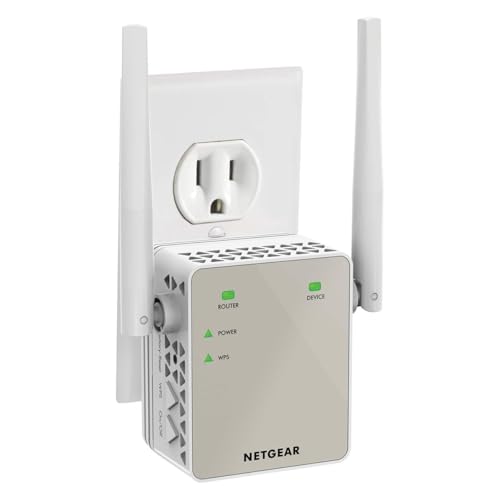
Best for: a small apartment where the extender sits on a hallway outlet Skip it if: you plan to hardwire a desktop through the Ethernet port at full speed
The EX6120 is the second-cheapest pick here and the smallest by every published dimension: 2.17 x 2.64 x 1.54 in, 4.64 oz. NETGEAR states AC1200 dual-band, with up to 300 Mbps on 2.4 GHz and 900 Mbps on 5 GHz, covering up to 1500 sq ft and 25 devices. The listing carries a 1 year warranty.
Two details set expectations honestly. NETGEAR itself writes that the Ethernet port is 10/100 Mbps and "is not Gigabit", so wired throughput to a workstation caps at 100 Mbps regardless of the wireless link. The listing also notes that if your router is WiFi 6 or newer you should confirm WPA2 or WPA2/WPA3 mixed mode support before buying, because the extender only pairs with WPA2 and WPA/WEP.
Against the RE550, the EX6120 gives up the gigabit port, drops from AC1900 to AC1200, halves the warranty, and loses the third antenna. What you buy is a smaller unit that hides on an outlet, nothing more.
Pros:
- Smallest wall extender in this set
- Dual-band AC1200 per the listing
- Covers up to 1500 sq ft claim
- Compact wall-plug body, no external antennas to aim
Cons:
- Ethernet port capped at 100 Mbps
- 1 year warranty, half the TP-Link picks
- Router security compatibility caveat in the listing itself
4. Amazon eero 6 mesh wifi add-on extender — Best minimal setup
The right pick only if you already run eero, because it is a mesh node that requires an eero network to work at all.
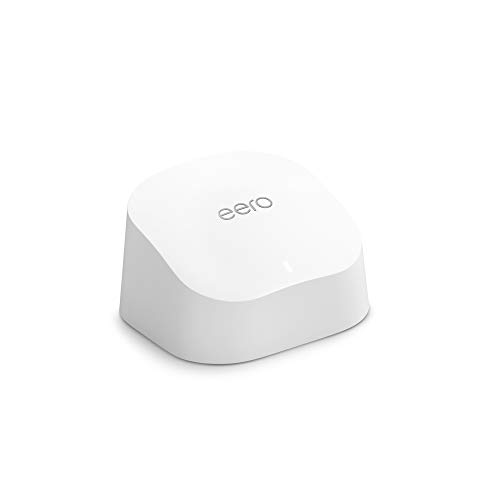
Best for: an existing eero mesh owner who wants one more node with no config Skip it if: you do not already run an eero network
The eero 6 add-on is a different kind of product from the rest of this list. It is a mesh node, not a wall-plug repeater, and the listing states clearly that an existing eero network is required. It adds up to 1500 sq ft of WiFi 6 coverage to that network, and its listing is the only one in the set that names TrueMesh routing, automatic updates and 7-day US customer support.
Published specs: 2.42 x 3.91 x 3.82 in, 0.63 lb, released in 2020. It sells faster than most of the rest of this set. The listing does not publish a warranty figure, a device cap, or a wired port specification, which is unusual next to the TP-Link entries.
The trade-off is scope. If your router is a Netgear, an ASUS or an ISP box, this extender does nothing for you. It also carries a premium position without publishing the throughput numbers the TP-Link picks quote, so the case for it is "my existing network is eero, one more node is easier than a repeater" rather than a spec comparison.
Pros:
- Adds 1500 sq ft of WiFi 6 coverage to an eero mesh
- App-driven setup with published US customer support
- TrueMesh routing per the listing
- Compact desk-friendly body
Cons:
- Requires an existing eero network
- No published warranty, wired port spec or device cap
- Premium price position for a narrower use case
5. NETGEAR WiFi Mesh Range Extender EX5000 — Best for pros
The smaller NETGEAR in this list, aimed at a compact second workspace rather than a whole house.

Best for: a compact second workspace under a thousand square feet Skip it if: you need gigabit wired backhaul to a desktop
The EX5000 lists AC1200 dual-band with up to 1200 Mbps of performance and coverage up to 1000 sq ft for 15 devices. It is 2.85 x 2.55 x 2.85 in and 5.44 oz, with a 1 year warranty, and released in 2020. NETGEAR calls it a mesh range extender, and the listing covers WPS pairing plus a mention of the NETGEAR WiFi Analyzer app for placement.
Within the set, this is a smaller-scope unit than either TP-Link and than the EX6120. Coverage tops out at 1000 sq ft against 1500 for the EX6120 and 2100 for the RE550, and the device count is capped at 15 in the listing rather than 25 or 32. The listing does not publish an Ethernet port specification, so treat wired throughput as unknown rather than assumed.
Against the RE550 the EX5000 gives up bandwidth headroom, published wired capability and a year of warranty. What it offers is a NETGEAR-brand mesh flavour for people already inside that ecosystem, and a smaller physical footprint than the RE550's three-antenna body.
Pros:
- AC1200 dual-band, 1200 Mbps claim
- Compact 5.44 oz body
- WPS pairing for one-button setup
- Works with any wireless router per the listing
Cons:
- 1000 sq ft is the smallest wall-extender coverage claim here
- 15-device cap, lowest in this set
- No published Ethernet port specification
- 1 year warranty
6. JOYOCHO WiFi Signal Extender Booster — Best budget pick
The cheapest of the six, with a coverage claim that reads well and a specification sheet that publishes almost nothing else.

Best for: a spare-room laptop that only needs a browser and email Skip it if: you rely on a stable connection for work calls
The JOYOCHO is the cheapest of the six here and only one seller lists it. JOYOCHO claims a maximum speed of 300 Mbps, coverage up to 8470 sq ft, and both Repeater and AP modes with an Ethernet port. That coverage figure is far above any other listing in this set, which is a good moment to remember that feature bullets are the manufacturer's claim, not a measured figure.
Where this pick falls short in the data is depth. The published specifications table lists a count of 1 and nothing else: no weight, no dimensions, no warranty, no model number in the specs, no release year. Every other pick in this set publishes at least six of those fields, and both TP-Links publish eight.
The trade-off against the rest of the set is straightforward. You get a very low price and a bold coverage claim, in exchange for a listing that leaves the durability, wired port speed and support commitments unknown. For a programmer whose income depends on a stable link during a work call, that is the wrong trade. For a spare tablet in a garage, it might not be.
Pros:
- Cheapest pick in this comparison
- Claims both repeater and access point modes
- Ethernet port listed in the feature bullets
- Simple app-free setup per the listing
Cons:
- Almost no published specifications beyond a count of 1
- Coverage claim of 8470 sq ft is far above the rest
- No published warranty
- Only one seller lists it
The one specification that separates these six
Line the picks up by wired port and the field splits cleanly.
- The RE550 publishes a gigabit Ethernet port.
- The RE715X's listing names Ethernet in the model line but does not publish port speed in the specs.
- The EX6120 publishes a 10/100 Mbps port and the listing itself calls out that it is not gigabit.
- The EX5000 does not publish a port specification.
- The eero 6 extender does not publish a wired port specification.
- The JOYOCHO names an Ethernet port in the feature bullets without a speed figure.
For a working desk this is the entire argument. A gigabit port turns a wireless extender into a wired access point for the room you actually work in, which is the one placement where the "half your router speed" warning stops mattering to the device you care about most.
Does the programmer angle change anything?
Partly. The listings here do not target programmers specifically, so nothing in the product data proves any of these picks was designed for a coder. What the programmer framing does change is the weighting.
A programmer typically runs a work laptop on a dock, pushes container images, joins long video calls, and needs a stable path to a self-hosted service or a VPN. That workflow rewards three things: a wired port on the extender, a warranty that outlives the machine, and enough bandwidth headroom that a large git pull does not choke a call.
By those three, the RE550 wins on the port and the warranty, and the RE715X wins on headroom. Everything else in the set makes compromises the working desk feels.
Where the programmer framing does not help:
- No listing publishes latency figures, so nobody in this set can claim a ping advantage.
- No listing publishes QoS behaviour for video calls.
- No listing exposes a CLI or SSH, so if you wanted a scriptable node, this category is not the answer.
RE550 vs RE715X: which one wins your desk?
The two TP-Links share more than they differ: same brand, same EasyMesh support, same 2 year warranty, same cybersecurity signatory line. The choice comes down to what your router is doing today.
Pick the RE550 when your router is WiFi 5, or when your laptop's radio is WiFi 5, or when the deciding constraint is a wired desktop on the extender's gigabit port. Its 1.9 Gbps of total bandwidth is plenty of headroom for a WiFi 5 world, and the gigabit jack is the strongest single spec in the set.
Pick the RE715X when your router is WiFi 6, you have WiFi 6 clients, and you are covering more than 2000 sq ft. Its 2404 Mbps on 5 GHz and the 64-device claim are worth the premium price position, but only under those conditions. Buy it for a WiFi 5 house and you are paying for headroom nothing else on your network can use.
What the listings quietly leave out
The product data on Amazon is generous on some fields and silent on others. It is worth knowing what is missing before you commit.
- Actual throughput at a distance. Every listing repeats that extenders halve real speed. None publishes the curve.
- Latency, jitter and packet loss. None of the six lists a figure. For call quality, these matter more than peak Mbps.
- Firmware update cadence. eero mentions automatic updates. The others do not commit to a schedule.
- Simultaneous stream count. MU-MIMO stream counts are not published on any of the six listings.
- Power draw. No wattage figure appears on any pick, so the running cost is unknown.
None of these gaps is a reason to skip an extender. They are reasons to be careful about superlatives. If a review promises "the fastest extender" from a listing that publishes none of the above, the review is guessing.
The verdict
The best premium WiFi extender for programmers is the TP-Link RE550. It is the only pick in this set that pairs a gigabit Ethernet port with 1.9 Gbps of dual-band bandwidth, a 2 year manufacturer warranty and an EasyMesh path if you later grow into a mesh. For a spare-room desk with a dock and a work laptop, those four together are the case.
Two conditions flip the recommendation. If your router already runs WiFi 6 and you have clients that can use it, step up to the TP-Link RE715X: 2404 Mbps on 5 GHz and a 64-device claim are the payoff, and the same 2 year warranty carries over. If you already run an eero mesh, the eero 6 add-on extender is the right node, because none of the wall extenders here will fold into that network.
For everyone else, treat the RE550 as the default. The EX6120 is a smaller-body alternative when a hallway outlet is the only spot you can use, and the JOYOCHO is only defensible for a low-stakes device that is not doing work.
FAQ
Is a premium WiFi extender worth it for a home coding setup?
A premium WiFi extender is worth it for a home coding setup when the extender carries a gigabit Ethernet port and a multi-year warranty, and when your router is far enough from your desk that a wireless-only link drops calls. The RE550's gigabit port and 2 year warranty are the reason to pay mid-range money instead of entry-level. Below that, savings are false.
Will a WiFi 6 extender help if my laptop is WiFi 5?
A WiFi 6 extender still connects to a WiFi 5 laptop, but the laptop link runs at WiFi 5 speeds because both ends of a wireless link have to support the newer standard for its features to appear. The RE715X's 2404 Mbps figure is a WiFi 6 number. Feeding a WiFi 5 laptop, you get WiFi 5 performance, which the cheaper RE550 already delivers.
How does the RE550 compare with the RE715X for a single home office?
The RE550 compares favourably with the RE715X for a single home office because a lone desk rarely fills WiFi 6's bandwidth headroom, and the RE550's gigabit Ethernet port is the specification that carries a wired laptop cleanly. The RE715X wins when the household has many WiFi 6 devices, coverage needs push toward 2400 sq ft, or a 64-device cap matters more than a wired jack.
Can I use the eero 6 extender without an eero router?
You cannot use the eero 6 extender without an eero router, because the listing states plainly that an existing eero network is required. It is a mesh add-on node, not a stand-alone repeater, and it will not pair with a TP-Link, NETGEAR or ISP-supplied router. If you do not already run eero, choose the TP-Link RE550 or the RE715X instead, both of which work with any router.
What is the biggest mistake buyers make with a premium WiFi extender?
The biggest mistake buyers make with a premium WiFi extender is chasing the peak Mbps number on the box while ignoring the wired port on the side. Every listing here repeats that extenders halve real wireless throughput. A gigabit Ethernet jack, like the one on the RE550, sidesteps that halving for the one device you plug into it, which is usually the desk that matters.
If you have read this far, the shortlist is short. Order the TP-Link RE550, place it midway between your router and your desk, and run a single Ethernet cable from the extender's gigabit port to your dock or workstation. That wired hop is where a shaky spare-bedroom signal turns into a call you can rely on. Buy the RE715X only if your router is already WiFi 6 and you have devices that can drink from that pipe, and choose the eero 6 add-on only if the network you already own says eero on the box.