Best Mesh WiFi Router for Students in a Dorm

The TP-Link Deco X55 leads this six-way comparison on speed and warranty, but a one-room dorm changes the math. Here's which mesh system fits a student budget and space.

By Lamar CalhounUpdated 13 min read
On this page
- How I screened these five systems
- Best mesh wifi router for students at a glance
- Does a student even need mesh?
- Best mesh wifi router for students: the five picks
- 1. TP-Link Deco X55 — Best overall
- 2. Amazon eero 6 — Best budget pick
- 3. TP-Link Deco S4 — Best warranty
- 4. Amazon eero 7 — Best upgrade
- 5. NETGEAR Orbi 370 — Best premium
- One unit or three: what your space decides
- What Wi-Fi 6 versus Wi-Fi 7 buys a student
- What the listings do not tell you
- The verdict
- FAQ
The best mesh wifi router for students is the TP-Link Deco X55, a three-pack Wi-Fi 6 AX3000 system that claims up to 6,500 square feet of coverage and carries a 2-year warranty. If you live in a single dorm room and want to spend the least, the one-unit Amazon eero 6 is the smarter buy at 0.66 lb and up to 1,500 square feet. Before you compare speed ratings, know the real risk: buying three units for a room that needs one, or one unit for a house that needs three.
How I screened these five systems
I compared the published specifications of five mesh systems side by side, then ranked them for a student's actual constraints: a rented room or shared house, a modest budget, and a plan you didn't choose. Here's how I cut the field.
- Coverage claim against space. A 6,500 sq ft rating means nothing in a 200 sq ft dorm, so I weighted right-sizing over raw reach.
- Price position. Three of the five sit in the entry or mid range, which matters more to a student than to a homeowner.
- Warranty on paper. Only three of the five list a warranty at all, and that gap decided a tie.
- Unit count. Some ship as a single router, some as a three-pack, and that changes who each one suits.
A quick note on the search itself: Amazon's results for the best mesh wifi router for students don't actually filter for student features. None of these five is built for students specifically. So I treated "students" as a set of constraints, not a product label, and matched each pick to a living situation rather than promising a student badge that doesn't exist.
Best mesh wifi router for students at a glance
| Pick | Coverage claim | Wi-Fi standard | Price |
|---|---|---|---|
Best overall TP-Link Deco X55 |
Up to 6,500 sq ft claim 3-pack |
Wi-Fi 6 AX3000 | Check Price |
Best budget pick Amazon eero 6 |
Up to 1,500 sq ft claim 1 unit |
Wi-Fi 6 | Check Price |
Best warranty TP-Link Deco S4 |
Up to 5,500 sq ft claim 3-pack |
Wi-Fi 5 AC1900 | Check Price |
Best upgrade Amazon eero 7 |
Up to 4,000 sq ft claim 2-pack |
Wi-Fi 7 | Check Price |
Best premium NETGEAR Orbi 370 |
Up to 6,000 sq ft claim 3-pack |
Wi-Fi 7 | Check Price |



Does a student even need mesh?
Mesh isn't automatic. A dorm room is small. One good router usually beats three cheap nodes squeezed into 200 square feet, and it costs less. So the real question isn't which mesh system, it's whether you need mesh at all.
You need mesh when your living space fights the signal. Signs you do:
- You live in a shared house or apartment with more than one floor.
- The router sits in a room you rarely use, far from your desk.
- Thick walls or a long hallway sit between you and the modem.
You probably don't when:
- You're in a single dorm room with the modem within arm's reach.
- Campus provides the WiFi and you can't attach your own equipment anyway.
That last point catches people. Many dorms run managed networks where personal routers are banned or useless. Check your housing rules before buying anything here. If your building allows it and your space is one room, the single-unit eero 6 covers up to 1,500 sq ft, which is plenty. The three-pack systems are for houses, not rooms.
Best mesh wifi router for students: the five picks
1. TP-Link Deco X55 — Best overall
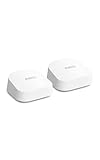
The Deco X55 is the best mesh wifi router for students in a shared house, pairing Wi-Fi 6 AX3000 speeds with the longest coverage claim in this set and a 2-year warranty.
Best for: students in a shared house who need coverage across several rooms Skip it if: you live in a single dorm room
What sets the X55 apart in this group is balance. It's the only Wi-Fi 6 three-pack here, and TP-Link rates it at AX3000 with a 6,500 sq ft coverage claim, the highest of any pick. The listing says each unit carries 3 Gigabit Ethernet ports, so you can wire a desktop or console straight in. It also claims support for up to 150 connected devices, more than any rival here states. The whole three-pack weighs 5.07 lb, and each cube measures 4.49 x 4.33 x 4.33 in, small enough to tuck on a shelf.
It sits at a mid price position, the third-cheapest of the five, and it's the system buyers reach for most often in this group. TP-Link backs it with a 2-year warranty, matching the longest term here. Released in 2022, it's the sweet spot between the aging Wi-Fi 5 Deco S4 and the pricier Wi-Fi 7 units. The trade-off: it's three units, so in a single room you're paying for coverage you'll never use.
Pros:
- Highest coverage claim in the set at 6,500 sq ft
- Wi-Fi 6 AX3000 with a 2-year warranty
- 3 Gigabit Ethernet ports per unit
- Claims support for up to 150 devices
- Mid price position, not premium
Cons:
- Overkill for a single dorm room
- Heavier three-pack at 5.07 lb
- No Wi-Fi 7 for future-proofing
2. Amazon eero 6 — Best budget pick
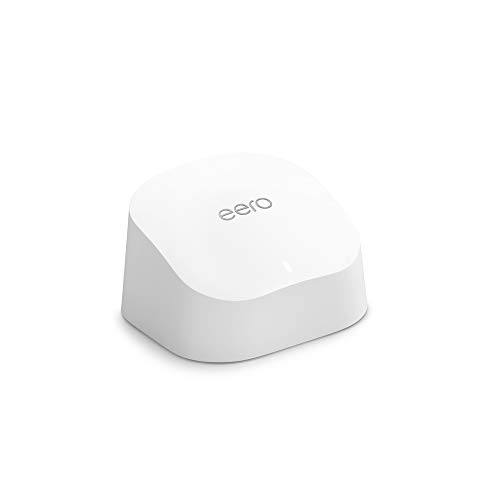
The eero 6 is the cheapest pick here and the right call for a single room, covering up to 1,500 sq ft from one 0.66 lb unit.
Best for: one-room dorm dwellers on a tight budget Skip it if: you need to cover more than one floor
This is the pick for students who don't actually need mesh but might expand later. It's the cheapest of the five and the smallest, at 0.66 lb and 2.42 x 3.91 x 3.82 in. eero says it covers up to 1,500 sq ft, supports internet plans up to 900 Mbps, and handles 75+ devices on Wi-Fi 6. For a dorm room, that's more than enough. It ships as a single router, so you're not paying for nodes you won't place.
There's a bonus buyers overlook: eero states a built-in Zigbee smart home hub that works with Alexa, so smart bulbs and plugs connect without a separate hub. Only one seller lists this model. The catch is that it's a single unit rated for one room, and no warranty is published for it, unlike the two-year term on both TP-Link picks. Buy it for a room, not a house.
Pros:
- Cheapest pick in the set
- Lightest at 0.66 lb
- Supports plans up to 900 Mbps
- Built-in Zigbee smart home hub claim
Cons:
- Single unit covers just one room
- No published warranty
- Only one seller lists it
3. TP-Link Deco S4 — Best warranty
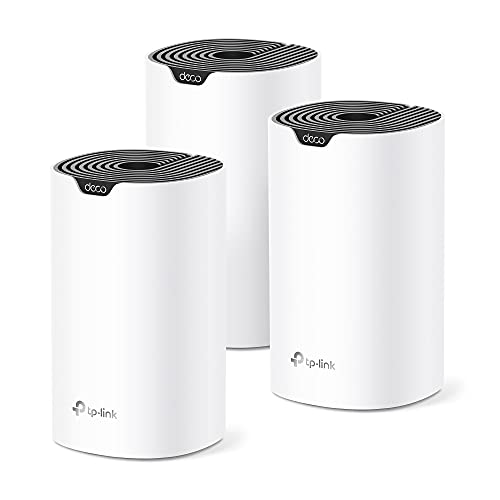
The Deco S4 is a three-pack that covers up to 5,500 sq ft and carries a 2-year warranty at an entry price, if you can live with Wi-Fi 5.
Best for: renters wanting simple three-unit coverage with a long warranty Skip it if: your plan is faster than AC1900 can carry
The S4 is the value three-pack. It's the second-cheapest here and sits in the entry price range, yet it still ships three units and claims 5,500 sq ft of coverage. TP-Link rates it at AC1900 across three streams and says it handles up to 100 devices. Each unit is taller than the X55 at 6.39 x 3.57 x 3.57 in, and the three-pack weighs 4.2 lb. Released in 2020, it runs the older Wi-Fi 5 standard.
Its real edge is the warranty paired with the price. It carries the same 2-year term as the X55 while costing less, which is why it earns the warranty label. But Wi-Fi 5 is the compromise. If your plan is under a few hundred Mbps and you just need whole-house coverage without dead zones, it delivers. Push a faster plan through it and the X55's Wi-Fi 6 will pull ahead. It's also the slowest seller of the five, so it's less proven in this group.
Pros:
- Entry price for a full three-pack
- 2-year warranty matches the X55
- Coverage claim up to 5,500 sq ft
- Claims up to 100 connected devices
Cons:
- Wi-Fi 5 AC1900 caps its ceiling
- Slowest seller of the five
- Bulkier per-unit body than the X55
4. Amazon eero 7 — Best upgrade
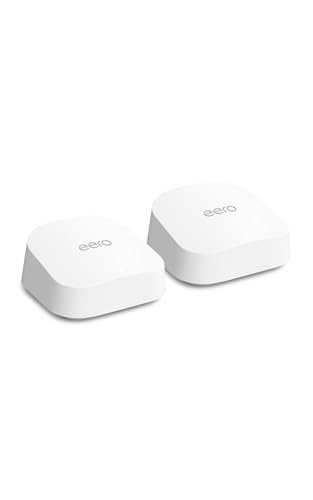
The eero 7 is the affordable way into Wi-Fi 7, a 2-pack rated for plans up to 2.5 Gbps and 4,000 sq ft of coverage.
Best for: students with a fast plan who plan to keep the router for years Skip it if: your internet is under a gigabit
If you're buying once and keeping it through several moves, the eero 7 is the future-proof choice. It's the newest eero here, released in 2025, and runs Wi-Fi 7. eero says it supports internet plans up to 2.5 Gbps through two auto-sensing 2.5 GbE ports, with wireless speeds up to 1.8 Gbps. The two-pack claims 4,000 sq ft and 120+ devices. Each unit weighs 1.34 lb and measures 5.12 x 5.12 x 2.52 in.
It sits in the premium price range, the fourth-cheapest of the five, so it costs more than the mid-range X55 for a two-pack instead of three. eero says it's backward compatible with older eero units, handy if you already own one. The honest problem for a student: Wi-Fi 7 only pays off if your internet plan is genuinely fast, and most student plans aren't. Below a gigabit, you're buying headroom you can't use yet. No warranty is published for it either.
Pros:
- Wi-Fi 7 with plans up to 2.5 Gbps
- Two 2.5 GbE ports
- Coverage claim up to 4,000 sq ft
- Backward compatible with older eero units
Cons:
- Premium price for only two units
- Wi-Fi 7 wasted on slower plans
- No published warranty
5. NETGEAR Orbi 370 — Best premium
The Orbi 370 is the top-tier pick, a Wi-Fi 7 three-pack claiming 6,000 sq ft and support for up to 70 devices.

Best for: a large shared house with many devices online at once Skip it if: you want a warranty longer than one year
The Orbi 370 is the most expensive pick here and the most ambitious. It's a Wi-Fi 7 three-pack, released in 2025, that NETGEAR rates at up to 6,000 sq ft. The listing claims speeds up to 5 Gbps, calls that 2.4 times faster than Wi-Fi 6, and says it's ready for plans up to 2.5 Gbps. NETGEAR describes dual-band technology with enhanced backhaul to keep every device fast at once.
For a big student house where six people stream and game simultaneously, that headroom matters. But the details temper it. It claims support for up to 70 devices, the lowest of any pick that states a figure, well below the X55's 150. Its warranty is only 1 Year Limited, the shortest here and half the term on the TP-Link systems. It's also the slowest seller of the five. You're paying premium for Wi-Fi 7 speed while giving up warranty length and device headroom the cheaper X55 already beats.
Pros:
- Wi-Fi 7 three-pack for a large house
- Coverage claim up to 6,000 sq ft
- Speed claim up to 5 Gbps
- Ready for plans up to 2.5 Gbps
Cons:
- Most expensive pick in the set
- Only a 1-year limited warranty
- Device claim of 70 trails rivals
- Slowest seller of the five
One unit or three: what your space decides
The single biggest mistake in this category is buying the wrong number of units. Coverage claims are marketing ceilings, not room measurements. Here's how to match unit count to your living space.
- One dorm room, modem nearby. Buy a single unit. The eero 6 at up to 1,500 sq ft covers it, and you skip paying for two extra nodes.
- A small apartment, one floor. A single unit or a light two-pack works. The eero 7 two-pack claims 4,000 sq ft, though that's premium spend for a small space.
- A shared house, two floors. This is where three-packs earn their keep. The Deco X55 claims 6,500 sq ft and the Deco S4 claims 5,500 sq ft.
- A big house, many roommates. Three units plus device headroom. The X55 claims 150 devices, the Orbi 370 claims 70.
The rule is simple. Every extra node is money you spend to fight distance and walls. If you don't have distance and walls, don't spend it.
What Wi-Fi 6 versus Wi-Fi 7 buys a student
Wi-Fi 7 sounds like the obvious upgrade. For most students it isn't. The standard only helps if your internet plan and devices can use it, and student plans rarely can.
- Wi-Fi 5 (AC1900): the Deco S4. Fine for plans under a few hundred Mbps and basic streaming.
- Wi-Fi 6 (AX3000): the Deco X55 and eero 6. The practical sweet spot, rated for plans up to 900 Mbps on the eero.
- Wi-Fi 7: the eero 7 and Orbi 370. Both are built for plans up to 2.5 Gbps.
The deciding question is your plan speed, not the standard's name. If your building's internet tops out at a few hundred Mbps, a Wi-Fi 7 router spends its extra capability on nothing. That's why the Wi-Fi 6 X55 wins overall. It matches typical student plans, keeps the price mid-range, and adds a 2-year warranty the premium picks can't match on term length.
What the listings do not tell you
A spec sheet hides a few things a student should weigh before buying the best mesh wifi router for students.
The Orbi 370 and both eero units publish no per-unit port count in this data, while the Deco X55 lists 3 Gigabit Ethernet ports per node. If you plug in a desktop or console, ports matter. The eero models also require the eero app to set up and manage, which ties your network to an account. That's convenient but worth knowing.
Warranty coverage is uneven. Both TP-Link picks list a 2-year term. The Orbi 370 lists 1 Year Limited. Neither eero publishes one here at all. For a device you'll move between rentals, a longer warranty is real value. Finally, availability varies: only one seller lists each eero, while the TP-Link and NETGEAR systems show two sellers each.
The verdict
If you live in a shared house or a multi-floor apartment, the TP-Link Deco X55 is the pick. It's a Wi-Fi 6 AX3000 three-pack with the highest coverage claim in this set at 6,500 sq ft, a 150-device claim, 3 Gigabit ports per unit, and a 2-year warranty, all at a mid price. Nothing else here matches that combination of coverage, ports, and warranty for the money.
If you live in a single dorm room, the eero 6 is the better buy. It's the cheapest pick, the lightest at 0.66 lb, and its 1,500 sq ft claim covers one room with room to spare. Buying a three-pack for a single room wastes money on nodes you'll never place.
The cutoff is your space and your plan. Below one floor and under a gigabit, the eero 6 wins. Above one floor, the X55 wins. Only reach for the Wi-Fi 7 eero 7 or Orbi 370 if your plan genuinely runs past a gigabit, because otherwise you pay premium prices for speed your internet can't feed. For most students, the X55 is the right default.
FAQ
Is a mesh wifi router worth it for a student?
A mesh wifi router is worth it for a student only when your space needs it. In a single dorm room with the modem nearby, a one-unit system like the eero 6 covering up to 1,500 sq ft is plenty. In a shared house with multiple floors, a three-pack like the Deco X55 at 6,500 sq ft earns its cost by killing dead zones.
How much coverage does the best mesh wifi router for students need?
The coverage the best mesh wifi router for students needs depends on your rooms, not a headline number. A dorm room needs around 1,500 sq ft, which the single eero 6 claims. A shared house with two floors needs a three-pack: the Deco X55 claims 6,500 sq ft and the Deco S4 claims 5,500 sq ft. Match the claim to your actual space.
Does the TP-Link Deco X55 support fast internet plans?
The TP-Link Deco X55 supports fast plans through Wi-Fi 6 AX3000, rated for whole-home speed with 3 Gigabit Ethernet ports on each unit for wired connections. TP-Link claims it handles up to 150 devices. For typical student plans under a gigabit, its Wi-Fi 6 ceiling is more than enough, which is why it leads this comparison.
Deco X55 or eero 6: which should a student pick?
Deco X55 or eero 6 comes down to space. The eero 6 is one unit covering up to 1,500 sq ft, cheapest here, and ideal for a single dorm room. The Deco X55 is a three-pack claiming 6,500 sq ft with a 2-year warranty, built for a shared house. Choose the eero for a room, the X55 for a house.
Do I need Wi-Fi 7 for a student mesh system?
You need Wi-Fi 7 for a student mesh system only if your plan is genuinely fast. The eero 7 and Orbi 370 both support plans up to 2.5 Gbps, but most student internet runs far slower. Below a gigabit, that capability sits idle. The Wi-Fi 6 Deco X55 matches typical student plans and costs less.
Start by measuring your actual living space and checking your internet plan speed, then buy to match. Most students in a shared house are best served by the TP-Link Deco X55, because its Wi-Fi 6 AX3000 speed, 6,500 sq ft coverage claim, and 2-year warranty land at a mid price that beats the premium picks on value. If you're in one dorm room, save the money and grab the single eero 6. And before you order anything, confirm your housing actually allows a personal router. That one check saves the whole purchase.