Best High Performance USB Hub by Port Count and Speed
Seven powered and bus-powered hubs compared on published port counts, transfer speeds and included power adapters, with a named winner and the conditions that flip the pick to something else.

By Lamar CalhounUpdated 18 min read
On this page
- Best high performance usb hub at a glance
- Which buyer profile do you fit?
- Does 10Gbps actually change anything for you?
- 1. SABRENT 10-Port 60W Powered USB 3.0 Hub — Best overall
- 2. ACASIS 16 Ports Powered USB 3.2 Hub — Best premium
- 3. intpw Powered USB Hub 10Gbps — Best for heavy use
- 4. Powered USB Hub, Wenter 11-Port USB Splitter Hub — Best for families
- 5. Anker USB Hub, 4-in-1 USB Splitter — Most versatile
- 6. SABRENT 4-Port Powered USB 3.0 Hub — Best lightweight
- 7. Acer USB Hub 4 Ports — Best budget pick
- Powered or bus-powered: what decides it
- What the listings do not tell you
- What more money buys across these seven
- The verdict
- FAQ
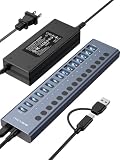
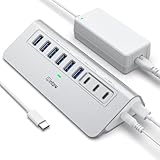
The best high performance USB hub for most desks is the SABRENT 10-Port 60W Powered USB 3.0 Hub, because ten switched 5Gbps ports and a 60W 12V/5A adapter cover a full peripheral load without starving anything. If you need USB-C sockets rather than USB-A, the ACASIS 16 Ports Powered USB 3.2 Hub splits its 16 ports evenly between the two shapes at a claimed 10Gbps.
This is not the category for you if your laptop has one USB-C port and you need HDMI or Ethernet out of it. That is a docking station, and none of these seven picks does video. These are port multipliers. Buy one when you have peripherals and nowhere to plug them.
Best high performance usb hub at a glance
| Pick | Ports | Speed claim | Price |
|---|---|---|---|
Best overall SABRENT 10-Port 60W Powered USB 3.0 Hub |
10 USB-A 3.0 | 5Gbps | Check Price |
Best premium ACASIS 16 Ports Powered USB 3.2 Hub |
8 USB-A + 8 USB-C | 10Gbps claim | Check Price |
Best for heavy use intpw Powered USB Hub 10Gbps |
9 total, 7 data 2 PD 45W |
10Gbps claim | Check Price |
Best for families Wenter 11-Port USB Splitter Hub |
10 data + 1 charge | 5Gbps class | Check Price |
Most versatile Anker USB Hub, 4-in-1 USB Splitter |
4 USB-A 3.0 | 5Gbps | Check Price |
Best lightweight SABRENT 4-Port Powered USB 3.0 Hub |
4 USB-A 3.0 | 5Gbps | Check Price |
Best budget pick Acer USB Hub 4 Ports |
4 USB-A 3.0 | 5Gbps | Check Price |



Which buyer profile do you fit?
I sorted these seven by the shape of the desk they belong on, not by specification alone. Four profiles cover almost everyone shopping for a high performance usb hub.
- The loaded desktop. Ten or more things live plugged in permanently: keyboard, mouse, webcam, microphone interface, two external drives, a card reader, a printer. You want ports and you want individual switches so a drive can sleep without being unplugged. The Sabrent 10-port and the Wenter 11-port both fit.
- The USB-C convert. Newer peripherals ship with C cables and you are tired of adapters. Only the ACASIS answers this properly, with 8 USB-C ports alongside its 8 USB-A.
- The laptop dock-lite. One box on the desk, data ports plus somewhere to charge a phone at speed. The intpw hub's two dedicated PD 45W charging ports are built for exactly this.
- The bag carrier. You need four extra ports and you need them to weigh nothing. The Acer at 1.6 oz and the Anker at 1.76 oz are the two picks here.
Three of the seven are bus-powered or lightweight enough to travel. Four ship with a wall adapter. That split is the first fork in the decision, and it matters more than the transfer figure.
Does 10Gbps actually change anything for you?
Two of the seven claim 10Gbps: the ACASIS and the intpw. The other five are 5Gbps USB 3.0 class. Roundups love this number because it's the biggest one on the box, and it is usually the least relevant thing about a high performance usb hub.
Here is the honest version. A keyboard, mouse, webcam, printer, microphone, game controller or USB flash drive will never saturate 5Gbps. Not one of them comes close. The transfer speed only earns its keep when the device on the other end can read or write faster than roughly 500 MB/s, which in practice means an NVMe external SSD.
So the test is short:
- Do you own an external NVMe SSD? The 10Gbps ports are worth paying for.
- Do you own spinning external drives, SATA SSDs or flash sticks? 5Gbps is not your bottleneck.
- Are you mostly plugging in input devices? Ignore the figure entirely.
One more thing the specification sheet hides. Every port on a hub shares the single upstream connection to your computer. A 10Gbps hub with two SSDs copying at once splits that 10Gbps between them. The ACASIS advertises 16 ports at 10Gbps, and that is 16 ports sharing one 10Gbps pipe, not 16 independent lanes. Same logic applies to the Sabrent's ten 5Gbps ports. Port count buys you convenience. It does not multiply bandwidth.
1. SABRENT 10-Port 60W Powered USB 3.0 Hub — Best overall
Ten switched USB 3.0 ports and a 60W 12V/5A adapter make this the pick that handles a fully loaded desk without rationing power.

Best for: a desk with ten always-connected peripherals Skip it if: you need USB-C ports on the hub itself
The number that separates this from the rest of the set is the adapter: 60W at 12V/5A. Spread across ten ports, that is real headroom, and it is the reason a bus-powered 2.5-inch drive stands a chance here where it would fail on the Anker or the Acer. Sabrent lists 5Gbps transfer over USB 3.0 with backward compatibility down to USB 2.0 and 1.1.
Each of the ten ports gets its own power switch and a blue LED. That sounds like a small feature until you have three external drives on one hub and want to spin down two of them. Sabrent also says no drivers are required on Windows, macOS or Linux.
The body measures 3.3 x 7.4 x 3.7 in, so it is a desk fixture, not a bag item. It carries a 1 Year limited warranty, which is the shortest coverage among the four powered picks here. The trade-off against the ACASIS is plain: this is USB-A only at 5Gbps, and it is a 2018 design. You are buying capacity and control, not the newest connector standard.
Pros:
- Ten USB 3.0 ports, most of any USB-A-only pick here
- 60W 12V/5A adapter included in the box
- Individual power switch and LED per port
- No driver install on Windows, macOS or Linux
- Backward compatible with USB 2.0 and 1.1
Cons:
- No USB-C ports at all
- 5Gbps, half the ACASIS and intpw claim
- 1 Year limited warranty, shortest of the powered picks
- 3.3 x 7.4 x 3.7 in footprint eats desk space
2. ACASIS 16 Ports Powered USB 3.2 Hub — Best premium
Sixteen ports split evenly between USB-A and USB-C, with a 96W adapter and the longest warranty in this set.
Best for: a workbench or studio running a large peripheral fleet Skip it if: you want something you can throw in a bag
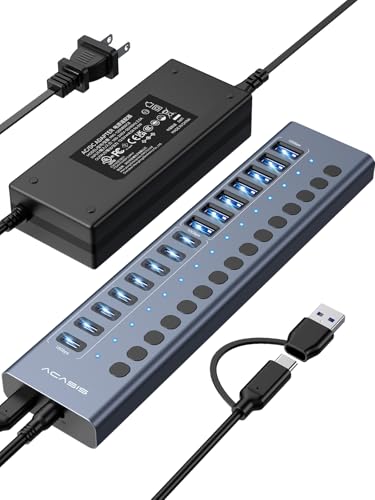
This is the most expensive pick here, and the port layout explains why. ACASIS lists 8 USB-A 3.2 ports and 8 USB-C 3.2 ports, all claimed at 10Gbps. No other hub in this set offers USB-C data ports at all, which makes it the only real answer if half your cables end in C.
The 96W power adapter is the largest supplied brick of the seven, though ACASIS states each port delivers up to 5V/1.5A. Read that carefully: 1.5A per port is fine for charging a phone slowly and plenty for peripherals, but it is not fast charging. The housing is aluminium alloy, which ACASIS says helps heat dissipation, and each 10Gbps port gets an independent switch. Compatibility is listed for Windows XP through 11, macOS and Linux.
It weighs 1.6 lb and measures 1.97 x 7.87 x 3.54 in, making it the heaviest pick by a wide margin. The 2 Year Warranty is the longest here. Against the Sabrent, you get six more ports and both connector types. Against the intpw, you lose dedicated high-wattage charging.
Pros:
- 16 ports, most in this set
- Only pick with USB-C data ports, eight of them
- 96W adapter, largest supplied here
- 2 Year Warranty, longest of the seven
- Aluminium alloy housing with independent port switches
Cons:
- Most expensive pick in this set
- 1.6 lb and 7.87 in long, not portable
- Per-port output capped at 5V/1.5A, so no fast charging
- 10Gbps is a manufacturer claim shared across one upstream link
3. intpw Powered USB Hub 10Gbps — Best for heavy use
Two dedicated PD 45W charging ports alongside seven data ports, which is the closest thing here to a hub and charger in one box.

Best for: a laptop desk that needs data and phone charging in one box Skip it if: you expected all nine ports to move data
The mix here is unusual and worth reading twice. intpw lists 1 USB-C 3.2 at 10Gbps, 2 USB-A 3.2 at 10Gbps, 4 USB-A 3.0 at 5Gbps, and 2 USB-C PD 45W charging ports that the brand explicitly says do not carry data. So nine ports, seven of which move files.
Those two PD 45W ports are the differentiator. No other pick in this set offers charging at that wattage. The ACASIS gives you more sockets but caps each at 5V/1.5A, so if a phone or tablet needs to go from empty to usable while you work, this is the hub that does it. The bundled adapter is 65W at 20V/3.25A.
The body is a one-piece aluminium wedge at a 32-degree angle, which intpw says is made with over 50% recycled materials, and it sits on feet. At 1.26 lb and 7 x 2.5 x 1 in it is the slimmest of the powered picks. Warranty is 18 months, second longest here. The trade-off: two of your nine ports are charge-only, so effective data expansion trails both the Sabrent and the ACASIS.
Pros:
- Two dedicated PD 45W charging ports, unique in this set
- Three ports claimed at 10Gbps
- 65W 20V/3.25A adapter included
- Angled aluminium body with over 50% recycled content
- 18-month warranty
Cons:
- Only seven of nine ports carry data
- 7 in long body still needs permanent desk space
- Mixed 10Gbps and 5Gbps ports mean you must pick the right socket
- Second most expensive pick here
4. Powered USB Hub, Wenter 11-Port USB Splitter Hub — Best for families
Eleven ports with individual LED switches and one dedicated smart charging port, at roughly mid-range for this set.

Best for: a shared computer with a rotating cast of phones and drives Skip it if: you want published weight and size figures before buying
The layout is 10+1: ten USB 3.0 data ports plus one smart charging port that Wenter positions for tablets, cameras and phones. That is one more data port than the Sabrent overall winner, at a lower price position. On a family machine where three people plug in three different things, having ten sockets and eleven switches is genuinely useful.
Every port gets its own on/off switch with an LED, so you can cut power to a drive without pulling the cable. Wenter lists compatibility with Windows XP through 10, macOS and Linux 9 and above, and support for USB 3.0, 2.0 and 1.1 devices. A power adapter is included.
This is also the thinnest listing of the seven. There is no published weight, no published dimensions, no stated warranty and no stated adapter wattage, where the Sabrent and intpw publish all four. If you want to know whether it fits behind your monitor before it arrives, the information is not there. It also does not state a transfer figure above the USB 3.0 class standard, and the charging port has no wattage attached, so treat "smart charging" as the brand's phrase rather than a number you can plan around.
Pros:
- Eleven ports, ten of them data
- Individual LED on/off switch per port
- Dedicated charging port separate from the data ports
- Roughly mid-range price position for eleven ports
- Broad OS compatibility back to Windows XP
Cons:
- No published weight, dimensions or warranty
- Adapter wattage not stated
- Charging port has no listed output figure
- 5Gbps class only, no USB-C anywhere
5. Anker USB Hub, 4-in-1 USB Splitter — Most versatile
A bus-powered four-port splitter that works on almost anything with a USB-A socket, including consoles.

Best for: moving between a laptop, a console and a desktop Skip it if: anything you plug in needs power from the hub
The appeal here is that there is nothing to plug into a wall. One USB-A cable in, four USB-A ports out, 5Gbps transfer. It weighs 1.76 oz and the listed dimensions are 0.39 x 27.7 x 1.18 in, that long figure being the attached 2 ft cable. Drop it in a bag and forget it.
Anker is explicit that this hub is not designed to charge devices, and that single line decides who should buy it. Keyboards, mice, controllers, flash drives and card readers all work. A bus-powered portable hard drive is asking for trouble, because everything shares the power available from one host port. Anker describes the build as precision-designed for heat resistance and durability, and the 18-month warranty matches the intpw for second longest here.
Versatility is what earns the label. Because it needs no mains power, it works on a desktop, a laptop on a plane tray, or a console where a wall brick would be awkward. Against the Sabrent 4-port, you lose the individual switches and the included adapter. Against the Acer, you gain warranty length and lose a little on price position.
Pros:
- Bus-powered, no wall adapter to carry
- 1.76 oz, easy to pack
- 5Gbps across all four USB-A ports
- 18-month warranty, longer than either Sabrent pick
- 2 ft attached cable reaches around a tower
Cons:
- Explicitly not designed to charge devices
- No individual port switches or LEDs
- Four ports only, fewest alongside the Acer
- Cable is fixed, so damage means replacing the hub
6. SABRENT 4-Port Powered USB 3.0 Hub — Best lightweight
Switched, powered and just 1.5 oz, and the listing ships a count of 2 rather than one unit.

Best for: a second desk or a travel bag that still needs switched ports Skip it if: four ports will not cover your peripherals
At 1.5 oz this is the lightest pick of the seven, and it manages that while still including a mains adapter rated at 2.5 Amp. That combination is rare. The Anker and Acer are similarly light but bus-powered, while the Sabrent 10-port and ACASIS are powered but heavy. This one sits in the middle and covers a small setup properly.
Each of the four ports gets a power switch with an LED indicator, the same control scheme as the flagship 10-port model. Sabrent lists 5Gbps on USB 3.0, 480Mbps on USB 2.0 and 12Mbps on USB 1.1, and describes it as plug and play with hot swapping. Dimensions are 2.08 x 3.51 x 5.12 in.
The listing shows a count of 2, so you are getting a pair rather than a single hub. That is the reason it lands third-cheapest here despite being a powered, switched design. The catch is age and capacity: this is a 2015 design with four ports, a 1 year limited warranty and a 2.5A supply that is modest next to the 60W and 96W bricks further up this list. Buy it for a laptop corner, not a main workstation.
Pros:
- 1.5 oz, lightest pick in this set
- Includes a 2.5 Amp power adapter
- Individual power switch and LED per port
- Listing count of 2 units
- Hot swappable, no drivers needed
Cons:
- Four ports only
- 2.5A supply is small next to the larger powered picks
- 2015 design, oldest here
- 1 year limited warranty
- No USB-C
7. Acer USB Hub 4 Ports — Best budget pick
The cheapest of the seven, and a 0.35 in thick body that disappears into a laptop sleeve.

Best for: adding a few ports to a laptop for the least outlay Skip it if: you plan to run a bus-powered hard drive
Four USB 3.0 ports at 5Gbps, a 2 ft cable, 1.6 oz, and dimensions of 0.35 x 4.13 x 1.18 in. That is the whole product, and for a lot of laptop owners it is enough. Acer names the controller as a GL3510 chip and says the thermal design keeps devices and data safe, which is more specific than most listings in this set manage.
There is no power adapter, so all four ports draw from your computer's single host port. Flash drives, a mouse, a keyboard, a printer and a card reader are all fine. A bus-powered 2.5-inch drive is where bus-powered hubs disappoint, and this one has no switches or LEDs to help you manage the load either. Acer lists compatibility across laptops, PS4 and Xbox alongside standard desktops.
The warranty is 1 year manufacturer, matching both Sabrent picks and trailing the 18 months on the Anker and intpw. Against the Anker, the two are close on paper: same port count, same speed, similar weight. The Acer wins on price position and thickness, the Anker on warranty and stated durability engineering. Neither will charge anything meaningfully.
Pros:
- Cheapest of the seven
- 0.35 in thick, thinnest pick here
- 1.6 oz with a 2 ft cable
- Named GL3510 controller with stated thermal design
- Listed as working with PS4 and Xbox
Cons:
- Bus-powered, so no help for power-hungry drives
- No port switches or LED indicators
- 1 year manufacturer warranty, shorter than the Anker
- Four ports and 5Gbps only
Powered or bus-powered: what decides it
Forget the speed claim for a moment. The question that actually splits these seven is whether the hub brings its own electricity.
A bus-powered hub takes everything from one port on your computer. That budget is small and it is shared. Plug in four low-draw devices and it works perfectly. Add a spinning external drive and you get disconnects, failed mounts or a drive that clicks and gives up mid-copy. The Anker listing states outright that it is not designed to charge devices, and the Acer has no adapter either.
A powered hub has its own brick. The supplied wattages here are 96W on the ACASIS, 65W on the intpw, 60W on the Sabrent 10-port and 2.5 Amp on the Sabrent 4-port, with the Wenter including an adapter of unstated rating.
Use this rule:
- Only input devices and flash drives? Bus-powered is fine and saves you an outlet.
- Any bus-powered hard drive, SSD enclosure or DAC? Powered, no exceptions.
- Charging a phone or tablet from the hub? Powered, and check the per-port figure.
- More than six ports? Powered, because the host budget will not stretch.
That last one is why every pick above four ports in this set ships with an adapter.
What the listings do not tell you
Reading seven listings side by side, the gaps are as informative as the specifications. Things you will not find published, and how to handle them:
- Whether ports are spaced for fat plugs. A row of ports at standard pitch will refuse two wide USB flash drives side by side. The Sabrent 10-port's 7.4 in length and the intpw's 7 in body suggest more room than the compact four-port picks, but none of these listings publishes port pitch.
- Cable length on the powered units. The Anker and Acer both state 2 ft. The upstream cable length on the Sabrent, ACASIS, intpw and Wenter is not given, which matters if your tower is under the desk.
- Real-world heat. ACASIS cites aluminium alloy for heat dissipation, intpw an aluminium one-piece body, Acer a GL3510 chip with thermal design. All three are claims about design, not measurements.
- Whether switches cut data or only power. Every switched pick here describes on/off power control. Whether the device disappears from your operating system cleanly is not stated.
- How the Wenter's charging port behaves. "Smart charging" appears with no wattage attached anywhere in the listing.
When a figure is missing, treat it as unknown rather than adequate. Two of the four powered picks publish full dimensions and weight. One publishes almost nothing.
What more money buys across these seven
Move up the price ladder in this set and the money goes to three things, in this order: port count, an included power supply, and connector variety.
At the entry positions you get the Acer, the Anker and the Sabrent 4-port. Four USB-A ports at 5Gbps each, all light enough to travel. The Sabrent is the outlier because it adds a 2.5A adapter and switches while still weighing 1.5 oz, and the listing count of 2 is part of why it sits where it does.
In the middle sits the Wenter, and the step up is bluntly quantitative: eleven ports instead of four, individual switches on all of them, and a bundled adapter. You do not get a faster interface or better documentation. You get sockets.
At the top, three picks compete. The intpw spends the money on charging, with two PD 45W ports and three 10Gbps data ports. The Sabrent 10-port spends it on capacity and a 60W supply. The ACASIS spends it on both connector types, sixteen ports, a 96W adapter and a 2 Year Warranty.
The thing you never buy with more money in a high performance usb hub is additional bandwidth to your computer. That stays at one upstream link no matter which of the seven you pick.
The verdict
Entry tier: the Acer USB Hub 4 Ports is the least you can spend and still get four working USB 3.0 ports at 5Gbps in a 0.35 in thick body. Add a little and the Sabrent 4-Port Powered USB 3.0 Hub brings a 2.5 Amp adapter, per-port switches and a listing count of 2, which makes it the smarter buy for anyone who might plug in a drive. The Anker sits alongside them with an 18-month warranty and an explicit warning that it charges nothing.
Middle tier: the Wenter 11-Port hub gives you ten data ports plus a charging port and eleven switches for a mid-range price position. Accept the thin documentation and it is the most sockets per dollar here.
Premium tier: the SABRENT 10-Port 60W Powered USB 3.0 Hub is the winner and the sensible default, because ten switched ports and a 60W 12V/5A adapter solve the actual problem most crowded desks have. The ACASIS 16 Ports Powered USB 3.2 Hub takes it if you need USB-C data ports, since it is the only pick with any, and it adds a 2 Year Warranty and a 96W supply. The intpw takes it if phone charging at PD 45W matters more than two extra data ports.
FAQ
Is a high performance usb hub worth it over a cheap splitter?
A high performance usb hub is worth it once you plug in anything that draws real current. The difference is the included adapter: 60W on the Sabrent 10-port, 96W on the ACASIS, 65W on the intpw. A cheap unpowered splitter shares one host port's budget across every device, which is where external drives start dropping off mid-transfer.
How many ports do I actually need?
How many ports you need is your current peripheral count plus two. Count what stays connected permanently, then add headroom for a flash drive and a phone cable. Four ports suits a laptop with a mouse, keyboard and drive. Ten or eleven, as on the Sabrent and Wenter, suits a desktop running webcam, microphone, printer and multiple drives at once.
Will a 10Gbps hub make my external drive faster?
A 10Gbps hub only makes an external drive faster if that drive can already exceed roughly 500 MB/s, which in practice means an NVMe SSD. Spinning drives, SATA SSDs and flash sticks will not notice the difference between the ACASIS or intpw at their claimed 10Gbps and the 5Gbps Sabrent. Match the interface to the drive, not to the box.
Sabrent 10-port or ACASIS 16-port: which should I buy?
Sabrent 10-port or ACASIS: pick on connector shape. The Sabrent gives ten USB-A 3.0 ports at 5Gbps with a 60W adapter for less outlay. The ACASIS is the only pick here with USB-C data ports, eight of them, plus a 96W adapter and a 2 Year Warranty. If your cables end in C, the choice is already made.
What mistake do first-time hub buyers make?
The mistake first-time hub buyers make is expecting a hub to replace a docking station. None of these seven outputs HDMI, DisplayPort or Ethernet. They multiply USB ports and nothing else. The second common error is buying bus-powered, then wondering why a portable hard drive keeps disconnecting. Check for an included adapter before you order.
Start by counting the cables currently fighting over your computer's ports, then add two. If that number is four or five, the Acer or the Sabrent 4-port ends the problem for very little. If it is eight or more, the SABRENT 10-Port 60W Powered USB 3.0 Hub is the one to buy, because ten switched ports and a 60W supply mean you stop thinking about which device gets to stay plugged in. That is the real win here. Not the transfer figure on the box, but never unplugging a drive to make room for a flash stick again.