Best Compact USB Hub for Graphic Designers: Anker Wins
A designer's desk fills up fast: tablet, dongle, backup drive, colour puck, card reader. Here's which compact USB hub actually earns its slot next to the laptop.

By Lamar CalhounUpdated 15 min read
On this page
- Best compact USB hub for graphic designers at a glance
- How I narrowed six hubs down from a crowded category
- What compact really means for a designer's desk
- Bus-powered or wall-powered: which do you actually need?
- USB-A in a USB-C world: is that still fine?
- 1. Anker 4-in-1 USB Splitter — Best overall
- 2. TP-Link UH720 — Best large-capacity
- 3. SABRENT HB-UMP3 — Best for pros
- 4. Plugable USB2-2PORT — Runner-up
- 5. MOGOOD 4-in-1 USB Hub — Best budget pick
- 6. StarTech ST4202USB — Best premium
- What the listings do not tell graphic designers
- The verdict
- FAQ
The best compact USB hub for graphic designers is the Anker 4-in-1 USB Splitter, a 1.28 oz black hub that turns one port into four at up to 5Gbps. If your desk needs nine ports, a charging tablet and a card reader all wired at once, the TP-Link UH720 is the wall-powered alternative that trades pocketability for a 12V/4A brick and a 2-year warranty.
Best compact USB hub for graphic designers at a glance
| Pick | Ports | Powered? | Price |
|---|---|---|---|
Best overall Anker 4-in-1 USB Splitter |
4 USB-A, 5Gbps claim | Bus-powered (data only) |
Check Price |
Best large-capacity TP-Link UH720 |
7 data + 2 charging | 12V/4A adapter | Check Price |
Best for pros SABRENT HB-UMP3 |
4 USB 3.0, per-port switches |
2.5A adapter | Check Price |
Runner-up Plugable USB2-2PORT |
2 USB 2.0 | Bus-powered | Check Price |
Best budget pick MOGOOD 4-in-1 Hub |
1 USB 3.0 + 3 USB 2.0 | Bus-powered | Check Price |
Best premium StarTech ST4202USB |
4 USB 2.0, TAA compliant |
Bus or adapter | Check Price |


How I narrowed six hubs down from a crowded category
USB hubs are a category where Amazon's search returns hundreds of near-identical black rectangles. Trimming that to six meant treating buyer profiles as filters and cutting anything that did not clearly serve at least one of them.
The profiles I mapped the picks to:
- The travelling designer who wants one hub that lives in the sleeve pocket.
- The studio designer whose desk needs many ports powered at once.
- The freelancer running a second, older workstation on a budget.
- The procurement-restricted buyer whose employer requires compliant hardware.
That gave a spread across weight, port count, power and warranty. The Anker at 1.28 oz and the Plugable at 9.07 g anchor the ultra-portable end. The TP-Link at 1.1 lb with its 12V/4A adapter anchors the desk-bound end. The SABRENT sits between them with per-port LED switches, which nothing else in the set offers. The MOGOOD covers the lowest price position. The StarTech ST4202USB is the only pick in the set that publishes TAA compliance, which matters for anyone buying through a GSA schedule.
What did not make it: hubs with no published dimensions, hubs stripped of stated warranty on the listing when a working alternative was available, and models where the ports mix was unclear.
What compact really means for a designer's desk
The best compact USB hub for graphic designers is not automatically the smallest one. Compact has to survive contact with a real workflow: a Wacom or Huion tablet cable, a photo card reader, a licence dongle, a portable SSD holding a working PSD archive, and often a phone that needs a top-up between client calls. Five things, and only four ports on most compact hubs.
That is why the picks split cleanly into two shapes. The first is a cable-style hub, like the Anker 4-in-1 or the MOGOOD, that lives permanently attached to a laptop port and vanishes into the bag. Weight matters. The Anker is 1.28 oz. The Plugable, the smallest by mass in the set, is a 9.07 g nub.
The second shape is a desk brick with a wall adapter. The TP-Link UH720 measures 2.8 x 7.8 x 5.8 in and weighs 1.1 lb; the SABRENT HB-UMP3 is 2.08 x 3.51 x 5.12 in. Neither is going in a jacket pocket, but both hold ports open when a bus-powered hub would brown out.
Pick which shape fits your desk before you pick a brand.
Bus-powered or wall-powered: which do you actually need?
This is the specification that actually decides the purchase, and it is not the port count.
Bus-powered hubs draw everything they deliver from your laptop's single USB port. Anker states plainly that its 4-in-1 "is not designed to charge devices," and the Plugable listing warns it is "bus-powered; no additional AC power required; intended for low or self-powered devices." That is fine for a mouse, a keyboard, a licence dongle, a card reader. It is not fine for two spinning external drives at once.
Wall-powered hubs bring their own supply. The TP-Link UH720 ships with a 12V/4A adapter and adds two dedicated 5V/2.4A charging ports that TP-Link says intelligently identify the connected device. The SABRENT HB-UMP3 ships with a 2.5A adapter and adds a per-port power switch with an LED, so you can cut power to one drive without unplugging it.
Rule of thumb for designers: if your busiest port draws more than a keyboard's worth of current, buy a powered hub.
USB-A in a USB-C world: is that still fine?
Every hub in this set uses USB-A as its host connector, and that is not an accident. USB-A peripherals still dominate a designer's kit bag: Wacom tablets, older card readers, licence dongles, mechanical keyboards, colour calibration pucks. A USB-A hub connects them to a USB-A laptop directly, or to a modern USB-C laptop through a single cheap USB-C-to-A adapter.
The one thing to check on the listing before you buy:
- The host cable length. Anker publishes 0.7 ft, which is short enough to sit tidy but too short to reach across a desk.
- The transfer speed. Anker, SABRENT, MOGOOD and TP-Link claim 5Gbps on their USB 3.0 ports. Plugable and StarTech are USB 2.0 only, capped at 480Mbps.
- The port mix. MOGOOD splits into one USB 3.0 and three USB 2.0 ports, which is fine for a keyboard, mouse and dongle plus one fast drive, but not for two drives.
If you move large PSDs, RAWs or video clips across the hub every day, USB 3.0 speeds are the floor. If the hub is only feeding input devices and a dongle, USB 2.0 is genuinely enough and the Plugable or StarTech will do.
1. Anker 4-in-1 USB Splitter — Best overall
A 1.28 oz cable-style hub that turns one USB-A port into four at up to 5Gbps, with an 18-month warranty behind it.

Best for: designers who want a near-weightless hub that lives in the laptop bag Skip it if: you plug in bus-hungry gear like external SSDs and colour calibrators at the same time
Within this set, the Anker is the pick that best fits the compact usb hub brief for graphic designers who move between locations. At 1.28 oz it is lighter than the SABRENT, the TP-Link and the StarTech combined, and its 0.7 ft integrated cable means there is no second cable to lose. Anker states the four ports run at up to 5Gbps, which is the same headline speed as the SABRENT and the TP-Link and 10 times what the Plugable and StarTech offer. Released in 2023, it is also the newest design in the set. The 18-month warranty sits below the TP-Link's 2 years but above the Plugable's stated lack of coverage.
The trade-off is honest: Anker explicitly says this hub does not charge devices, and it is bus-powered only. A tablet, a mouse, a card reader and a licence dongle work fine together. Two portable SSDs at once do not.
Pros:
- Lightest 4-port option in the set at 1.28 oz
- Integrated 0.7 ft cable, no second cable to pack
- 5Gbps claim on all four ports
- 18-month warranty published
- 2023 design, newest here
Cons:
- Not designed to charge devices, per Anker
- Bus-powered only, so no wall adapter for hungry drives
- 0.7 ft cable is too short to reach across a wide desk
2. TP-Link UH720 — Best large-capacity
Seven USB 3.0 data ports plus two smart charging ports, backed by a 12V/4A adapter and TP-Link's 2-year warranty.

Best for: a studio desk running a tablet, two drives, a card reader and a phone charger Skip it if: you need something you can pocket between coworking spaces
This is the only hub in the set that solves the "too many peripherals, not enough amps" problem outright. Seven USB 3.0 data ports at TP-Link's claimed 5Gbps handle a Wacom, a card reader, two external drives, a keyboard, a mouse and still leave a spare. The two extra 5V/2.4A ports are for charging, and TP-Link says its charging technology identifies the device to deliver the correct current. The listing also mentions overheat, overload, overvoltage and short-circuit protection on the circuit design.
The weight and footprint are the reason it is not the overall winner. At 1.1 lb and 2.8 x 7.8 x 5.8 in, the UH720 is a desk fixture, not a travel accessory. It also needs its own power outlet, which is one more brick under the desk. The 2-year warranty is the longest in this set, matched only by the StarTech.
Pros:
- Nine total ports, most of any pick here
- 12V/4A adapter delivers real power
- Two dedicated smart charging ports
- 2-year warranty, longest in the set
- Multiple protection modes listed
Cons:
- 1.1 lb, heaviest pick here
- Needs a wall outlet, not portable
- Adds a power brick under the desk
- The most expensive pick here
3. SABRENT HB-UMP3 — Best for pros
A powered 4-port USB 3.0 hub whose per-port LED switches let you cut power to one device without unplugging the others.

Best for: designers who want to cut power to individual devices without unplugging them Skip it if: you want a hub that runs off the laptop alone with no brick
The SABRENT is the only hub in this comparison with a per-port power switch. For a designer, that is more useful than it sounds. It means you can safely power down an external SSD without ejecting-then-unplugging, kill power to a webcam when you are not in a call, or cycle a misbehaving USB device without touching your desk cabling. The LED per port also tells you at a glance which devices are live.
SABRENT lists 5Gbps on USB 3.0, with fallback to 480Mbps and 12Mbps, and ships a 2.5A power adapter. At 2.08 x 3.51 x 5.12 in and 1.5 oz it is more compact than the TP-Link and heavier than the Anker. The 1-year limited warranty is shorter than TP-Link's and StarTech's. The trade-off against the Anker is portability: SABRENT is the better desk hub, Anker is the better bag hub.
Pros:
- Individual power switch per port, unique in this set
- LED indicators per port
- 2.5A adapter for reliable power
- 5Gbps USB 3.0 on all four ports
- Compact for a powered hub at 1.5 oz
Cons:
- 1-year limited warranty, shorter than TP-Link's 2 years
- Needs wall power to feed high-draw devices
- Only one seller lists it
4. Plugable USB2-2PORT — Runner-up
A featherweight 9.07 g USB 2.0 splitter that turns one USB-A port into two, ideal for the input-device layer of a second workstation.

Best for: a second machine that only needs a mouse and a keyboard split off one port Skip it if: you move large PSD or RAW files across the hub every day
At 9.07 g the Plugable is by far the smallest hub here by weight, and the only 2-port model. That sounds limiting until you check what it is actually for. Plugable calls it "simple USB expansion for everyday accessories" and pitches it at remote workers and travellers. For a designer, it is the piece that sits behind a Mac mini or a second laptop, splitting one port between a keyboard and a mouse so the other USB-A stays free for a tablet or drive.
Two honest limits keep it out of the top spot. The ports are USB 2.0, capped at 480Mbps, so a fast SSD will bottleneck. And the listing states "no warranty" on the field a competitor might fill with a year or two of coverage, though Plugable's marketing describes lifetime support. It is bus-powered, so it works with self-powered devices only.
Pros:
- 9.07 g, the lightest pick in the set
- Fully plug-and-play across Windows, macOS, Linux, ChromeOS
- No adapter or second cable
- Dimensions of 1.5 x 6.2 x 4.2 in
Cons:
- USB 2.0 only, capped at 480Mbps
- No published warranty in the listing spec
- Only two ports, not enough as a main hub
- Bus-powered, so not for hungry drives
5. MOGOOD 4-in-1 USB Hub — Best budget pick
The cheapest of the six, giving you one USB 3.0 and three USB 2.0 ports in a 0.39 x 2.76 x 1.97 in slim slab.

Best for: students or freelancers spinning up a second workstation on a tight budget Skip it if: warranty coverage and published weight matter to your buying decision
MOGOOD sits at the entry price position and delivers a reasonable spread of ports for it. The 4-in-1 layout is one USB 3.0 port for a fast device such as an SSD or card reader, plus three USB 2.0 ports for keyboard, mouse and dongle. MOGOOD claims the USB 3.0 port hits 5Gbps, which the listing describes as 10 times USB 2.0 speed. The 0.39 x 2.76 x 1.97 in body is slim enough for a laptop sleeve, and it is plug-and-play with no drivers.
The trade-off is what the listing does not tell you. There is no published weight. There is no published warranty. There is no released date on the spec sheet. For a designer whose work depends on the hub, those absences matter. Set against Anker's 18 months of coverage and TP-Link's 2 years, MOGOOD asks you to accept less paperwork for the lowest price in the set.
Pros:
- The cheapest pick here
- 1 USB 3.0 plus 3 USB 2.0 in one slim body
- No drivers needed
- Slim 0.39 in profile
Cons:
- No warranty published on the listing
- No weight figure published
- Only one seller lists it
- Fewer published specifications than any other pick here
6. StarTech ST4202USB — Best premium
A TAA-compliant 4-port USB 2.0 hub that works bus-powered or with the included adapter, backed by a 2-year warranty.
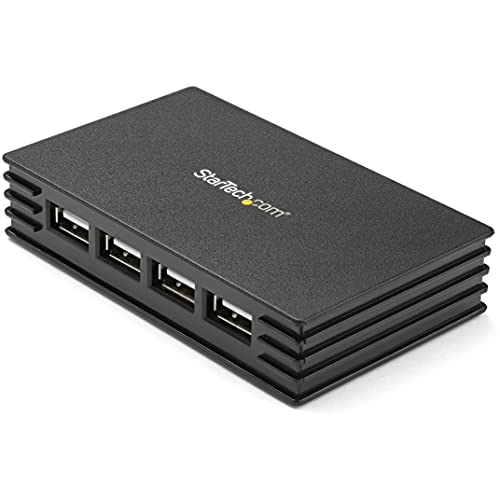
Best for: government, education or enterprise designers who need TAA-compliant purchasing Skip it if: you have no procurement rule that requires TAA compliance
StarTech's ST4202USB is the highest price position in the set, and there is a single specific reason to pay it: TAA compliance. StarTech states the hub "adheres to the requirements of the US Federal Trade Agreements Act (TAA), allowing government GSA Schedule purchases." No other hub in this comparison lists that. If you are a designer working inside a federal agency, a state college or a large enterprise with a compliant-only rule, that one line on the spec sheet is what unlocks the purchase order.
Beyond compliance, the ST4202USB gives you four USB 2.0 ports at 480Mbps, cascadable up to 127 devices, in a 0.8 x 3.9 x 2.4 in body weighing 2.56 oz. It can run bus-powered or with the included adapter, which is genuinely flexible. The 2-year warranty matches the TP-Link. The trade-off, obviously, is speed. USB 2.0 is fine for input devices and a dongle, but it is not fine for fast storage.
Pros:
- TAA compliant, unique in this set
- 2-year warranty, longest in the set
- Runs bus-powered or with adapter
- Compact 2.56 oz body
- Cascadable up to 127 devices per USB 2.0 spec
Cons:
- USB 2.0 only, capped at 480Mbps
- The most expensive pick here
- No 5Gbps ports for fast drives
What the listings do not tell graphic designers
A few things worth checking on the product page before you buy any compact usb hub, because none of them are always spelled out:
- Host cable orientation. The MOGOOD is sold in a "Left Side Version" configuration; on a laptop where your host port is on the right, that matters more than the price does.
- Whether ports are stacked or in-line. Wide connectors on Wacom cables or USB dongles can block adjacent ports on stacked layouts.
- Whether the hub delivers any charging current. Anker states outright its 4-in-1 does not charge devices. TP-Link's UH720 adds two dedicated charging ports at 5V/2.4A. Assume no charging unless the listing says so.
- Whether the wall adapter is included. SABRENT and TP-Link ship theirs. StarTech includes one. Others are bus-only.
- Warranty length as published. Anker publishes 18 months, TP-Link 2 years, StarTech 2 years, SABRENT 1 year limited, Plugable "no warranty" on the spec field, MOGOOD nothing at all.
That last one is the fastest way to sort a hub you can trust for a paid workflow from one you cannot.
The verdict
If you travel with your laptop and want one compact usb hub that vanishes into the sleeve, buy the Anker 4-in-1 USB Splitter. It is 1.28 oz, it claims 5Gbps on all four USB-A ports, its 0.7 ft integrated cable keeps the desk tidy, and Anker publishes 18 months of warranty coverage. That is the winner for the profile in the keyword.
If your desk is fixed and you routinely have a tablet, two drives, a card reader and a phone all wired at once, buy the TP-Link UH720 instead. Nine ports, a 12V/4A adapter, two dedicated 5V/2.4A charging ports, and a 2-year warranty are worth the 1.1 lb footprint you accept in exchange.
The cutoff between them is honest: if your busiest USB device draws more than a mouse or a dongle, and you plug in more than one such device at once, you have crossed into powered-hub territory and the Anker will disappoint you. Below that threshold, the Anker wins on weight, cable neatness and warranty coverage against every other bus-powered option in this comparison.
FAQ
Is a compact usb hub for graphic designers worth buying over a full docking station?
A compact usb hub for graphic designers is worth buying when your peripheral load is USB-A input devices, dongles, card readers and one drive at a time. A dock adds video output, ethernet and power delivery, at three to five times the outlay. If you already have video and power sorted through your laptop's USB-C port, a hub like the Anker 4-in-1 handles the rest at a fraction of the cost.
Can I use a USB-A hub with a modern USB-C-only laptop?
A USB-A hub with a modern USB-C-only laptop works fine through a single USB-C-to-A adapter, which is a cheap accessory. Every hub in this set uses USB-A as its host connector. The alternative, a native USB-C hub, usually adds HDMI and power delivery you may not need, so pairing a USB-A hub with an adapter often costs less and keeps your options open.
Anker 4-in-1 or SABRENT HB-UMP3 for a design workstation?
Anker 4-in-1 or SABRENT HB-UMP3 depends on where the hub lives. The Anker at 1.28 oz travels with the laptop, has an integrated 0.7 ft cable and needs no adapter, but it does not charge devices. The SABRENT stays on the desk, adds per-port LED switches and a 2.5A adapter, and reliably powers hungry devices. Choose Anker for mobility, SABRENT for a fixed desk.
Does a compact usb hub slow down file transfers from an external SSD?
A compact usb hub can slow down file transfers when it uses USB 2.0, which caps at 480Mbps, or when several devices share the same 5Gbps upstream link. The Anker, SABRENT, MOGOOD and TP-Link all claim 5Gbps on their USB 3.0 ports. The Plugable and StarTech ST4202USB are USB 2.0 only. For a designer moving PSDs or RAWs daily, pick 5Gbps.
What compact usb hub feature do graphic designers overpay for?
Compact usb hub feature designers overpay for is total port count. Seven or nine ports look reassuring on the box, but most design setups actively use three or four: tablet, mouse, keyboard, storage. Paying the premium price position for the TP-Link UH720 makes sense only when a phone charger, a card reader and a second drive are also permanent fixtures. Otherwise the Anker's four ports are enough.
Pick the hub that matches how you actually work, not the one with the biggest number on the box. If you move between a laptop bag and a coffee shop, start with the Anker 4-in-1: it weighs almost nothing, publishes a real warranty, and covers the four ports most designers actually use. If your desk is a permanent studio setup with a tablet, drives and a phone charger competing for power, order the TP-Link UH720 and stop worrying about brownouts. The rest of the picks each solve one specific problem, and if your problem is on that list, they are the better buy.