Best Drawing Tablet for Writers Who Handwrite Drafts
Six graphics tablets compared for people who write rather than draw, with the active area, weight and key-count figures that actually decide which one suits a longhand drafting habit.
By Lamar CalhounUpdated 17 min read
On this page
- Best drawing tablet for writers at a glance
- How I weighted the criteria for handwriting, not art
- Does a drawing tablet actually work for writing?
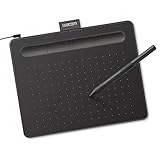
- 1. Wacom Intuos Small — Best overall
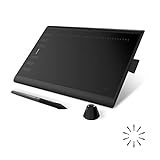
- 2. HUION Inspiroy H1060P Graphics Drawing Tablet — Best minimal setup
- 3. HUION Inspiroy H640P 6x4 inch Drawing Tablet — Best warranty
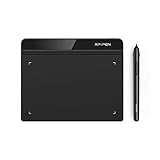
- 4. XP-Pen Drawing Tablet XPPen StarG640 — Best upgrade
- 5. PicassoTab 11" Standalone Drawing Tablet — Best premium
- 6. Kortimu Artist Drawing Glove — Best budget pick
- Active area: how much room does longhand need?
- Shortcut keys are the feature writers actually use
- What the listings do not tell you
- When a different pick wins
- The verdict
- FAQ
The best drawing tablet for writers is the Wacom Intuos Small, because a 6.3 x 7.87 in slab at 0.51 lb sits between keyboard and monitor without displacing either, and its battery-free pen never dies mid-sentence. If you mark up long manuscripts on a big screen, the HUION Inspiroy H1060P and its 10 x 6.25 in active area is the better buy. The deciding specification here is active area against desk space, not pressure levels. Writers move a pen in small, repetitive arcs. Artists sweep.
Best drawing tablet for writers at a glance
| Pick | Active area / screen | Shortcut keys | Price |
|---|---|---|---|
Best overall Wacom Intuos Small |
6.3 x 7.87 in body | 4 ExpressKeys claim | Check Price |
Best minimal setup HUION Inspiroy H1060P |
10 x 6.25 in active | 12 press + 16 soft keys claim | Check Price |
Best warranty HUION Inspiroy H640P |
6 x 4 in active | 6 press keys claim | Check Price |
Best upgrade XP-Pen StarG640 |
6 x 4 in active | None listed | Check Price |
Best premium PicassoTab X11 |
11 in 2K screen | On-screen only | Check Price |
Best budget pick Kortimu Artist Drawing Glove |
Fits 3.34 x 8.07 in hand | Not applicable | Check Price |



How I weighted the criteria for handwriting, not art
I set the weights before I looked at the picks, then compared the published specifications side by side. Four criteria, in order of weight.
- Desk footprint, weighted heaviest. A writer's tablet lives in front of a keyboard, or gets slid over it. Body dimensions matter more than any pen figure.
- Pen power source, second. A battery-free pen has no charge state to forget. Four of these six list one.
- Shortcut key count, third. Undo, save and scroll are the three commands a marking-up session hits constantly.
- Published warranty, last but not ignored. Five of six state one year. One states nothing.
What I deliberately left out: pressure sensitivity. The HUION H640P listing leads with 8192 levels of pen pressure, which is a real number and a real advantage for a painter shading a jawline. Handwriting uses a narrow band of that range. Weighting it would have reordered the list around a spec that does not change how a sentence looks.
I also cut anything that only made sense with a stylus you buy separately. Every drawing tablet for writers on this list ships with its pen included, per the count of one in each listing.
Does a drawing tablet actually work for writing?
Worth being straight about this, because the search phrase promises more than the category delivers. A graphics tablet is an input surface. Your handwriting appears on your monitor, not under the nib. Nothing in these listings claims handwriting recognition, dictation or manuscript software, and I am not going to invent it.
So what does the best drawing tablet for writers actually get you?
- Annotation. Circle a paragraph in a PDF, scrawl "cut this" in a margin, sign a contributor agreement.
- Whiteboarding. Story maps, character webs, act structures drawn freehand instead of typed as bullets.
- Mouse replacement. HUION describes the H640P as a pen tablet that replaces your mouse, and XP-Pen lists e-signatures and Microsoft Office compatibility for the StarG640.
What it does not get you, unless you buy the standalone pick, is the feeling of writing on the thing you are looking at. Your hand is here, the ink appears there. Most people adapt inside a week. Some never do. That gap is the single biggest reason a returned tablet gets returned, and it is why the PicassoTab X11 earns its place at the expensive end of this set.
1. Wacom Intuos Small — Best overall
The smallest footprint here with a stated shortcut-key layout, which is exactly the combination a keyboard-first writer needs.
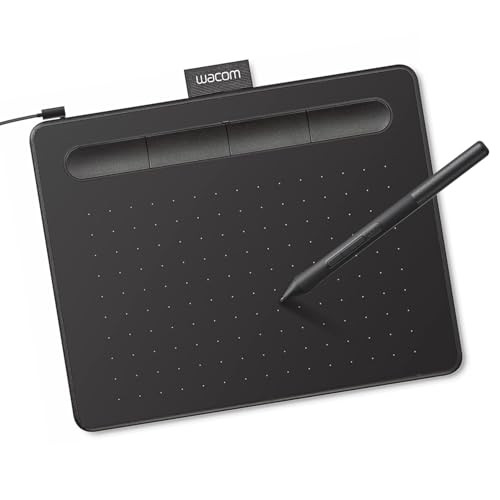
Best for: someone annotating manuscripts beside a keyboard Skip it if: you need a screen you can write directly on
At 0.1 x 6.3 x 7.87 in and 0.51 lb, the CTL4100 is the lightest of the four pen-and-slab options here, and the thinnest alongside the XP-Pen. Those two numbers are the whole argument. A tablet that lives permanently on a desk needs to earn the space, and this one is smaller than a hardback. It weighs less than a full coffee mug, so shifting it from beside the keyboard to on top of the keyboard is a one-handed move you will make forty times a day.
Wacom's own copy leans on its EMR battery-free pen technology and says the pen feels like pen on paper. The battery-free part is the claim that matters for a writer: no charge cycle, no dead stylus at the exact moment an edit lands. The listing also says the tablet works in any software program, which covers the PDF readers and word processors most writing happens in rather than the art apps the marketing images show.
The trade-off is reach. Against the H1060P, this gives up a large chunk of usable surface, so long margin sweeps become several short ones. It is also the second most expensive of the four slabs, and it dates to 2018.
Pros:
- Lightest slab here at 0.51 lb
- Smallest desk footprint, 6.3 x 7.87 in
- Battery-free pen, no charging
- One year manufacturer warranty stated
- Listing claims compatibility with any software
Cons:
- Wired only, no cordless option listed
- Small surface forces short pen strokes
- 2018 model, the oldest dated pick here
- Fewer shortcut keys than either HUION
2. HUION Inspiroy H1060P Graphics Drawing Tablet — Best minimal setup
The 10 x 6.25 in active area and 28 total programmable keys mean fewer trips back to the keyboard than anything else here.
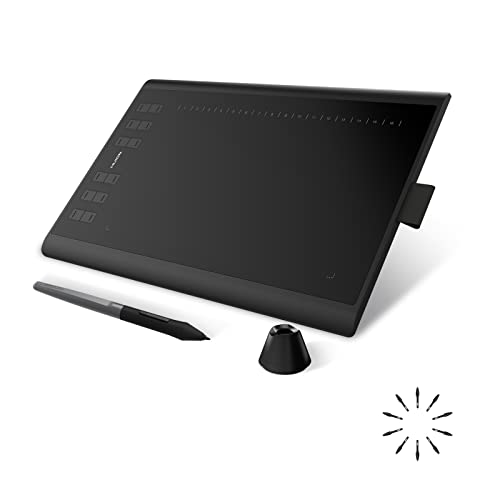
Best for: margin-heavy markup on a big monitor Skip it if: your desk or bag is tight on space
This is the reach pick. HUION lists a 10 x 6.25 in working area, which is the largest surface among the four pen slabs, and it maps far more comfortably to a wide monitor than a 6 x 4 in pad does. When you drag a pen across a 27-inch screen from a 6-inch pad, every movement is scaled up and small hand tremors get magnified. More surface means gentler scaling and steadier lines through a long editing session.
The key count is the other reason it ranks second. HUION claims 12 programmable press keys plus 16 programmable soft keys, and says they can be assigned to erase, zoom and scroll in the driver. For a writer, that is undo, save, next page and highlight sitting under your non-drawing hand. The listing also states a symmetrical design with 180-degree rotation for left-handed use, and support for Windows 7 or later, macOS 10.12 or later, Android 6.0 or later and Linux.
The cost is bulk. At 0.39 x 14.2 x 9.45 in and 1.7 lb, it is the heaviest and by far the largest here, and HUION notes a USB adapter is required for a Mac. It also sits in the more expensive half of this set.
Pros:
- Largest active area of the slabs, 10 x 6.25 in
- 12 press plus 16 soft keys claimed
- Battery-free PW100 stylus with tilt
- Left-handed 180-degree rotation stated
- Broad OS support including Linux
Cons:
- Heaviest slab at 1.7 lb
- 14.2 x 9.45 in body dominates a desk
- Mac users need a separate USB adapter
- One of the pricier picks in this group
3. HUION Inspiroy H640P 6x4 inch Drawing Tablet — Best warranty
Six programmable keys on a 6 x 4 in pad, which is the best key-to-footprint ratio in this comparison.

Best for: writers who want six one-touch shortcuts Skip it if: you want the thinnest slab possible
The H640P is the small tablet that did not drop its buttons. HUION lists six customizable press keys and specifically names undo, zoom, brush switch and save as assignable commands. Three of those four are commands a person editing prose uses every few minutes. On a 6 x 4 in active area, that is a lot of function in a pad you can park on a closed laptop lid.
Compatibility is the second reason it earns a slot. The listing covers Mac, Windows and Linux PCs, plus Android phones and tablets on OS 6.0 or later. Being able to mark up a draft on a phone screen while away from the desk is genuinely useful, and only this pick and the H1060P name Android support. The PW100 stylus is battery-free, so it is ready without a charge cycle. Both HUION picks carry a stated one-year warranty, matching the field.
Where it loses: at 0.31 x 10 x 5.98 in and 0.6 lb it is thicker and slightly heavier than the Wacom while offering less surface than the H1060P, so it lands in the middle without winning either end. It also sits in the mid price group, above the XP-Pen, which is the cheaper route to the same 6 x 4 in area.
Pros:
- Six programmable press keys on a small pad
- Battery-free PW100 stylus included
- Android 6.0 or later support stated
- Compact at 0.6 lb
- One year warranty stated
Cons:
- Thicker than the Wacom and XP-Pen at 0.31 in
- Smaller area than the H1060P, no reach advantage
- Costs more than the similarly sized XP-Pen
- No tilt function mentioned in this listing
4. XP-Pen Drawing Tablet XPPen StarG640 — Best upgrade
The only pick here that names Chromebook support, and at 6 oz it is the lightest slab in the group.
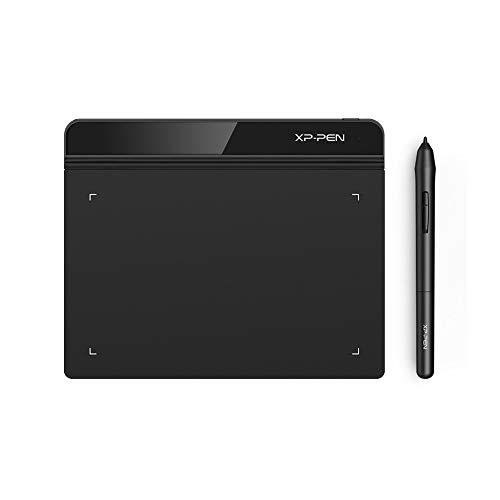
Best for: Chromebook users signing and marking up documents Skip it if: you rely on shortcut buttons
The StarG640 is the travel option. It weighs 6 oz, measures 0.1 x 7.5 x 6.5 in, and XP-Pen puts the thickness at 2 mm. That is thin enough to sit in a laptop sleeve alongside the laptop, which none of the other pen slabs manage as cleanly. It is also the second-cheapest pick in this set, and the cheapest of the four tablets that come with a pen.
For writers specifically, two claims stand out. XP-Pen lists Chromebook support and Microsoft Office compatibility, naming Word directly, and calls out e-signatures and online teaching as intended uses. If your drafting happens in a browser-based document on a school-issued Chromebook, this is the pick that says so on the box. The PN01 stylus is battery-free, keeping the pattern of the group.
The omission is buttons. Nothing in this listing describes programmable express keys, so every undo and save goes back through the keyboard. That is a real cost across a two-hour markup session, and it is why this ranks below both HUION picks despite the price advantage. Only one seller lists it, and the warranty is stated as one year, matching but not beating the field.
Pros:
- Lightest option at 6 oz
- 2 mm thin, easy to pack
- Chromebook and Word compatibility stated
- Battery-free PN01 stylus
- Second-cheapest pick here
Cons:
- No programmable shortcut keys listed
- 6 x 4 in area is small for a wide monitor
- No Android support mentioned
- Only one seller lists it
5. PicassoTab 11" Standalone Drawing Tablet — Best premium
The only pick you write directly onto, which removes the hand-here-ink-there gap entirely.

Best for: drafting longhand away from a computer Skip it if: you already own a laptop you write on
Everything else here is a pad wired to a machine. The X11 is the machine. PicassoTab describes it as fully standalone with no computer needed, and lists an 11 in 2K fully laminated screen that it says reduces parallax and glare for a paper-like feel. Parallax is the small offset between nib and cursor on a glass screen, and reducing it is the closest any of these picks comes to writing on paper. For a writer who drafts longhand in a café and types up later, that changes the whole workflow.
The internals are listed as an octa-core processor with 6GB RAM and 128GB storage, expandable to 1TB, so notes, references and reading material live on the same device. The bonus bundle covers a lifetime Pro upgrade for the Concepts drawing app and a lifetime VIP upgrade for the Artixo tutorials app, plus four accessories. The body is 0.04 x 11 x 11 in and one year of warranty is stated.
The catch is duplication and price. This is the most expensive pick here, and if you already own a laptop, you are buying a second computer to get a pen surface. No weight is published either, which matters for something you carry.
Pros:
- Standalone, no computer required
- 11 in 2K laminated screen, reduced parallax
- 6GB RAM, 128GB storage expandable to 1TB
- App upgrades and four accessories bundled
- One year warranty stated
Cons:
- The most expensive pick in this set
- Redundant if you already own a laptop
- No weight published for a portable device
- Locked to its own app ecosystem, not your desktop software
6. Kortimu Artist Drawing Glove — Best budget pick
Two gloves for the cheapest outlay here, and the fix for palm smudging on a tablet you already own.

Best for: adding palm rejection to a tablet you own Skip it if: you do not already have a tablet
This is an accessory, not a tablet, and it is the cheapest pick in the group by a wide margin. It solves one problem, and it is a problem writers hit harder than artists do. Handwriting rests the side of your palm on the surface for long unbroken stretches. On a screen you write directly onto, like the PicassoTab, that means stray marks and greasy patches. Kortimu describes a three-layer anti-slip, anti-smudge design that it says prevents accidental palm touches and keeps the screen clean.
The count is two gloves, listed in Midnight Ink, at 0.1 x 8.07 x 3.34 in for the medium. Kortimu says the two-finger cut is ambidextrous and fits either hand, which matters if you switch hands or share the desk. Three sizes are listed, with medium at 3.34 x 8.07 in and large at 3.54 x 8.46 in, and a cleaning cloth is included. The fabric is described as stretchy and moisture-wicking for long sessions.
Two honest limits. It does nothing on the Wacom, HUION or XP-Pen pads, because you are not looking at the surface you touch. And the warranty field on this listing is empty, the only pick here with nothing published.
Pros:
- Cheapest pick in this group
- Two gloves plus a cleaning cloth included
- Ambidextrous two-finger cut
- Three sizes listed, medium at 3.34 x 8.07 in
- Moisture-wicking fabric for long sessions
Cons:
- Not a tablet, adds nothing on its own
- Useless with the non-screen pads here
- No warranty published, unlike every other pick
- Sizing by hand measurement risks a poor fit
Active area: how much room does longhand need?
Here is the thing about surface size, and it runs opposite to the usual advice. Artists want more area. Writers often want less.
Handwriting on a pad is scaled. A 6 x 4 in surface stretched across a 27-inch monitor means a half-inch pen stroke becomes a two-inch letter on screen. Your natural handwriting comes out oversized and loose, and the wobble in your hand gets magnified with it. A 10 x 6.25 in area, like the H1060P, scales more gently and keeps letters closer to the size your hand actually forms.
So the split runs like this:
- Short annotations, ticks, circles, initials. A 6 x 4 in pad is plenty. The H640P or StarG640 will do.
- Sustained longhand or dense margin notes. Go to the H1060P's 10 x 6.25 in.
- Mixed use on a crowded desk. The Wacom's 6.3 x 7.87 in body is the compromise, small enough to keep out of the way.
Check your monitor before your pad. On a 13-inch laptop screen the scaling problem mostly vanishes and the small pads become the smarter buy.
Shortcut keys are the feature writers actually use
Most guides to the best drawing tablet for writers compare pressure levels. That is the wrong number. Pressure sensitivity governs how a brush stroke thickens under load, which is a painting concern. Marking up a chapter is not painting.
What you actually repeat is undo, save, zoom and scroll, hundreds of times per session. Every one of those either costs a keyboard reach or a key on the pad. The counts here spread wide.
The H1060P claims 12 programmable press keys plus 16 programmable soft keys, and HUION names erase, zoom and scroll as example assignments. The H640P claims six press keys and names undo and save. Wacom's Intuos Small has ExpressKeys on the CTL4100 body. The StarG640 lists none, so every command routes through the keyboard.
That last point is the reason a cheaper tablet can cost you more over a year. Reaching for Ctrl+Z with the pen still in hand breaks the flow of reading a sentence. Four keys under your left thumb does not.
What the listings do not tell you
Four gaps worth knowing before you buy any drawing tablet for writers.
- No handwriting recognition is claimed anywhere. None of these six listings mentions converting your handwriting into typed text. If that is what you came for, this category does not promise it and neither will I.
- Driver quality is invisible in specifications. Shortcut keys only work through the manufacturer's driver, and how well that driver behaves on your operating system version is not something a listing tells you.
- Cable length and connector type are unlisted for the wired picks. HUION does note the H1060P needs a USB adapter for a Mac, which is more than the others say.
- Surface texture wear. Pen nibs abrade the writing surface over time. No listing here publishes a nib life figure or a replacement nib count.
The gaps cut both ways. The PicassoTab publishes RAM and storage, which no pen pad needs to. The Wacom publishes a release year of 2018, which none of the others do, and that is useful context rather than a mark against it.
When a different pick wins
Six thresholds that flip the recommendation off the Wacom.
- Your monitor is 24 inches or wider and you write in margins daily. Go to the H1060P for the 10 x 6.25 in area.
- You work on a Chromebook. The StarG640 is the only pick naming Chromebook support.
- You want more than four shortcut keys on a compact pad. The H640P's six keys is the answer.
- You draft away from any computer. The PicassoTab X11 is standalone, and nothing else here is.
- You already own a pen-screen tablet and get palm smudges. Buy the Kortimu gloves and stop.
- You need Android phone markup. Both HUION picks state Android 6.0 or later.
The verdict
Three tiers, and the tier you belong to depends on whether you already own the computer you write on.
At the entry end, the XP-Pen StarG640 gets you a 6 x 4 in surface, a battery-free PN01 stylus and Chromebook support at 6 oz. You give up shortcut keys, so every undo goes back through the keyboard. It is the right call for occasional signing and light annotation, not for a daily editing habit.
The middle tier is where most writers should land, and where the winner sits. The Wacom Intuos Small takes it on footprint: 0.1 x 6.3 x 7.87 in and 0.51 lb, the smallest and lightest slab here, with ExpressKeys and a stated one-year warranty. Its runner-up in this tier, the HUION H640P, has exactly one clear advantage: six programmable press keys against Wacom's four, and HUION names undo and save among them. If you want that extra pair of shortcuts, take it.
At the premium end the choice splits by reach. The HUION H1060P offers a 10 x 6.25 in area and 28 programmable keys for anyone marking up on a wide monitor. The PicassoTab X11 goes further and replaces the computer entirely with an 11 in 2K laminated screen. Buy the X11 only if you genuinely draft longhand away from a desk. Otherwise you are buying a second computer to hold a pen.
FAQ
Is a drawing tablet worth it for writers?
A drawing tablet is worth it for writers who annotate, sign or sketch story structure regularly, and not much use to anyone who only types. The value sits in pen input for margin notes and PDF markup. If your week contains no handwriting at all, a mouse does everything you need and costs less.
What is the cheapest way into this category?
The cheapest way into this category is the Kortimu Artist Drawing Glove, at the lowest price position in this set, but it only helps if you already own a pen-screen tablet. For an actual tablet with a pen, the XP-Pen StarG640 is the cheapest of the four slabs and includes the battery-free PN01 stylus.
Wacom Intuos Small or HUION H640P: which suits writing better?
Wacom Intuos Small or HUION H640P comes down to footprint against buttons. The Wacom is thinner at 0.1 in versus 0.31 in and lighter at 0.51 lb versus 0.6 lb. The H640P counters with six programmable press keys, including undo and save. Cramped desk, take the Wacom. Heavy markup sessions, take the HUION.
Will these tablets work with my Mac or Chromebook?
These tablets work with Mac in most cases, with caveats. HUION lists macOS 10.12 or later for the H1060P but notes a USB adapter is required. The H640P lists Mac, Windows and Linux plus Android 6.0 or later. Only the XP-Pen StarG640 names Chromebook support outright, so browser-based writers should start there.
What mistake do first-time buyers make here?
The mistake first-time buyers make is choosing on pressure sensitivity. High pressure counts matter for shading a painting, not for forming letters. Buy on active area matched to your monitor size, on shortcut key count matched to your editing habits, and on whether the pen needs charging. Those three decide whether you keep using it.
Start by measuring your desk between keyboard and monitor. If the gap is under seven inches, the Wacom Intuos Small is the only pen slab here that fits without rearranging everything, and that alone settles it for most people who write for a living. Its real edge is not any single specification but the fact that at 0.51 lb you will actually leave it out, and a tablet you leave out is a tablet you use. Buy the H1060P only if you have measured the space for 14.2 x 9.45 in of it, and buy the PicassoTab only if your drafting genuinely happens away from a screen.