Best Drawing Tablets: XPPen StarG640 Leads
Five graphics tablets compared on active area, weight, thickness and shortcut keys, with a clear winner for anyone signing documents and marking up screens from a home desk.
By Lamar CalhounUpdated 15 min read
On this page
- Best drawing tablet for remote workers at a glance
- How I screened these five drawing tablets
- Does "remote working" actually change what you should buy?
- Small or large active area: which one fits your desk?
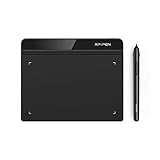
- 1. XP-Pen StarG640 — Best overall
- 2. HUION Inspiroy H640P — Most versatile
- 3. Wacom Intuos Small — Best for families
- 4. HUION Inspiroy H1060P — Best warranty
- 5. XPPen Deco 01 V3 — Best premium
- How many shortcut keys do you really need?
- What the listings do not tell you
- The verdict
- FAQ
The best drawing tablet for remote workers is the XPPen StarG640, a 6 oz slate just 0.1 in thick that slides under a laptop when the video call ends. If you need Linux support or a wider set of shortcut keys, the HUION Inspiroy H640P takes it instead, at 0.6 lb and 0.31 in thick. The specification that splits this field is not pressure sensitivity. It is active area against desk space, because a tablet that cannot sit square in front of your keyboard never gets used.
Best drawing tablet for remote workers at a glance
| Pick | Active area | Footprint & weight | Price |
|---|---|---|---|
Best overall XP-Pen StarG640 |
6x4 in | 7.5 x 6.5 in 6 oz |
Check Price |
Most versatile HUION Inspiroy H640P |
6x4 in | 10 x 5.98 in 0.6 lb |
Check Price |
Best for families Wacom Intuos Small |
Small | 7.87 x 6.3 in 0.51 lb |
Check Price |
Best warranty HUION Inspiroy H1060P |
10 x 6.25 in | 14.2 x 9.45 in 1.7 lb |
Check Price |
Best premium XPPen Deco 01 V3 |
10 x 6.25 in | 13.8 x 8.54 in 2.2 lb |
Check Price |


How I screened these five drawing tablets
I started from the published specifications and lined them up side by side, because that is the only fair comparison available across five listings from three brands. Four figures carried the weight: active drawing area, outer dimensions, weight, and the number of programmable keys.
Everything in this set shares two things. Every one uses a battery-free stylus, so there is no pen to charge. Every one publishes a one-year warranty. That means neither of those is a tiebreaker here, which is useful to know before you start reading specification sheets and looking for a differentiator that does not exist.
What I cut for:
- Anything without a published active area or outer dimensions. Footprint is the deciding number in this category and a listing that hides it is not comparable.
- Anything with no stated warranty. All five survivors publish one.
- Anything where the drawing surface and the shortcut keys were not clearly separated. A tablet whose keys sit inside the active area causes accidental strokes.
What survived splits cleanly into two groups by size. Two picks land at a 6x4 in active area. Two land at 10 x 6.25 in. The Wacom Intuos Small sits in the small camp, with a 7.87 x 6.3 in body but no active-area figure published on the listing.
Does "remote working" actually change what you should buy?
Only one of these five listings mentions remote work at all, and it does so in marketing copy rather than in a specification. So treat "for remote workers" as your own constraint, not something the hardware certifies. No tablet here is built differently because you work from home.
What does change is how you'll use it. A remote worker is usually not drawing for eight hours. You're signing a contract, redlining a design mockup, annotating a shared screen mid-call, or sketching a diagram in a whiteboard app. That's short bursts, mixed in with typing.
Three things follow from that:
- The tablet shares desk space with a keyboard. A large slate means moving the keyboard every time, and after a week you stop bothering.
- You reach for it and put it away. Weight and thickness matter more than they would for a full-time illustrator.
- Pen precision beyond a certain point stops mattering. Signing your name does not need 16,384 pressure levels.
That is why the small picks lead this list. If your actual job is illustration and the remote part is incidental, invert that reasoning and jump to the large-format section.
Small or large active area: which one fits your desk?
Here's the trick with active area. The number you compare is not the drawing surface, it's the outer footprint, because that's what claims the space.
The XPPen StarG640 and the HUION Inspiroy H640P both give you the same 6x4 in drawing surface. But the StarG640's body is 7.5 x 6.5 in and the H640P's is 10 x 5.98 in. Same working area, very different desk shapes: one is nearly square, the other is wide and shallow.
At the other end, the HUION Inspiroy H1060P measures 14.2 x 9.45 in and the XPPen Deco 01 V3 measures 13.8 x 8.54 in. Both deliver a 10 x 6.25 in surface. Both need a dedicated stretch of desk that a keyboard cannot occupy at the same time.
The cutoff worth remembering: if your usable desk width in front of the monitor is under about 14 in once the keyboard is placed, the two large picks will not sit comfortably. Measure before you buy. Most shoppers skip this step and then find the tablet living on a shelf.
Weight tells the same story from another angle. The StarG640 at 6 oz is the lightest here by a clear margin. The Deco 01 V3 at 2.2 lb is the heaviest, roughly five times as much.
1. XP-Pen StarG640 — Best overall
The lightest and thinnest pick in the set, and the one that survives sharing a desk with a keyboard.
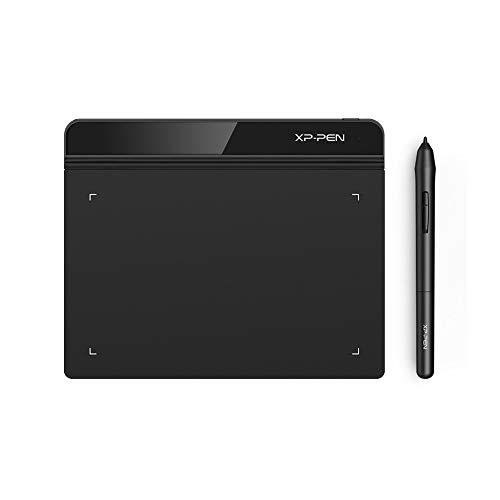
Best for: a shared or cramped desk where the tablet moves daily Skip it if: you sketch full illustrations and want room to swing your arm
Two numbers make the case. At 6 oz, the StarG640 weighs less than half of anything else here. At 0.1 x 7.5 x 6.5 in, it is the thinnest of the five and its body is nearly square, which matters when it has to sit centred in front of a keyboard rather than off to one side.
The 6x4 in active area is the smaller of the two sizes in this set, matched only by the H640P. For signatures, markup and diagram sketching, that is plenty of surface. XPPen says the PN01 stylus is battery-free, which every pick here shares. The listing also claims Chromebook support alongside Mac and Windows, and Microsoft Office compatibility, which is a genuinely useful pairing if your day runs through Word and shared documents rather than a drawing app.
What you give up is expansion room and controls. This is the only pick of the five with no shortcut keys published on its listing, so every command stays on the keyboard. It is also the one buyers choose most often in this group, and the cheapest of the five, which is a rare combination. The trade-off against the H640P is real: same drawing surface, no programmable keys.
Pros:
- Lightest here at 6 oz
- Thinnest profile in the set, 0.1 in
- Near-square 7.5 x 6.5 in body fits in front of a keyboard
- Cheapest of the five picks
- Chromebook support claimed alongside Mac and Windows
Cons:
- No shortcut keys listed, unlike four rivals
- Smallest drawing surface tier at 6x4 in
- Only one seller lists it
- No published Linux support
2. HUION Inspiroy H640P — Most versatile
Same 6x4 in surface as the winner, plus six programmable keys and the widest published operating system list.

Best for: someone switching between a laptop, a Linux box and an Android tablet Skip it if: you want the thinnest possible slate
The H640P is the second-cheapest here and the closest thing to a direct alternative to the winner. Its drawing surface matches at 6x4 in. Its body is a different shape: 10 x 5.98 in, wide and shallow rather than square, which suits a desk with width but little depth.
Six customisable press keys sit on the edge, which is the meaningful gap over the StarG640. HUION suggests assigning undo, zoom, brush switch or save, and for markup work an undo key alone earns its place. Compatibility is the other differentiator. HUION lists Mac, Windows, Linux PCs and Android 6.0 or later, and that Linux line is the only one in this group. If your work machine runs Ubuntu, this becomes the default rather than the alternative.
At 0.6 lb it is heavier than the StarG640 and at 0.31 in it is three times thicker, matching the H1060P's chunkier build in a small body. That thickness is the honest cost of the keys and the wider port arrangement. Against the winner, you trade portability for controls.
Pros:
- Six programmable press keys
- Only pick here with published Linux support
- Android 6.0 support claimed
- Second-cheapest of the five
- Same 6x4 in surface as the winner
Cons:
- 0.31 in thick, three times the winner's profile
- 0.6 lb, heavier than the Wacom small pick
- 10 in width is wide for a small tablet
- No stated bundled software
3. Wacom Intuos Small — Best for families
The only pick that ships with bundled creative software and online training, which matters when more than one person uses it.
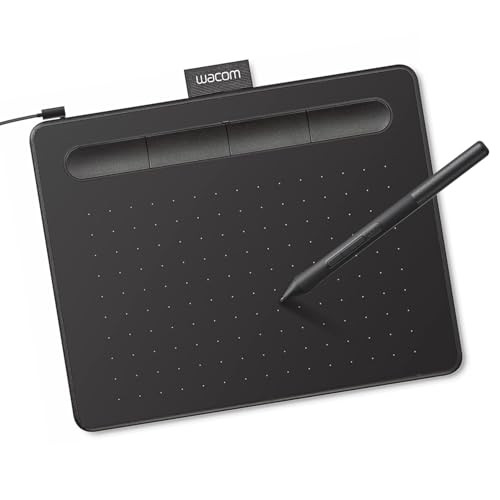
Best for: a household where kids also use the tablet for schoolwork Skip it if: you want shortcut keys under your fingers
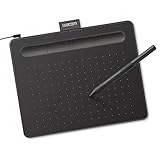
The Intuos Small is the mid-priced pick here and the only one from Wacom. Its body measures 0.1 x 6.3 x 7.87 in, which ties the StarG640 for thinnest at 0.1 in, and it weighs 0.51 lb. Its listing gives a size of "Small, Wired" without a published active-area figure, so if the exact drawing surface is your deciding number, the two 6x4 in picks are the safer comparison.
Wacom's differentiator on paper is what comes with it. The listing states that software and online training are included on registration, and it's the only pick in this group making that claim. For a shared household tablet, where a teenager needs a drawing app and a parent needs markup, that bundle is worth more than a pressure specification. Wacom describes EMR battery-free technology and claims a pen-on-paper feel, and says the tablet works in any software program.
It's also the only pick with a published release year, 2018, which tells you it's a mature design rather than a recent one. Like the StarG640, it lists no shortcut keys. Against the H640P at a lower price position, that's the sharpest trade: you're paying more for the software bundle and losing the six press keys.
Pros:
- Only pick with bundled software and training claimed
- Ties for thinnest at 0.1 in
- 0.51 lb, lighter than both HUION picks
- Two sellers list it
Cons:
- No active-area figure published
- No shortcut keys listed
- Wired only, per the listing
- 2018 design, the oldest published here
- Mid price position without press keys
4. HUION Inspiroy H1060P — Best warranty
The most control surface in the set: 12 press keys plus 16 soft keys, on a 10 x 6.25 in drawing area.
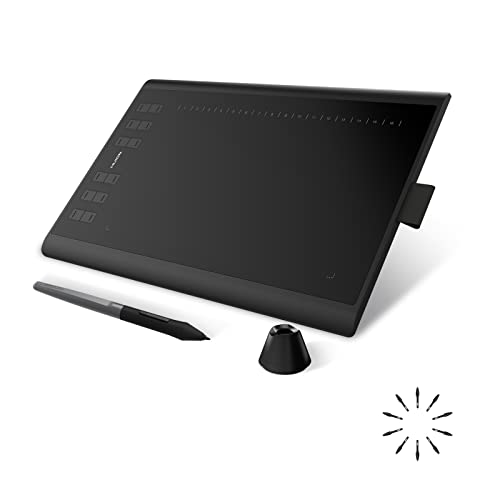
Best for: a permanent desk with room for a 14.2 in slate Skip it if: your desk is already crowded with a keyboard and two monitors
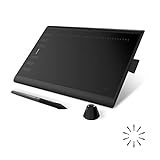
This is the largest body here at 0.39 x 14.2 x 9.45 in, and it delivers a 10 x 6.25 in working area. That's the same surface as the Deco 01 V3, in a slightly bigger shell. It weighs 1.7 lb, so it stays where you put it.
The control count is what sets it apart. HUION lists 12 programmable press keys plus 16 programmable soft keys, which is 28 assignable inputs against six on the H640P and none on two other picks. For work where you cycle through the same handful of commands, that removes most of the reaching for the keyboard. HUION also describes a symmetrical design that rotates 180 degrees in the driver for left-handed users, and lists Windows 7 or later, macOS 10.12 or later, Android 6.0 or later, and Linux Ubuntu. A USB adapter is required for a Mac, per the listing.
It shares the one-year warranty every pick here publishes, so the award reflects that it matches the field's best rather than beating it. Two honest marks against it: it's the thickest of the five at 0.39 in, and it sits in the higher price tier while offering the same drawing surface as the Deco 01 V3 with a lower published pressure figure.
Pros:
- 12 press keys plus 16 soft keys, the most here
- 10 x 6.25 in working area
- 180-degree rotation for left-handed use
- Windows, macOS, Android and Linux all listed
- Lighter than the Deco 01 V3 at 1.7 lb
Cons:
- Largest footprint of the five, 14.2 x 9.45 in
- Thickest at 0.39 in
- Mac connection needs a USB adapter
- Only one seller lists it
- No count figure published
5. XPPen Deco 01 V3 — Best premium
The highest published pressure figure here at 16,384 levels, with 60 degrees of tilt claimed.

Best for: detailed shading work where pressure resolution matters Skip it if: you mostly annotate PDFs and sign contracts
The Deco 01 V3 is the most expensive pick here and the one whose case rests on pen performance. XPPen states 16,384 levels of pressure sensitivity and support for up to 60 degrees of tilt, which is the highest pressure figure published across these five listings. For shading and line-weight variation, that resolution is the point.
The body measures 0.31 x 13.8 x 8.54 in with a 10 x 6.25 in drawing area, so it's marginally more compact than the H1060P for the same surface. It carries eight customisable shortcut keys, positioned for both right and left-handed users. XPPen lists Android 10.0 or above and describes USB-C to USB-C connectivity with adapters included, which is the cleanest published connection story in the set if your laptop is USB-C only.
At 2.2 lb it's the heaviest pick by a wide margin, five to six times the StarG640. That is the reason it sits last for remote work rather than first: a tablet this size and weight is a fixture, not something you tuck away between calls. And for markup and signatures, most of that pressure resolution goes unused. If you're an illustrator who happens to work from home, reverse the ranking and start here.
Pros:
- 16,384 pressure levels claimed, highest published here
- 60 degrees of tilt support claimed
- USB-C to USB-C connectivity with adapters
- Eight shortcut keys, ambidextrous layout
- Slightly smaller body than the H1060P for the same surface
Cons:
- Heaviest here at 2.2 lb
- Most expensive pick in the set
- Fewer shortcut keys than the H1060P's 28
- Android support starts at 10.0, narrower than rivals
- Only one seller lists it
How many shortcut keys do you really need?
Key counts across this set run from zero to 28, which is a wide spread for one category. Here's how I'd map them to actual work.
- Zero keys (StarG640, Intuos Small): fine if your commands live in keyboard shortcuts already. Signing and light markup barely need more.
- Six to eight keys (H640P, Deco 01 V3): the useful middle. Undo, redo, zoom in, zoom out, save, and a tool toggle covers most annotation work.
- 28 keys (H1060P): only pays off if you have a repeatable command set and the desk space to keep the tablet in one orientation.
The honest answer for most people signing documents and marking up mockups is that anything past six keys goes unassigned. I'd rather have the thinner body.
One detail worth checking against your own setup: both HUION picks and the Deco 01 V3 mention left-handed support, with the H1060P listing a 180-degree rotation in its driver. If you're left-handed, that narrows the field before any other specification does.
What the listings do not tell you
A few gaps show up when you compare these five listings closely, and knowing them saves a return.
Cable length and connector type are mostly absent. Only the Deco 01 V3 states its arrangement, USB-C to USB-C with adapters. The H1060P says a Mac needs a USB adapter. The Intuos Small is described as wired. For the other two, plan on checking what's in the box against the ports on your machine.
Nib replacements aren't specified. Every pen here is battery-free, which is the good news. None of the listings states how many spare nibs are included, and nibs wear down with use.
Active area isn't always published. The Wacom Intuos Small gives a size label and outer dimensions but no drawing-surface figure. If that number decides it for you, the two 6x4 in picks and the two 10 x 6.25 in picks are the ones you can compare directly.
Driver behaviour on your specific operating system. Listings name supported systems. They don't tell you how the driver handles a multi-monitor setup, which is the single most common friction point for anyone using a pen tablet across two screens at a home desk.
The verdict
Three tiers, and the choice mostly follows your desk rather than your ambition.
At the entry end, the XPPen StarG640 is the best drawing tablet for remote workers and the default I'd hand almost anyone. It's the cheapest here, the lightest at 6 oz, and tied for thinnest at 0.1 in, with a near-square 7.5 x 6.5 in body that shares space with a keyboard instead of fighting it. The HUION Inspiroy H640P sits alongside it at the same price tier and wins on exactly two points: six programmable keys and published Linux support. Both give you the same 6x4 in surface.
The middle tier is the Wacom Intuos Small, and what the extra money buys is the software and training bundle, the only one claimed in this group. That's a household argument more than a solo one.
At the top, the HUION Inspiroy H1060P and the XPPen Deco 01 V3 both deliver a 10 x 6.25 in surface. Choose the H1060P for 28 assignable keys, the Deco 01 V3 for 16,384 pressure levels. Both demand roughly 14 in of clear desk width. If you don't have it, don't buy either.
FAQ
Is a cheap drawing tablet good enough for remote work?
A cheap drawing tablet is good enough for most remote work, because signatures, PDF markup and whiteboard sketching don't stress pen resolution. The two entry-priced picks here, the XPPen StarG640 and the HUION Inspiroy H640P, both offer a 6x4 in active area and a battery-free stylus. Spend more only when you need a 10 x 6.25 in surface or a large bank of programmable keys.
Is the best drawing tablet for remote workers worth it over a mouse?
Whether the best drawing tablet for remote workers is worth it over a mouse depends on how much annotating you do. Pen input is faster and more precise for redlining, circling, freehand diagrams and signing. HUION describes the H640P as replacing a mouse for more natural control. If your week involves under an hour of markup, a mouse is fine.
Will these drawing tablets work with a Mac or Chromebook?
These drawing tablets work with Macs across the board, but the details vary. XPPen lists Mac, Windows and Chromebook support for the StarG640, the only Chromebook mention in the set. HUION states the H1060P needs a USB adapter to connect to a Mac. The H640P lists Mac, Windows, Linux and Android 6.0 or later. Check your ports before buying.
XPPen StarG640 or HUION Inspiroy H640P: which should I pick?
Between the XPPen StarG640 and the HUION Inspiroy H640P, both share a 6x4 in drawing area. The StarG640 wins on portability at 6 oz and 0.1 in thick. The H640P wins on features, with six programmable press keys and published Linux support, at 0.6 lb and 0.31 in. Cramped desk, take the StarG640. Linux machine, take the H640P.
What mistake do first-time drawing tablet buyers make?
The mistake first-time drawing tablet buyers make is choosing by pressure levels instead of footprint. A 14.2 x 9.45 in slate like the H1060P needs dedicated desk width that a keyboard cannot share, and an unused tablet is a wasted purchase. Measure the clear space in front of your monitor first, then pick the largest active area that fits comfortably inside it.
Grab a tape measure before you grab your wallet. Measure the clear width between your keyboard and your monitor stand, then match it against the outer dimensions in the table above rather than the drawing-area figures. That one step sorts this category faster than any specification comparison. For most people working from a home desk, the StarG640's 7.5 x 6.5 in body and 6 oz weight mean it earns its place permanently, because the tablet you can leave out is the tablet you actually use. The larger picks are better hardware for a purpose most remote workers don't have.