Best Budget Desktop for Everyday Use: HP ProDesk
A ranked shortlist of five budget desktops, with the HP ProDesk 600 G1 SFF leading on footprint and price, and a Dell Optiplex ready to take over when storage matters.
The best budget desktop computer for everyday use is the HP ProDesk 600 G1 SFF, a renewed 15.4 lb slim tower with 8GB of RAM, a 500GB hard drive and Windows 11 Pro that lands as the cheapest of the five picks here. The Dell Optiplex 7050 SFF is the runner-up when 1TB of SSD storage and 32GB of DDR4 matter more than the lowest price. The deciding specification below is not the processor generation, and it is not the price. It is storage type.
Best budget desktop computer for everyday use at a glance
| Pick | Memory & storage | Form factor | Price |
|---|---|---|---|
| Best overall HP ProDesk 600 G1 SFF |
8GB / 500GB HDD | Slim tower, 15.4 lb | Check Price |
| Runner-up Dell Optiplex 7050 SFF |
32GB / 1TB SSD | Small form factor, 11.4 x 11.5 x 3.6 in | Check Price |
| Best for pros Dell Optiplex 5050 SFF |
16GB / 512GB NVMe SSD | Small form factor, 10.7 lb | Check Price |
| Best minimal setup HP 22" FHD All-in-One |
8GB DDR5 / 128GB | All-in-one, 9 lb | Check Price |
| Best premium Lenovo IdeaCentre 24" AIO |
16GB DDR4 / 512GB NVMe SSD (claim) | All-in-one, 23.8" display | Check Price |
How I narrowed a crowded field to five
I started with what a shopper actually types into the search box: a cheap desktop that will handle a full working day. That rules out gaming boxes, mini PCs sold without an operating system, and anything priced like a workstation. The five picks here all ship with Windows 11 pre-installed, all sit inside a footprint you can hide behind a monitor, and every one of them lists a memory, storage and processor figure so the comparison is not guesswork.
Three cuts drove the final list.
- Cut for empty spec sheets. Any listing that did not publish memory, storage and dimensions was dropped. A budget desktop with a mystery drive is a coin toss.
- Cut for no included peripherals. A cheap desktop that arrives without a keyboard is not actually cheap. The three towers here all include a USB keyboard and mouse; both all-in-ones ship with keyboard and mouse in the box.
- Cut for form-factor mismatch. Mid-towers with room for a graphics card were removed. Everyday use is answered by slim, small-form-factor or all-in-one designs, and every finalist fits that brief.
That left three renewed business towers and two new all-in-ones, which is the split you see below. It is also, honestly, the split the budget desktop market actually offers right now.
1. HP ProDesk 600 G1 SFF Slim Business Desktop Computer — Best overall
The HP ProDesk 600 G1 SFF is the cheapest of the five and the smallest tower on the list, and that combination is what a budget desktop for everyday use is supposed to deliver.
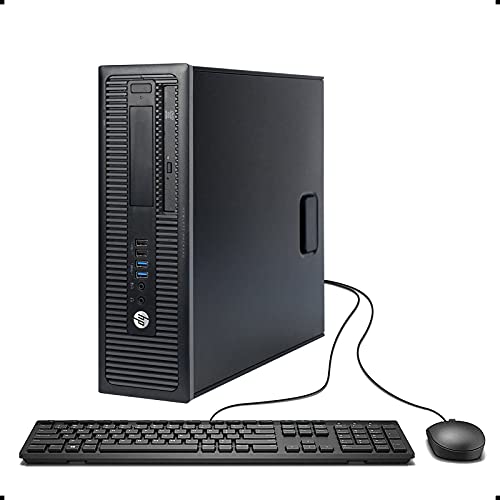
Best for: a home office that needs a small, cheap Windows 11 Pro box for email, browser tabs and documents Skip it if: you want a fresh warranty longer than 90 days or built-in Wi-Fi confirmed on the listing
The ProDesk 600 G1 measures 10 x 14 x 3 in and weighs 15.4 lb, so it slides under a monitor arm or stands on end next to one. HP says it ships with an Intel i5-4570 processor, 8GB of RAM, a 500GB hard drive and Windows 11 Pro, plus a DVD drive, a USB keyboard and a USB mouse. HP also lists a 30-day Microsoft Office trial. This is a renewed unit, and HP states the refurbishing process covers functionality testing, cleaning, inspection and repackaging.
Against the two Dell Optiplex towers here, the trade-off is real: the ProDesk has half the memory of the Optiplex 5050 and a spinning 500GB hard drive instead of an NVMe SSD. For a browser, email client and word processor, that is workable. For anything that opens large files repeatedly, it is the slowest of the three towers on paper. It sells faster than any other tower in this set, which suggests the price is doing most of the persuading.
Pros:
- The cheapest of the five picks
- Smallest tower footprint at 10 x 14 x 3 in
- Windows 11 Pro pre-installed
- USB keyboard, mouse and DVD drive included
- HP-certified renewed process stated on the listing
Cons:
- 500GB spinning hard drive rather than an SSD
- 8GB of RAM is the entry rung for Windows 11
- 90 days limited warranty
- Wi-Fi is not called out in the specifications
2. Dell Optiplex 7050 SFF Desktop PC — Runner-up
The Dell Optiplex 7050 SFF is the memory-and-storage pick: 32GB of DDR4 and a 1TB SSD in an 11.4 x 11.5 x 3.6 in body, faster-selling than anything else in this set.

Best for: someone editing large spreadsheets or running two monitors from one desk Skip it if: you only browse the web and check email
Dell lists the Optiplex 7050 SFF with an Intel Core i7-7700 quad-core running at 3.60 GHz, 32GB of DDR4 memory, a 1TB solid-state drive and Windows 11 Pro. The listing also states Wi-Fi, Bluetooth, HDMI and dual monitor support, which is the connectivity story the ProDesk does not tell. It ships renewed. Dimensions are 11.4 x 11.5 x 3.6 in, which is a shade wider than the ProDesk but still a small form factor.
Inside this five-pick set, the 7050 is the only tower with a 1TB drive and the only one with 32GB of memory. That is what a budget desktop computer for everyday use looks like when everyday use includes 40 browser tabs and a video call at the same time. The catch is the same one every renewed tower here shares: a 90-day warranty and a 2019-era processor. If you want the newest silicon on the invoice, the runner-up spot is not for you. If you want the most working memory in the group, it is.
Pros:
- 32GB DDR4, the most in this set
- 1TB SSD stated on the listing
- Dual monitor support and Wi-Fi called out
- Faster-selling than any other pick in this set
- Windows 11 Pro pre-installed
Cons:
- 90 days warranty on a renewed unit
- Weight is not stated on the listing
- Intel Core i7-7700 dates to 2017
- Priced above both other towers here
3. Dell Optiplex 5050 Small Form Factor — Best for pros
The Dell Optiplex 5050 SFF pairs a 512GB NVMe SSD with 16GB of DDR4 in a 10.7 lb chassis, which is the fast-storage middle ground between the ProDesk and the 7050.

Best for: a light creative workload that leans on fast NVMe storage and 16GB of memory Skip it if: you want the newest generation of processor on the spec sheet
Dell states an Intel Core i7-7700 at 3.6 GHz with turbo up to 4.2 GHz, 16GB of DDR4, a 512GB NVMe SSD and Intel HD Graphics 630. Windows 11 Pro is pre-installed, and a wired keyboard and mouse are included. Dimensions come in at 3.7 x 11.5 x 11.4 in and the machine weighs 10.7 lb, the lightest of the three towers here and the second-cheapest pick overall. It also ships renewed under a 90-day limited warranty.
The reason it lands in third rather than first is honest: on paper it is a straight upgrade over the ProDesk and a straight downgrade from the 7050. It buys you fast NVMe boot times and a doubling of memory over the ProDesk, without paying for the 1TB drive or 32GB of RAM the 7050 stacks on top. If your work opens a lot of files but does not keep dozens of them open at once, the 5050 is the pick that reads best on price-to-spec.
Pros:
- 512GB NVMe SSD, not a spinning hard drive
- 16GB DDR4 memory
- Lightest tower here at 10.7 lb
- Second-cheapest pick in the set
- USB keyboard and mouse included
Cons:
- Intel HD Graphics 630 is basic integrated graphics
- 90 days limited warranty
- Wi-Fi is not called out on the listing
- Same processor generation as the 7050 without the memory or drive size
4. HP 22" FHD All-in-One Desktop Computer — Best minimal setup
The HP 22-inch all-in-one puts the screen, computer, camera and speakers into one 9 lb, 21.5-inch FHD unit with a single power cable.

Best for: a single-cable desk where the screen, PC and webcam are one 9 lb unit Skip it if: you need more than 128GB of internal storage without adding a drive
HP lists a 13th Gen Intel N100 with four cores and up to 3.4 GHz, 8GB of DDR5 memory, 128GB of storage and Windows 11 Pro. The display is a 21.5-inch Full HD panel with anti-glare coating. Ports called out include one USB Type-C at 5Gbps for data, two Hi-Speed USB Type-A, one 5Gbps USB Type-A and a headphone/microphone combo jack. A HD webcam is built in. The chassis measures 15.1 x 6.69 x 19.4 in and weighs 9 lb, and HP publishes a 1-year warranty. This is a new unit, not renewed.
The reason this sits fourth is storage. 128GB fills quickly on a Windows 11 machine once updates, Microsoft Office and the usual browser caches settle in. Set against the towers, the trade is clear: you gain the freshest processor generation in the set, a fresh 1-year warranty and a proper anti-glare screen; you give up drive space and expandability. The all-in-one path is the right one for a clean desk, not a heavy workload.
Pros:
- One box holds screen, PC, webcam and speakers
- 13th Gen Intel N100 with DDR5 memory
- 1-year warranty stated on the listing
- 21.5-inch FHD anti-glare display
- USB Type-C at 5Gbps included
Cons:
- 128GB of storage is the smallest in this set
- 8GB is the entry rung for DDR5 too
- USB Type-C is data-only on the listing
- The most expensive pick here alongside the Lenovo
5. Lenovo IdeaCentre 24" FHD All-in-One — Best premium
The Lenovo IdeaCentre 24-inch all-in-one is the biggest screen in this set: a 23.8-inch Full HD IPS panel Lenovo claims covers 99% sRGB, with Wi-Fi 6 and Bluetooth 5.2 on the listing.

Best for: a shared family desk that wants a 23.8-inch IPS screen and Wi-Fi 6 in one box Skip it if: you want a taller warranty figure or Windows 11 Pro rather than Home
Lenovo lists the same Intel N100 processor as the HP all-in-one, with four cores and up to 3.4 GHz. It pairs that with what the listing describes as 16GB of DDR4 memory and a 512GB NVMe SSD, on a 23.8-inch FHD IPS display Lenovo claims hits 99% sRGB coverage. Wi-Fi 6 and Bluetooth 5.2 are called out, along with Windows 11 Home. A USB wired keyboard and mouse are included. The warranty figure on the listing reads 1.
Inside this five-pick set, the IdeaCentre is the slowest seller and the highest price rank, and the specification sheet from Lenovo is thinner than HP's on ports and dimensions. That is why it lands fifth rather than higher. Where it earns its place is the display: a 24-class IPS panel is a jump over a 21.5-inch anti-glare LCD, and for a family desk that doubles as a homework station, the extra inches are the whole point.
Pros:
- 23.8-inch FHD IPS display, the largest in this set
- 99% sRGB coverage claimed on the listing
- Wi-Fi 6 and Bluetooth 5.2 called out
- 16GB of memory and a 512GB NVMe SSD claimed
- USB keyboard and mouse included
Cons:
- Windows 11 Home, not Pro
- Warranty figure on the listing is short
- Dimensions and weight are not published
- The most expensive pick in this set
The specification that actually decides everyday use
The processor generation gets most of the attention on a budget desktop listing. It should not. On the five picks here, all of them run Windows 11 without complaint and none is going to render video for a living. What actually decides how a budget desktop computer for everyday use feels day to day is the drive.
A 500GB spinning hard drive, like the one in the HP ProDesk, boots slower and opens files slower than a 512GB NVMe SSD, like the one in the Dell Optiplex 5050. That is the biggest single perceived-speed gap in this set. It is bigger than the gap between an Intel Core i5-4570 and an Intel Core i7-7700 for everyday tasks. It is bigger than the gap between 8GB and 16GB of memory once your browser is warm.
Read the storage line first. If it says HDD, know what you are buying: the cheapest tower here and the slowest to load. If it says SSD or NVMe, you are in the fast-storage bracket, and the rest of the specification sheet decides which SSD desktop suits you. That is the real budget desktop for everyday use question, and it is the one the listings hide inside a spec bullet halfway down.
Renewed vs new: what changes for a budget desktop?
Three of the picks here are sold renewed. Two are new. That is the biggest single split in the set and it needs its own paragraph.
Renewed, on this list, means the three business towers: the HP ProDesk 600 G1, the Dell Optiplex 5050 SFF and the Dell Optiplex 7050 SFF. Each lists a 90-day limited warranty. HP describes its refurbishing process as functionality testing, cleaning, inspection and repackaging. Each ships with Windows 11 Pro, and each includes a USB keyboard and mouse.
The two all-in-ones, the HP 22-inch and the Lenovo IdeaCentre 24-inch, are new. The HP lists a 1-year warranty. The Lenovo warranty figure on the listing is short. Both include a keyboard and mouse in the box.
The trade is straightforward. A renewed business tower buys you a stronger internal specification for less: a 32GB, 1TB SSD Optiplex 7050 costs less than a new 8GB, 128GB HP all-in-one in this set, based on price rank. What you give up is the fresh warranty and the newest processor generation. Neither is a small thing, but neither is a dealbreaker for email, spreadsheets and video calls. Decide which side of that fence you sit on before you filter by anything else.
Tower or all-in-one for a small desk?
The two form factors on this list solve different desk problems. Choose by the desk, not by the specification sheet.
- Tower plus separate monitor. The HP ProDesk 600 G1 (10 x 14 x 3 in, 15.4 lb), Dell Optiplex 5050 (10.7 lb) and Dell Optiplex 7050 (11.4 x 11.5 x 3.6 in) are slim enough to stand next to a monitor or lie flat under one. You supply the display and any speakers. Upgrade paths are wider: a bigger SSD, more RAM, a second monitor. The 7050 listing states dual monitor support.
- All-in-one, one cable. The HP 22-inch (9 lb, 21.5-inch FHD) and the Lenovo IdeaCentre 24-inch (23.8-inch FHD IPS) integrate the screen, computer, webcam and speakers. One power cable clears the desk. Upgrade paths are narrower.
If desk clutter is the problem you are solving, an all-in-one wins outright. If value per dollar of internal specification is the problem you are solving, a tower with a monitor you already own wins. There is no third answer.
What the listings do not tell you about ports and upgrades
Listings for budget desktops leave gaps. The five here are honest about the big numbers and quiet about the small ones, and the small ones bite later.
- Wi-Fi is inconsistently stated. The Dell Optiplex 7050 listing calls out Wi-Fi and Bluetooth. The Lenovo IdeaCentre calls out Wi-Fi 6 and Bluetooth 5.2. The HP ProDesk and the Dell Optiplex 5050 do not name Wi-Fi. If you need wireless, plan for a USB Wi-Fi adapter as insurance.
- USB port counts vary. The HP all-in-one lists one USB Type-C at 5Gbps (data only), two Hi-Speed USB Type-A and one 5Gbps USB Type-A. That is four USB ports on the machine itself. If you own a printer, an external drive and a webcam, count your peripherals against the ports before you buy.
- Renewed desktops rarely publish a full port map. You get the big specifications and the operating system. Expect the standard business-tower port set on the ProDesk and both Optiplex units, but plan a powered USB hub if your desk is peripheral-heavy.
- Upgrade paths on all-in-ones are narrow. A tower can take a bigger SSD or more memory. An all-in-one usually cannot, or at least not easily.
None of this changes the ranking above. It changes what you buy alongside the desktop.
The verdict
The HP ProDesk 600 G1 SFF is the winner for a straightforward reason: it is the cheapest pick here, it fits a 10 x 14 x 3 in footprint, and it ships with Windows 11 Pro plus a keyboard and mouse. That is the whole brief. For email, a browser and a word processor on a home desk, nothing else in this set does the job for less money.
Two conditions flip the recommendation. First, if you actually use the drive: opening large files, saving big folders, running dozens of tabs. The 500GB hard drive in the ProDesk is the slowest storage in this set, and the Dell Optiplex 7050 SFF with its 1TB SSD and 32GB of DDR4 is the pick that solves that problem. Second, if you want one box and one cable on a small desk, the HP 22-inch all-in-one collapses the screen, computer and webcam into a 9 lb unit with a fresh 1-year warranty, and the Lenovo IdeaCentre 24-inch takes the same idea up to a 23.8-inch IPS display.
The runner-up's exact advantage is memory and storage: 32GB of DDR4 and a 1TB SSD, and it sells faster in this set than any other pick.
FAQ
Is a renewed budget desktop safe for everyday use?
A renewed budget desktop is safe for everyday use provided you read the seller's process and the warranty. Each of the three renewed towers here, the HP ProDesk 600 G1, the Dell Optiplex 5050 and the Dell Optiplex 7050, lists a 90-day limited warranty. HP describes functionality testing, cleaning, inspection and repackaging. If you want a fresh multi-year warranty, buy new instead.
Is 8GB of RAM enough for everyday use in 2025?
8GB of RAM is enough for everyday use when everyday means a browser with a modest tab count, email, video calls and word processing. It is tight for heavy multitasking. Two picks here, the HP ProDesk and the HP 22-inch all-in-one, ship with 8GB. If you keep 20 tabs open alongside Office, step up to 16GB in the Optiplex 5050 or 32GB in the Optiplex 7050.
Is the HP ProDesk worth it against the Dell Optiplex 5050?
The HP ProDesk is worth it if price is the deciding factor and your workload is light: browser, email, documents. The Dell Optiplex 5050 is worth the step up if storage speed matters, because the 5050 lists a 512GB NVMe SSD against the ProDesk's 500GB spinning hard drive, and the 5050 doubles memory to 16GB DDR4. Both are renewed with 90-day warranties.
How much storage does an everyday desktop actually need?
How much storage an everyday desktop needs depends on cloud use. If your documents and photos live in a cloud service, 128GB, as on the HP 22-inch all-in-one, will hold Windows 11 and Office comfortably. If you keep files locally, choose 512GB or 1TB. The Dell Optiplex 7050 in this set lists a 1TB SSD, the largest drive of the five picks here.
Which is better for a small desk, a tower or an all-in-one?
Which is better for a small desk depends on the monitor you own. If you already have one, a slim tower like the HP ProDesk at 10 x 14 x 3 in wins on price and internal specifications. If you have no monitor, an all-in-one like the HP 22-inch at 9 lb or the Lenovo IdeaCentre with its 23.8-inch IPS display is the one-cable answer, and it clears the desk.
If the ProDesk fits your desk and your workload sounds like the profile above, that is where I would start. Add a small SSD upgrade later if the spinning drive begins to drag; that single change is the largest jump in perceived speed a budget desktop like this can take. If your work leans on memory or fast storage instead, jump straight to the Dell Optiplex 7050 SFF and skip the intermediate step. The point of a budget desktop computer for everyday use is that it disappears into the routine, and the ProDesk disappears at the lowest price on this list.
Last updated: September 7, 2026. Product availability re-checked.
This page contains affiliate links. As an Amazon Associate we earn from qualifying purchases, at no extra cost to you.