Best SDR Receiver by Frequency Range and Bandwidth
Six SDR receivers compared by frequency range, tuner accuracy and bandwidth, with the Nooelec NESDR v5 leading on coverage and the RTL-SDR Blog V3 close behind.
The best SDR receiver for most buyers is the Nooelec RTL-SDR v5 Bundle, which tunes from 100kHz to 1.75GHz with a 0.5PPM TCXO and ships with three antennas in an aluminium enclosure. If you already have antennas and want the cheapest working dongle, the RTL-SDR Blog V3 covers 500kHz to 1.7GHz for less. Who should skip this category entirely: video crews looking at the DJI SDR Transmission Combo, which is a wireless camera link, not a radio scanner. Send them to a monitoring kit instead.
Best SDR receiver at a glance
| Pick | Frequency range | Form factor | Price |
|---|---|---|---|
| Best overall Nooelec RTL-SDR v5 Bundle |
100kHz-1.75GHz | Dongle + 3 antennas | Check Price |
| Best warranty RTL-SDR Blog V3 with Dipole Kit |
500kHz-1.7GHz | Dongle + dipole kit | Check Price |
| Best budget pick RTL-SDR Blog V3 Dongle Only |
500kHz-1.7GHz | Dongle only | Check Price |
| Most versatile yyiikee Portable SDR DSP Receiver |
100kHz-149MHz | Standalone, 4.3" touchscreen | Check Price |
| Best upgrade Raddy MLite-880 |
Full-band claim, aviation | Standalone, 2.3" waterfall | Check Price |
| Best premium DJI SDR Transmission Combo |
2.4/5GHz video link | TX + RX pair | Check Price |
How I screened the field down to six
I started from a longer list of SDR listings on Amazon and cut hard on three grounds. Amazon's search returned mixed results for the phrase, so the first job was separating radio receivers from unrelated hardware. Three criteria did the work.
The criteria, in order of weight:
- Frequency coverage, weighted highest. Anything that could not state a usable HF-through-UHF range in the listing was cut. A receiver that stops at FM broadcast is not what a "best SDR receiver" shopper needs.
- Tuner accuracy, second. A TCXO with a stated PPM figure separates the picks that hold a frequency from the ones that drift. I kept only listings that specified one, or offered a spectrum-and-waterfall display so drift can be spotted and corrected.
- Form factor honesty, third. A dongle needs a host computer and an antenna. A standalone needs a battery and a screen. I kept examples of both, so the recommendation matches the workflow, not just the spec sheet.
Why those weights: an SDR that cannot reach the frequencies you want is useless at any price, and one that drifts a kilohertz an hour makes single-sideband work miserable. The rest is comfort and portability. The DJI SDR Transmission Combo survived the cut only to serve as a warning, because the "SDR" in its name means something entirely different and shoppers do land on it by mistake.
What actually decides an SDR receiver purchase
Most guides compare price. That is not what decides it. The deciding specification is the lower bound of the frequency range, because HF reception below roughly 25MHz is where shortwave, amateur bands and utility signals live, and it is where the cheap dongles compromise.
Look at the numbers side by side. The Nooelec NESDR v5 states 100kHz as its lower limit. The RTL-SDR Blog V3 states 500kHz. The yyiikee portable states 100kHz. That is a five-times difference at the bottom of the band, and it maps directly to what you can hear on a long wire antenna without an upconverter. The Nooelec listing is candid that HF below 25MHz uses direct sampling and works best with a suitable antenna, and it still recommends an upconverter for serious HF work. That is the kind of honesty a shopper should reward.
Above 25MHz the field flattens out. Both RTL-SDR Blog dongles tune to 1.7GHz. The Nooelec reaches 1.75GHz. The yyiikee stops at 149MHz, which rules out UHF scanning and the 70cm amateur band. If your interest is airband, marine and 2m amateur only, that ceiling is fine. If you want to hear pagers, DMR trunks or ISM traffic at 433MHz and 868MHz, it is not.
Bandwidth matters less than shoppers think. 3.2MHz of instantaneous bandwidth on the RTL-based dongles is enough to view a full amateur band segment at once. You do not need more to start.
1. Nooelec RTL-SDR v5 Bundle — Best overall
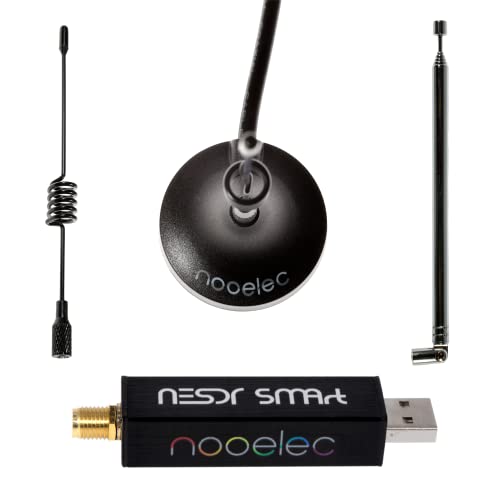
The widest published frequency range in the set, paired with a tighter oscillator than the other dongles here.
Best for: hobbyists who want the widest frequency coverage from a single dongle Skip it if: you need a self-contained radio with a screen and battery
The NESDR v5 tunes from 100kHz to 1.75GHz, the widest range published in this set. Its oscillator is rated at 0.5PPM, tighter than the 1PPM figure on the RTL-SDR Blog V3. In practice that means less retuning during long SSB sessions and better behaviour at UHF, where a small percentage error becomes a large offset. Nooelec claims HF SNR is improved by up to 15dB over the RTL-SDR v3 and VHF/UHF SNR by up to 6dB, though those are the manufacturer's numbers and worth treating as directional rather than absolute.
The bundle ships with three antennas and an aluminium enclosure at 5.26 oz. Dimensions are 0.39 x 1.97 x 1.57 in, small enough to leave permanently plugged into a laptop. A 2 year manufacturer warranty matches the longest in this group. Against the cheaper RTL-SDR Blog V3 Dongle Only, you pay more for the tighter oscillator, the extra antennas and the higher published ceiling; against the standalone receivers, you accept that the NESDR needs a host computer to do anything at all.
Pros:
- Widest frequency range here, 100kHz-1.75GHz
- 0.5PPM TCXO, tighter than the 1PPM alternatives
- Three antennas included in the box
- Aluminium enclosure at 5.26 oz
- 2 year manufacturer warranty
Cons:
- Needs a computer, phone or tablet to run
- HF below 25MHz still uses direct sampling
- Nooelec itself recommends an upconverter for serious HF
2. RTL-SDR Blog V3 with Dipole Antenna Kit — Best warranty
The dongle plus a working antenna in one box, with the longest stated warranty and the strongest sales position of the RTL-SDR Blog listings.

Best for: beginners who want a dongle plus a working antenna in one box Skip it if: you already own dipoles and only need the dongle
This is the RTL-SDR Blog V3 packaged with the multipurpose dipole antenna kit. The V3 tunes 500kHz to 1.7GHz with up to 3.2MHz of instantaneous bandwidth (2.4MHz stable), uses the R860 tuner, and includes a 1PPM TCXO, an SMA connector and an aluminium shielded body. The dipole kit is the one most tutorials assume you have, which matters because the biggest reason a first-time SDR buyer hears nothing is that they plugged the dongle straight into a random wire.
Warranty is 2 years on manufacturing defects. It sells faster than the rest of this set by a wide margin, which speaks to the value of buying the bundle over the bare dongle. The listing notes HF reception below 24MHz uses direct sampling with reduced performance, so if your priority is shortwave, upgrade to the Nooelec or budget for an upconverter. Against the Dongle Only version, the antenna kit is what turns a paperweight into a working receiver on day one.
Pros:
- Bundle includes portable VHF/UHF dipole antenna kit
- 500kHz-1.7GHz tuning range with 3.2MHz bandwidth
- 1PPM TCXO and SMA F connector
- 2 years warranty on manufacturing defects
- Aluminium shielded housing
Cons:
- HF below 24MHz uses reduced-performance direct sampling
- Lower frequency floor than the Nooelec (500kHz vs 100kHz)
- Costs more than the bare dongle for the same silicon
3. RTL-SDR Blog V3 Dongle Only — Best budget pick
The cheapest of the six, and the fastest way to see whether SDR is a hobby you want to keep.

Best for: a second dongle or a first-time trial on the cheapest terms Skip it if: you have no antenna to plug into it
The Dongle Only version of the RTL-SDR Blog V3 carries the same core electronics as the bundle above: 500kHz to 1.7GHz tuning, R860 tuner, 1PPM TCXO, HF Bias Tee, SMA F connector, aluminium shielded body. What it does not carry is an antenna. That is the whole trade. If you already have a dipole, a discone, or an outdoor long wire, buying the bare dongle is the right move. If you do not, you are one shipment away from a receiver you cannot use.
At the cheapest position in this set, it is also the natural choice for a second unit. Running two dongles side by side is how ADS-B enthusiasts combine coverage, and how you can monitor two bands simultaneously without swapping cables. The 2 years warranty on manufacturing defects matches the bundle. Against the Nooelec v5, you lose the 100kHz floor, the 0.5PPM oscillator and the antennas, in exchange for the lowest ticket in the set. That is a reasonable trade for a known audience.
Pros:
- Cheapest of the six
- Same 500kHz-1.7GHz tuning as the bundled version
- 1PPM TCXO and SMA F connector
- Aluminium shielded housing
- 2 years warranty on manufacturing defects
Cons:
- No antenna in the box
- Needs a host computer and separate cabling
- Lower frequency floor than the Nooelec
4. yyiikee Portable SDR DSP Radio Receiver — Most versatile
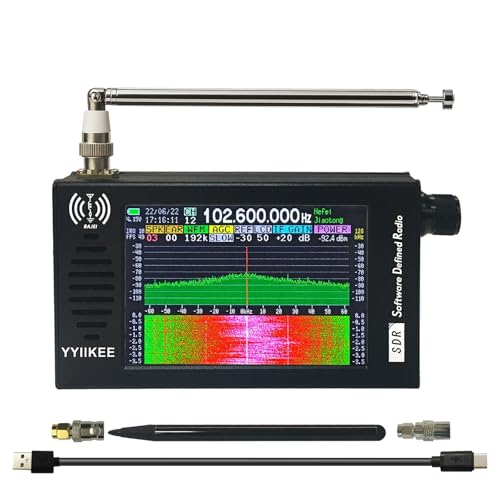
The standalone route, with a 4.3" touchscreen and a 192kHz spectrum view built in.
Best for: listeners who want a standalone receiver they can tune without a laptop Skip it if: you need coverage above 149 MHz
The yyiikee flips the SDR formula. Instead of a dongle plus a computer, it is a self-contained radio with a 4.3" touchscreen at 800x480 resolution, a CNC aluminium alloy case, and a rechargeable battery. The listing states 100kHz to 149MHz coverage, which spans HF, the FM broadcast band, airband, marine and the 2m amateur band. It supports CW, AM, SSB (LSB/USB), WFM and FM stereo through headphones, and shows a 192kHz spectrum with a waterfall.
Dimensions are 2.9 x 5.5 x 1 in, so it sits between a handheld ham radio and a shirt-pocket receiver. Warranty is 1 year. The main trade is the 149MHz ceiling, which cuts off UHF entirely; if you want to scan the 70cm amateur band, DMR trunks or ISM traffic at 433MHz, this is the wrong device. Against the dongles, you gain a screen, a battery and the ability to walk outside with the whole receiver in one hand. You lose the frequency headroom.
Pros:
- Self-contained receiver with 4.3" touchscreen
- 100kHz lower limit for HF work
- Real 192kHz spectrum and waterfall
- Rechargeable battery, CNC aluminium body
- Supports SSB, CW, AM, WFM and FM stereo
Cons:
- 149MHz ceiling rules out UHF
- 1 year warranty, shorter than the RTL-SDR Blog dongles
- No stated PPM figure for the oscillator
5. Raddy MLite-880 SDR Shortwave Radio Receiver — Best upgrade
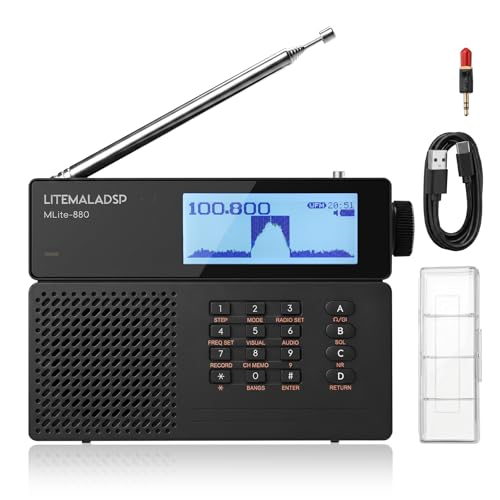
A standalone shortwave receiver with aviation band, adjustable noise reduction and a replaceable 5000mAh battery.
Best for: portable shortwave and aviation listening with a real waterfall display Skip it if: you want the cheapest way into SDR
The MLite-880 is the pick for a shopper who wants an SDR-derived receiver that behaves like a traditional shortwave portable. Raddy states full-band coverage with aviation band, a 2.3" real-time spectrum and waterfall, and multi-mode reception across SSB (LSB/USB), AM, CW, SAM, NFM and WFM. The DSP block adds adjustable noise reduction, notch filtering and AGC control. A dedicated keypad handles direct frequency entry, and a fine-tuning control offers adjustable steps.
Physical dimensions are 7.9 x 3.9 x 2 in, larger than the yyiikee and closer to a classic portable radio. Raddy specifies an extended 5000mAh 21700 lithium cell, replaceable and USB-C rechargeable, which matters on a receiver you actually take outside. The warranty is 18 months. The MLite-880 sells more slowly than the RTL-SDR Blog bundle here, and it sits at the second-most expensive position in this set, so the value case rests on the physical controls, the aviation band, and not needing a laptop.
Pros:
- Full-band SDR receiver with aviation coverage
- 2.3" real-time waterfall display
- Adjustable DSP noise reduction and notch filter
- Replaceable 5000mAh 21700 battery, USB-C charging
- Dedicated keypad and fine-tuning control
Cons:
- Second-most expensive here for a portable
- 18 month warranty, shorter than the dongles
- Bulkier than the yyiikee at 7.9 x 3.9 x 2 in
6. DJI SDR Transmission Combo — Best premium
Not a scanner. A 1080p/60fps wireless video link for camera crews that happens to use SDR in its name.

Best for: video crews who need low-latency wireless monitoring, not radio scanning Skip it if: you are shopping for a scanner or ham receiver
I have included the DJI SDR Transmission Combo because Amazon returns it for this query and buyers do click through by mistake. It is a paired transmitter and receiver for wireless camera monitoring. The listing states a 3km transmission distance, 1080p/60fps video, a bitrate up to 20Mbps and 35ms of latency, with auto frequency hopping across 2.4GHz and 5GHz bands. The receiver weighs 0.64 lb, measures 1.26 x 3.41 x 2.52 in, and offers SDI, HDMI, Wi-Fi and USB-C monitoring outputs. It was released in 2024.
None of that helps you tune shortwave, listen to airband or decode ADS-B. The "SDR" in the name refers to how the video link's radio is implemented, not to a general-purpose receiver you can point at the spectrum. It is the most expensive pick here for a reason: it is a different product category. Against the other five, its trade is total, since it does not overlap with any radio-scanning use case at all. If a film unit needs a reliable director's monitor feed, this is a fine product. For SDR reception, it is the wrong buy.
Pros:
- 1080p/60fps video at up to 20Mbps
- 35ms latency for near-live monitoring
- Auto frequency hopping across 2.4GHz and 5GHz
- SDI, HDMI, Wi-Fi and USB-C outputs
- Broadcast mode supports unlimited receivers
Cons:
- Not a spectrum-monitoring SDR receiver
- Most expensive pick in this set
- Does not tune HF, VHF or UHF radio bands
- Wrong category for anyone shopping this keyword
Dongle or standalone: which shape suits you?
This decision matters more than which brand you buy. A dongle is a peripheral. It connects to a computer over USB, runs software like SDR#, SDRuno, GQRX or CubicSDR, and lets that software do the demodulation and display. A standalone is a self-contained device with its own screen, battery and controls.
The dongle route:
- Cheaper for the same tuner silicon, since the host does the work
- Software choice is huge, and free
- Screen size limited only by your monitor
- Tied to a laptop, so less portable in practice
- Needs an antenna you probably do not already own
The standalone route:
- Turns on and works, no drivers, no software installs
- Portable in a jacket pocket or backpack side pouch
- Physical tuning knobs and keypads, not mouse clicks
- Smaller screens, typically 2.3" to 4.3"
- Locked to the manufacturer's demodulator quality and firmware
The honest split is this. If you already own a laptop and enjoy tinkering, buy a dongle. The Nooelec NESDR v5 or one of the RTL-SDR Blog V3 variants will land inside a working setup for less than any standalone here. If you want to sit in a garden, on a beach, or in a car and listen to shortwave without a laptop on your knees, buy the yyiikee or the Raddy MLite-880.
What the listings do not tell you about HF reception
Every HF-capable dongle here reaches its lower frequencies through direct sampling, and the listings say so. What they do not spell out is what direct sampling actually costs you. The RTL2832U was not designed to sample HF; the direct-sampling trick routes the antenna past the tuner and into the ADC, which works, but with reduced sensitivity, more images and more susceptibility to strong local signals.
That is why Nooelec itself recommends an upconverter for HF work, and why the RTL-SDR Blog listings state "reduced performance" below 24MHz. If your main interest is shortwave broadcast, amateur HF or CW below 30MHz, plan on either:
- Buying a Ham It Up or similar upconverter, which shifts HF up into a range the tuner handles natively.
- Choosing a standalone receiver with a proper HF front end, like the yyiikee or the Raddy MLite-880.
The other omission is grounding and antenna choice. A dongle plugged into a laptop USB port on a metal desk in an apartment full of switching power supplies will hear noise, not radio. You want the shortest cable to a real antenna outside the room and, ideally, a common-mode choke on the coax. None of the listings mention this, and it is the difference between hearing something and hearing nothing.
Head-to-head: Nooelec NESDR v5 vs RTL-SDR Blog V3
These are the two dongles most buyers of the best SDR receiver end up comparing, so it is worth laying them side by side on the specifications the listings actually publish.
- Frequency range: Nooelec 100kHz-1.75GHz vs RTL-SDR Blog 500kHz-1.7GHz. The Nooelec wins at both ends.
- Oscillator: Nooelec 0.5PPM TCXO vs RTL-SDR Blog 1PPM TCXO. Tighter on the Nooelec.
- Instantaneous bandwidth: RTL-SDR Blog states up to 3.2MHz (2.4MHz stable). Nooelec states up to 3.2MHz. Effectively the same.
- Antennas included: Nooelec three antennas. RTL-SDR Blog dipole kit in the bundle, none in the Dongle Only version.
- Warranty: Nooelec 2 year manufacturer warranty. RTL-SDR Blog 2 years on manufacturing defects. Effectively matched.
- Weight and size: Nooelec 5.26 oz at 0.39 x 1.97 x 1.57 in. RTL-SDR Blog dimensions vary by SKU.
The Nooelec wins on paper for HF work and long-session stability. The RTL-SDR Blog V3 wins on sales momentum and community familiarity, since a decade of tutorials assume it is the dongle on your desk. Neither is a wrong answer. If you can afford the Nooelec, take the wider range. If you would rather spend the difference on an antenna, the RTL-SDR Blog V3 with the dipole kit is the smarter package.
The verdict
The best SDR receiver for the widest audience is the Nooelec RTL-SDR v5 Bundle. It publishes the widest frequency range in this set at 100kHz to 1.75GHz, its 0.5PPM TCXO is the tightest of the dongles here, and it arrives with three antennas so you can actually receive something on day one. The 2 year manufacturer warranty matches the best on offer. Nothing else in this roundup pairs that ceiling, that oscillator and those inclusions.
Two conditions flip the recommendation. First, if your budget is the constraint and you already own a dipole or long wire, the RTL-SDR Blog V3 Dongle Only is the honest cheapest way in and carries the same 2 years of coverage on manufacturing defects. Second, if you refuse to sit at a laptop, the Raddy MLite-880 is the standalone that most closely matches what a "best SDR receiver" shopper actually wants: full-band coverage with aviation, a real waterfall, DSP noise reduction and a replaceable 5000mAh battery. The yyiikee portable is the alternate standalone, cheaper, smaller and with a bigger touchscreen, but its 149MHz ceiling narrows what you can hear. The DJI is a warning label, not a competitor. Buy it only if you need wireless camera monitoring.
FAQ
Is an SDR receiver worth it for a beginner?
An SDR receiver is worth it for a beginner if you want to explore multiple bands and modes without buying separate radios. A dongle like the RTL-SDR Blog V3 with dipole kit gets you on air quickly, spans 500kHz to 1.7GHz, and pairs with free software. The learning curve is real, but a weekend gets you from unboxing to hearing airband, FM broadcast and the 2m amateur band clearly.
What frequency range should the best SDR receiver cover?
The best SDR receiver should cover from below 1MHz up to at least 1.7GHz if you want the full hobbyist experience. The Nooelec NESDR v5 reaches 100kHz to 1.75GHz. The RTL-SDR Blog V3 covers 500kHz to 1.7GHz. Standalones like the yyiikee stop at 149MHz, which excludes UHF entirely. Match the range to the bands you actually want to hear before you spend anything.
Nooelec NESDR v5 or RTL-SDR Blog V3: which is better?
Nooelec NESDR v5 or RTL-SDR Blog V3 comes down to two numbers. The Nooelec publishes 100kHz to 1.75GHz coverage and a 0.5PPM TCXO. The RTL-SDR Blog V3 publishes 500kHz to 1.7GHz and a 1PPM TCXO. For HF work and stability, the Nooelec has the edge. For a working antenna in the box at lower cost, the RTL-SDR Blog V3 dipole bundle is the better first buy.
Can the best SDR receiver pick up shortwave clearly?
Can the best SDR receiver pick up shortwave clearly depends on the antenna and the front end. Dongles here use direct sampling below roughly 24MHz, which the listings themselves describe as reduced performance. For clean shortwave, either add an upconverter to a Nooelec or RTL-SDR Blog dongle, or choose a standalone like the yyiikee or Raddy MLite-880, which handle HF natively with DSP noise reduction.
What antenna do I need with the best SDR receiver?
What antenna do I need with the best SDR receiver depends on the bands you want. The RTL-SDR Blog V3 bundle ships with a portable VHF/UHF dipole, which covers airband, FM and 2m out of the box. The Nooelec v5 includes three antennas. For HF, add a long wire outside, keep coax runs short, and use a common-mode choke to reduce noise from nearby electronics and switching supplies.
The path in is simple. Order the Nooelec RTL-SDR v5 Bundle if you have a laptop and want the widest coverage on day one, and download SDR# or CubicSDR while it ships. Order the RTL-SDR Blog V3 with the dipole kit if you would rather save the difference and spend it on a proper outdoor antenna later. What makes the Nooelec the right default is not any one specification in isolation. It is the combination of a 100kHz floor, a 0.5PPM oscillator, three antennas in the box, and a 2 year warranty on a dongle small enough to leave permanently plugged in. Few peripherals earn their desk space that fast.
Last updated: September 7, 2026. Product availability re-checked.
This page contains affiliate links. As an Amazon Associate we earn from qualifying purchases, at no extra cost to you.