Best Dual Monitor Arm for Programmers by Reach

Six dual monitor arms compared on published reach, load limits, screen range and warranty length, with a named winner and three conditions that flip the pick.

By Lamar CalhounUpdated 17 min read
On this page
- Best dual monitor arm for programmers at a glance
- Which buyer does each arm actually fit?
- Why extension reach beats load rating
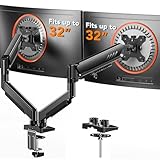
- 1. ErGear Dual Monitor Arm — Best overall
- 2. WALI Adjustable Dual Monitor Arm — Best budget pick
- 3. MOUNTUP Dual Monitor Stand — Most versatile
- 4. VIVO Dual Monitor Stand — Best for families
- 5. HUANUO FlowLift Pro — Best upgrade
- 6. HUANUO Stacked Dual Monitor Stand — Best premium
- Will it clamp to your desk?
- Stacked or side by side for a coding setup?
- What the listings do not tell you
- What more money buys in this set
- The verdict
- FAQ
The best dual monitor arm for programmers is the ErGear Dual Monitor Arm, because it pairs a 19.8 lbs per-screen ceiling with a 13-32 inch range and a 5-year warranty, which is the widest window in this six-arm set. If you run panels no bigger than 27 inches and adjust them several times a day, the HUANUO FlowLift Pro is the better buy for its 15.4 lbs arms and tension window.
Most guides for this category compare load ratings. That is not what decides it. Two of these six list the identical 19.8 lbs limit and a third goes higher, so the number stops separating them almost immediately. Reach does the separating. A programmer running an IDE on one screen and logs on the other needs both panels far enough forward to sit at arm's length, and the published extension figures here range from 17.3 inches up to 19.3 inches.
Best dual monitor arm for programmers at a glance
| Pick | Screen range | Max load per arm | Price |
|---|---|---|---|
Best overall ErGear Dual Monitor Arm |
13"-32" | 19.8 lbs 5-year warranty |
Check Price |
Best budget pick WALI Adjustable Dual Monitor Arm |
13"-32" | 22 lbs claim 10-year warranty |
Check Price |
Most versatile MOUNTUP Dual Monitor Stand |
17"-32" | 4.4-17.6 lbs 2-year warranty |
Check Price |
Best for families VIVO Dual Monitor Stand |
17"-32" | 4.4-19.8 lbs 3-year warranty |
Check Price |
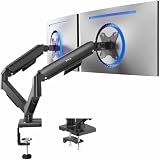
Best upgrade HUANUO FlowLift Pro |
13"-27" | 15.4 lbs 5-year warranty |
Check Price |
Best premium HUANUO Stacked Dual Monitor Stand |
17"-32" | 19.8 lbs no stated warranty |
Check Price |




Which buyer does each arm actually fit?
I built this shortlist around buyer profiles rather than a spec sheet ranking, because the screens you already own decide most of it for you.
Six arms, six people:
- You run two 32-inch panels. Four of these six accept a 32-inch screen. The ErGear, WALI, MOUNTUP and VIVO all list it; the FlowLift Pro stops at 27 inches.
- Your screens are heavy. WALI claims 22 lbs per arm, the highest published figure here. ErGear, VIVO and the stacked HUANUO list 19.8 lbs.
- Your screens are light and you reposition constantly. MOUNTUP's stated window runs 4.4 lbs to 17.6 lbs, the lowest ceiling in the group.
- You have almost no desk depth. Only the HUANUO stacked mount puts one screen above the other rather than beside it.
- You share the desk. VIVO describes mechanical spring counterbalance and 360° rotation, which suits a screen that gets swung around several times a day.
- You want the longest cover. WALI lists 10 years, the longest stated in this set. ErGear and the FlowLift Pro list 5 years each.
Notice what is not on that list: language support, IDE compatibility, anything code-specific. No arm here publishes a specification aimed at developers. The best dual monitor arm for programmers is simply the one that holds your screens at the reach and height your neck needs, and that is a hardware question about weight, VESA pattern and desk edge.
Why extension reach beats load rating
Here's the trick with this category. Load capacity gets top billing in every listing title, but it fails as a tiebreaker the moment you compare three arms rated at exactly 19.8 lbs. A 27-inch IPS panel usually sits well under those limits anyway once you strip the factory stand.
Reach is the figure that changes how the desk feels. ErGear says its arms extend and lift up to 17 inches of height adjustment. WALI claims 19.3 inches of horizontal extension and 17.3 inches of lift, the longest published reach here. MOUNTUP lists 17.3 inches of arm extension. HUANUO's stacked mount claims a 17-inch extension pole raising screens up to 25.19 inches.
Why it matters for code:
- Long lines of text push you to sit further back, and a short arm forces the screen toward you instead.
- A second screen angled inward needs horizontal travel, not vertical.
- Docking a laptop under the primary screen eats depth that the arm has to give back.
Height range is the other half. Getting the top edge of the screen near eye level is the whole ergonomic argument, and HUANUO says the FlowLift Pro is backed by the American Chiropractic Association for exactly that reason. That is the manufacturer's claim rather than a measured result, so treat it as a design intent.
1. ErGear Dual Monitor Arm — Best overall
The widest usable combination here: 13-32 inch screens, 19.8 lbs per side, and 5 years of stated cover at the second-cheapest position in this set.
Best for: two 27-inch to 32-inch screens on a desk with real depth behind it Skip it if: your desk is shallow and the base would overhang the back edge
What sets the ErGear apart in this group is that nothing about it narrows. The 13-32 inch range is the broadest published here, matched only by WALI. The 19.8 lbs limit clears most 32-inch panels once the factory stand comes off. The 5-year warranty is longer than four of the other five listings state. Model EGDMA70B-DS-UK, black, single unit.
ErGear says the VESA plate installs tool-free in three steps and that the upgraded head cuts the gap by 50 percent for a tighter fit. It also claims independent height adjustment up to 17 inches per arm and tool-free cable clips. Those are listing claims, not measurements, but the pattern support is concrete: VESA 100x100mm.
The listed footprint is 18.1 x 30.7 x 5.91 in, which is the largest published dimension set in this roundup. That is the trade-off. Against MOUNTUP's compact 5.75 x 16.7 x 8.35 in listing, the ErGear takes more room behind the screens, and only one seller lists it, so you have no fallback if that one goes quiet.
Pros:
- 13-32 inch range, widest published here
- 19.8 lbs per screen ceiling
- 5-year warranty, longer than four rivals
- Tool-free VESA plate per the listing
- Second-cheapest of the six
Cons:
- Largest published dimensions in this set
- Only one seller lists it
- VESA 100x100mm only, no 75x75mm stated
- No published unit weight to plan desk clamping
2. WALI Adjustable Dual Monitor Arm — Best budget pick
The cheapest of the six, and it still publishes the highest load rating and the longest warranty in the group.

Best for: heavier 32-inch screens when you'd rather not spend up Skip it if: you want a single named seller and a smaller footprint
WALI is the outlier on paper. It is the cheapest here, yet its listing claims 22 lbs per arm, more than the 19.8 lbs that ErGear, VIVO and the stacked HUANUO state. It also lists a 10-year warranty, double the 5 years from ErGear and the FlowLift Pro, and five times the 2 years MOUNTUP publishes. Model GSMP002N, released 2024, 8.16 lb unit weight.
The reach figures are the other reason it earns a place. WALI claims 19.3 inches of horizontal extension and 17.3 inches of lift above the desktop, the longest published extension in this comparison. Mounting is flexible too: C-clamp or grommet, both quoted for desks 0.39-2.76 in thick. Screen range runs 13 inches to 32 inches with VESA 75x75mm and 100x100mm patterns supported.
Where it gives ground is polish. There's no published dimension set, so you cannot plan clearance behind the desk before it arrives, and three sellers list it, which means the item you receive may not ship from WALI directly. The listing also leans on generic full-motion language rather than describing a named tension system, unlike the FlowLift Pro.
Pros:
- Cheapest of the six
- 22 lbs per arm, highest published rating here
- 10-year warranty, longest in this set
- 19.3 in extension, longest published reach
- Both C-clamp and grommet mounting
Cons:
- No published overall dimensions
- Three sellers list it, so fulfilment varies
- No named tension or lock system described
- Desk thickness capped at 2.76 in
3. MOUNTUP Dual Monitor Stand — Most versatile
The most compact published footprint here, with pneumatic arms and both clamp styles, if your screens stay under 17.6 lbs.

Best for: lighter 24-inch to 27-inch panels and an awkward desk edge Skip it if: either monitor weighs more than 17.6 lbs
MOUNTUP's advantage in this set is size. Its listed 5.75 x 16.7 x 8.35 in dimensions are the smallest published here, well under the ErGear's 18.1 x 30.7 x 5.91 in, and the unit weighs 8.51 lb. That compactness is what makes it the flexible choice for a desk with a shelf, a wall or a cable tray in the way.
The listing describes pneumatic arms rather than mechanical springs, quotes 17.3 inches of arm extension, and states cable management channels that conceal wires inside the arms. Screen support runs 17 inches to 32 inches across VESA 75x75mm and 100x100mm, with C-clamp or grommet installation. Model MU0005.
The catch is the load window: 4.4 lbs to 17.6 lbs. That is the lowest ceiling in this roundup, more than 2 lbs below what ErGear, VIVO and the stacked HUANUO claim, and 4.4 lbs under WALI's figure. A 32-inch panel is entirely capable of exceeding it. The 2-year warranty is also the shortest stated here, against WALI's 10 years. Weigh your screens before you commit.
Pros:
- Smallest published footprint in this set
- Pneumatic arms with 17.3 in extension
- Cables routed inside the arms
- C-clamp and grommet options included
Cons:
- 17.6 lbs ceiling, lowest here
- 2-year warranty, shortest stated in this set
- Minimum 4.4 lbs per screen limits small panels
- Starts at 17 inches, so no 13-inch support
4. VIVO Dual Monitor Stand — Best for families
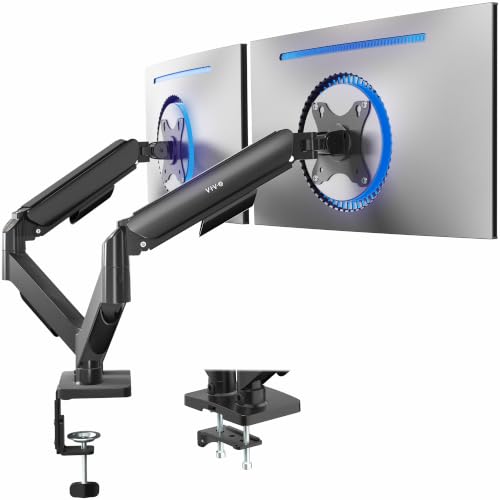
Mechanical spring counterbalance with 360° rotation, which is what a shared desk needs when two people want different angles.
Best for: a shared desk where more than one person repositions the screens Skip it if: your desk sits flush against a wall
VIVO's case rests on movement. The listing quotes +90° to -90° tilt, 180° swivel and 360° rotation, and describes mechanical spring adjustment with counterbalance in all directions. On a desk where a partner or a kid takes over in the evening, that combination matters more than a load figure nobody is testing.
Support runs 17 inches to 32 inches, 4.4 lbs to 19.8 lbs per screen, across VESA 75x75mm and 100x100mm. Mounting uses a heavy-duty C-clamp for tops up to 3 inches thick or thereabouts per the listing, and VIVO says the open-top VESA plates let monitors slide on. Model STAND-V002O, black, 3-year warranty.
VIVO is candid about one limitation, and it deserves flagging: the listing states the back of the arms will extend past the edge of your desk. If the desk is pushed against a wall, that is a hard blocker. It's also fourth-cheapest of the six, so you pay more than the ErGear for a narrower screen range and a shorter warranty, and no unit weight or dimension set is published.
Pros:
- 360° rotation and 180° swivel per the listing
- Mechanical spring counterbalance described
- 19.8 lbs per screen, matching the top of this set
- Handles desk tops up to roughly 3 in thick
Cons:
- Arms extend past the rear desk edge, per the listing
- 3-year warranty against WALI's 10 years
- Starts at 17 inches, no 13-inch support
- No published weight or dimensions
- Costs more than ErGear for a narrower range
5. HUANUO FlowLift Pro — Best upgrade
The only arm here with a described tension window, so you set spring resistance by sight rather than by trial and error.

Best for: 13-inch to 27-inch screens you move several times a day Skip it if: you run 32-inch panels
Adjustment quality is the FlowLift Pro's pitch, and it is the only listing in this set that names a mechanism for it. HUANUO describes a PrecisionView window that shows tension rather than leaving you to judge by feel, plus a LockSteady system it says resists sagging and moves with one finger. It also calls the arm MechaSpring and claims 2x longer life with a dual C-clamp.
The 5-year warranty ties the ErGear for second-longest here. Unit weight is 9.26 lb, the heaviest published in this roundup, which usually signals more metal in the post. Model HNDMA119B-DS. HUANUO says the American Chiropractic Association backs the design for reducing neck and back strain, which is the brand's claim about intent.
The constraint is screen size. At 13-27 inches, this is the only arm here that will not take a 32-inch panel, and four of the other five will. Load tops out at 15.4 lbs, second-lowest after MOUNTUP's 17.6 lbs. It also sits at the fifth price position, so you pay near the top of this set for the narrowest screen range. Three sellers list it.
Pros:
- Visible tension window, unique in this set
- 5-year warranty
- Heaviest published unit at 9.26 lb
- Tool-free VESA mount per the listing
- Accepts screens down to 13 inches
Cons:
- Caps at 27 inches, narrowest range here
- 15.4 lbs load, second-lowest in this set
- Second-highest price position for less screen support
- No published dimensions to plan clearance
6. HUANUO Stacked Dual Monitor Stand — Best premium
The only stacked mount here, putting one screen above the other and freeing desk width no side-by-side arm can match.

Best for: a narrow desk where two screens cannot sit side by side Skip it if: you need a published warranty
This is the structural outlier, and it is the reason it stays in the roundup. Every other pick spreads two screens horizontally. HUANUO's stacked mount goes vertical, which is a genuinely different answer for anyone whose desk is not wide enough for two 27-inch panels plus a keyboard.
HUANUO claims a 17-inch extension pole that elevates monitors up to 25.19 inches, the tallest published lift figure here, plus 90° tilt, 180° swivel and 360° rotation. Screen support runs 17 inches to 32 inches at up to 19.8 lbs, with VESA 75mm and 100mm patterns. Mounting covers desks 0.39-3.54 in thick, the widest desk thickness range in this set. Listed dimensions are 17 x 6.9 x 8 in, count 2, model HNDS8.
Two things count against it. It is the most expensive pick here, and its listing publishes no warranty at all, while five of the six others state between 2 and 10 years. Stacking also puts the upper screen well above eye level, which is the opposite of the ergonomic goal for the screen you read most. Treat the top panel as a reference display.
Pros:
- Only stacked layout in this set
- Lift to 25.19 in claimed, tallest here
- Handles desks 0.39-3.54 in thick, widest range
- 19.8 lbs per screen
Cons:
- No stated warranty, unlike five rivals
- Most expensive pick in this roundup
- Upper screen sits above eye level
- Vertical layout suits fewer setups than side by side
- Compatibility notes require three conditions to match
Will it clamp to your desk?
The clamp is where most of these installations go wrong, and it is checkable in 60 seconds with a tape measure. Measure your desktop thickness, then measure the clear space behind the rear edge.
Published desk thickness limits:
- HUANUO stacked mount: 0.39-3.54 in, the widest here
- VIVO: tops up to roughly 3 in per the listing
- WALI: 0.39-2.76 in, either C-clamp or grommet
- MOUNTUP: C-clamp or grommet, no thickness range stated
- ErGear and FlowLift Pro: no thickness range published, FlowLift Pro describes a dual C-clamp
A grommet base is the fix for desks outside the clamp range or with a lip that blocks the jaw, and WALI and MOUNTUP both state grommet hardware in the box. Drilling a hole is not reversible, so measure first.
Rear clearance is the second trap. VIVO says outright that the arms extend past the desk edge, and any post-mounted arm needs a few inches of breathing room behind it to swing. The ErGear's published 18.1 x 30.7 x 5.91 in footprint is the largest here, which is one more reason to check the gap between desk and wall before ordering. Nothing about picking the best dual monitor arm for programmers changes this: the desk decides.
Stacked or side by side for a coding setup?
Five of these six arms mount screens side by side. One stacks them. That is the real fork in the road once weight and screen size are settled.
Side by side wins when you have the width. Two panels at equal height means equal neck rotation to either side, and it suits the common developer split of editor on the left and terminal or browser on the right. Every arm here except the HUANUO stacked mount does this.
Stacking wins in narrow spaces. HUANUO's stacked mount claims monitors elevated up to 25.19 inches, which means the upper screen ends up well above your natural eye line. That is fine for a dashboard, a log tail or a chat window you glance at. It is uncomfortable for the screen holding your code, so plan on the lower panel being the primary.
A third option that this data supports: portrait orientation. Four listings here quote 360° rotation, which means a screen can be turned vertical. A vertical 27-inch panel shows a lot more of a file at once, and it is one of the few genuinely code-specific gains an arm can give you. Check your panel's own bezel clearance before committing to it.
What the listings do not tell you
I compared the published specifications side by side, and the gaps are as informative as the figures. Four things you will not learn from any of these six listings:
- Post diameter and material. No listing here publishes it, so you cannot judge flex from the data.
- Cable channel capacity. ErGear mentions clips, MOUNTUP mentions internal concealment, and neither states how many cables fit.
- Whether your specific panel clears the arm. HUANUO's stacked mount and the FlowLift Pro both state three compatibility conditions that must all be met, which is a hint that odd-shaped screens fail.
- Unit weight for half the set. WALI lists 8.16 lb, MOUNTUP 8.51 lb and the FlowLift Pro 9.26 lb. ErGear, VIVO and the stacked HUANUO publish none.
Two figures you should get yourself. First, your monitor's actual weight without its stand, which is usually printed in its own manual and is often several pounds less than the boxed weight. Second, your VESA pattern, either 75x75mm or 100x100mm. ErGear's listing states 100x100mm only. The other five state both.
What more money buys in this set
Not much, and that is the useful finding. The cheapest pick, WALI, publishes the highest load rating at 22 lbs, the longest reach at 19.3 inches, and the longest warranty at 10 years. The most expensive pick publishes no warranty at all.
Reading the tiers:
- Entry positions buy you the widest screen ranges. Both the ErGear and WALI cover 13-32 inches, and both come in below the four pricier picks.
- Middle positions buy layout flexibility rather than capability. MOUNTUP's compact footprint and VIVO's counterbalance are real advantages on the right desk, but both start at 17 inches and neither beats WALI's load figure.
- Top positions buy a mechanism or a shape. The FlowLift Pro buys the tension window and a 5-year warranty at the cost of 32-inch support. The stacked HUANUO buys a vertical layout nothing else here offers.
So spend up only for a reason you can name. If your answer to "why this one" is a specific desk constraint or a specific adjustment habit, the premium picks earn it. If your answer is a vague sense that more money means sturdier, the data does not back you.
The verdict
Entry tier, and this is where most programmers should land: the ErGear Dual Monitor Arm is the default. Nothing else here combines a 13-32 inch range, 19.8 lbs per screen and a 5-year warranty at that price position. The WALI sits alongside it as the cheapest pick, publishing an even higher 22 lbs rating, 19.3 inches of extension and a 10-year warranty, and it is the smarter buy if your screens are genuinely heavy or you want the longest cover.
Middle tier buys shape, not strength. Take the MOUNTUP if your desk edge is crowded and its 5.75 x 16.7 x 8.35 in footprint solves a clearance problem, accepting the 17.6 lbs ceiling. Take the VIVO if several people share the desk and its 360° rotation and spring counterbalance will actually get used, and only if there's clearance behind the rear edge.
Premium tier buys a mechanism or a layout. The HUANUO FlowLift Pro is worth it if you reposition screens daily and want the tension window, provided both panels are 27 inches or under. The stacked HUANUO is worth it only if your desk cannot fit two screens side by side, and you accept that no warranty is published.
The cutoff is your screen weight. Under 15.4 lbs, everything here is open to you. Over 17.6 lbs, it comes down to ErGear, WALI or VIVO.
FAQ
Is a dual monitor arm worth it for a programmer?
A dual monitor arm is worth it if you spend six or more hours a day at two screens. Getting the top edge near eye level is the whole point, and these arms claim 17 inches to 17.3 inches of height adjustment. HUANUO says the FlowLift Pro is backed by the American Chiropractic Association for reducing neck strain. You also reclaim the desk space two factory stands occupy.
Which is the best value dual monitor arm for programmers here?
The best value dual monitor arm for programmers in this set is the WALI, because it is the cheapest of the six while publishing the highest load rating at 22 lbs per arm, the longest extension at 19.3 inches, and a 10-year warranty. Nothing pricier here beats all three figures. Its downside is no published dimensions, so plan clearance carefully.
What VESA pattern do these dual monitor arms support?
The VESA pattern support splits the field. Five of the six state both 75x75mm and 100x100mm: WALI, MOUNTUP, VIVO, the FlowLift Pro and the stacked HUANUO. ErGear's listing states 100x100mm only. Check the four screw holes on the back of your monitor and measure between their centres in millimetres before you order anything.
ErGear or HUANUO FlowLift Pro for a coding setup?
Choosing between ErGear and HUANUO FlowLift Pro comes down to screen size. ErGear takes 13-32 inch panels at 19.8 lbs each, so it fits a 32-inch main display. The FlowLift Pro caps at 27 inches and 15.4 lbs, but it is the only arm here with a described tension window and it costs more. Big screens: ErGear. Frequent repositioning of smaller screens: FlowLift Pro.
What mistake do first-time monitor arm buyers make?
The mistake first-time buyers make is chasing load ratings and ignoring the desk. VIVO's own listing warns the arms extend past the rear edge. Clamp ranges vary from 0.39-2.76 in on the WALI up to 0.39-3.54 in on the stacked HUANUO. Measure desktop thickness and rear clearance before you compare a single specification.
Measure three things this afternoon: your desktop thickness, the clear space behind the rear edge, and each monitor's weight without its stand. Those three numbers will eliminate at least half of this set for you, which is faster than any spec comparison. Then start with the ErGear. It is the arm that asks the fewest questions of your hardware, covering 13 inches to 32 inches and 19.8 lbs per side with 5 years of stated cover behind it, and a broad-fit arm is the one you keep when the screens on your desk change next year.