Best Compact WiFi Router for Students: Dorm Picks
Five compact wifi routers ranked for dorms, shared apartments and study-abroad terms, with the specs that actually decide the pick.

By Lamar CalhounUpdated 14 min read
On this page
- Best compact wifi router for students at a glance
- How I screened this shortlist
- What actually decides a compact router for a dorm
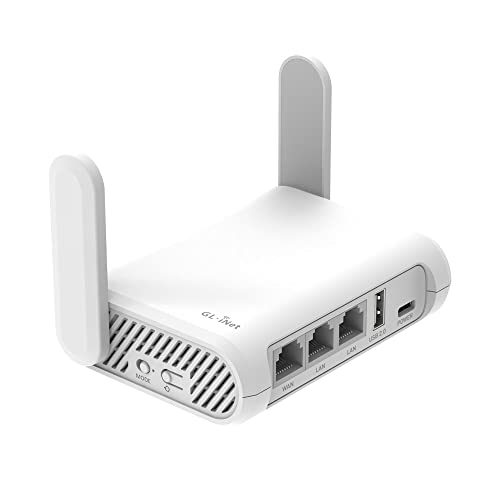
- 1. GL.iNet GL-SFT1200 Opal Travel Router — Best overall
- 2. TP-Link Roam 6 AX1500 Portable Wi-Fi 6 Travel Router — Best warranty
- 3. TP-Link AX1800 WiFi 6 Router — Most versatile
- 4. GL.iNet GL-MT3000 Beryl AX Wi-Fi 6 Travel Router — Best premium
- 5. NETGEAR WiFi 6 Router 4-Stream — Best upgrade
- Travel router or desktop router: which suits student life?
- How much coverage do you really need in a dorm room?
- What the listings do not tell you
- The verdict
- FAQ
The best compact wifi router for students is the GL.iNet GL-SFT1200 Opal: it weighs 0.66 lb, measures 3.35 x 4.65 x 1.18 in, and carries a 2-year warranty in the cheapest slot of this set. If you move between campus, home and hotel networks every few weeks, the TP-Link Roam 6 at 5.44 oz is the better compact wifi router for students on the road.
Best compact wifi router for students at a glance
| Pick | Wi-Fi standard | Weight | Price |
|---|---|---|---|
Best overall GL.iNet GL-SFT1200 Opal |
AC1200 dual-band | 0.66 lb | Check Price |
Best warranty TP-Link Roam 6 AX1500 |
Wi-Fi 6, AX1500 | 5.44 oz | Check Price |
Most versatile TP-Link Archer AX21 |
Wi-Fi 6, AX1800 | 1.1 lb | Check Price |
Best premium GL.iNet GL-MT3000 Beryl AX |
Wi-Fi 6, AX3000 claim | 6.91 oz | Check Price |
Best upgrade NETGEAR Nighthawk R6700AX |
Wi-Fi 6, AX1800 | 1.41 lb | Check Price |




How I screened this shortlist
Amazon's search for a student-specific router is loose: the marketplace does not tag routers by who buys them, so the "students" qualifier here is partial at best. I treated it as a set of practical constraints instead. A dorm-friendly compact wifi router for students has to fit on a shared desk, survive four moves in four years, and either handle one room well or one small apartment cleanly.
Three reasons picks were cut before this list:
- Bulky towers with vertical antennas. Anything taller than a textbook loses on a shared desk.
- No published warranty. A router that ships without a stated coverage window is a bad bet on gear that moves every August.
- Enterprise or gaming-first features. Link aggregation, gaming QoS suites, and 10G ports are money spent on things a student rarely uses.
What survived is a five-product set with two categories inside it. Three are travel routers under 7 oz. Two are desktop routers around a pound. Every one publishes a warranty. Every one runs on Wi-Fi 6 except the Opal, which sticks to AC1200 and takes the entry price slot for that reason.
What actually decides a compact router for a dorm
Most guides compare peak Wi-Fi speed. That is not what decides it.
Peak speed is a ceiling that campus internet almost never reaches. A student on a shared dorm connection is more likely bottlenecked by the building's uplink than by the router in the room. The specification that actually matters is a mix of three things:
- Physical footprint, so the router fits on a desk already holding a laptop stand and a monitor.
- Warranty length, because a router bought freshman year should still be under cover during a study-abroad term junior year.
- Ports and power flexibility, so it works whether the room has ethernet in the wall, a captive-portal Wi-Fi login, or nothing but a USB-C brick.
Four of these five picks carry a 2-year warranty. Only the NETGEAR R6700AX ships with a 1-year limited warranty, which is the shortest cover in the set. That single figure moved it out of the winner's slot despite its published 1,500 sq. ft. coverage claim.
1. GL.iNet GL-SFT1200 Opal Travel Router — Best overall
The Opal wins because it puts a full gigabit port set, VPN support and a 2-year warranty in the smallest and cheapest package here.
Best for: a single dorm room with a wired ethernet jack and a VPN habit Skip it if: you need one router to cover a whole shared apartment
The Opal is the smallest desktop-capable router in this set at 3.35 x 4.65 x 1.18 in and 0.66 lb, and it sits in the cheapest slot. GL.iNet states dual-band AC1200 speeds of 300 Mbps on 2.4 GHz and 867 Mbps on 5 GHz, which is well above what a typical shared dorm uplink delivers. What separates it from the two TP-Link travel routers is the port layout: GL.iNet lists two gigabit LAN ports and one gigabit WAN port, so a student can wire in a desktop and a games console at the same time.
The listing also states that OpenVPN and WireGuard are pre-installed and that the router works with 30+ VPN service providers. For a compact wifi router for students who use university VPNs to reach library resources from off-campus, that matters. The trade-off against the pricier picks is Wi-Fi standard: this is AC1200, not Wi-Fi 6. If four roommates all stream 4K on the same box, the Archer AX21 is the better call.
Pros:
- Cheapest of the five picks in this set
- 2-year warranty on an entry-price router
- Two gigabit LAN ports plus one gigabit WAN
- OpenVPN and WireGuard pre-installed, per the listing
- 0.66 lb pocket-friendly footprint
Cons:
- AC1200, not Wi-Fi 6
- No published USB port for tethering
- Coverage not stated for larger apartments
2. TP-Link Roam 6 AX1500 Portable Wi-Fi 6 Travel Router — Best warranty
The Roam 6 is the lightest pick here at 5.44 oz and adds Wi-Fi 6 with a 2-year manufacturer warranty on a 2024 model.

Best for: students who travel between campus, home and hotel Wi-Fi Skip it if: you want gigabit LAN and USB 3.0 on the same box
At 5.44 oz and 1.1 x 4.09 x 3.54 in, the Roam 6 is the lightest router in the set by a clear margin: the Opal is 0.66 lb (roughly 10.6 oz), and the Beryl AX is 6.91 oz. TP-Link states Wi-Fi 6 speeds of 1201 Mbps on 5 GHz and 300 Mbps on 2.4 GHz. It launched in 2024, which is the newest release date among the travel routers here.
The Roam 6 earns its award for what the listing calls Hotspot Mode: it connects to public Wi-Fi and creates a private network for your devices, which is the exact use case for hotel and dorm captive portals that only allow one MAC address. TP-Link also states that the router can be powered by USB-C from a 5V/3A PD power bank, so a student on a train or a long study session can run it off a laptop charger. The downside against the Opal is fewer wired ports and no gigabit LAN pair.
Pros:
- 5.44 oz, the lightest pick here
- Wi-Fi 6 in a pocket form factor
- 2-year manufacturer warranty
- USB-C power from a standard PD source, per the listing
- Hotspot mode for captive-portal Wi-Fi
Cons:
- Fewer wired ports than the Opal
- No USB 3.0 for storage sharing
- Newer release means fewer third-party firmware options
3. TP-Link AX1800 WiFi 6 Router — Most versatile
The Archer AX21 is the desktop router in the set that stretches to cover a shared apartment while still fitting on a dorm desk.

Best for: a shared apartment where three or four roommates all stream at once Skip it if: your desk is small and you want something you can pocket
The Archer AX21 is 1.1 lb and measures 1.61 x 10.3 x 5.3 in, which reads long but sits flat: it lays on a shelf or the top of a mini-fridge without stacking upward. TP-Link states AX1800 speeds of 1200 Mbps on 5 GHz and 574 Mbps on 2.4 GHz, four high-gain antennas, and Beamforming for range. For a shared apartment with two or three bedrooms off a central living room, that is the right mid-tier compact wifi router for students who split rent.
TP-Link also lists OFDMA under Wi-Fi 6, which the brand says helps when many devices connect at once. A four-roommate household with two laptops, three phones and a smart TV each is exactly the load that eats older AC routers. The AX21 released in 2020, so it is the most established model here, and TP-Link states a 2-year manufacturer warranty. Its trade-off is size and portability: it does not travel, and its footprint takes real desk space.
Pros:
- AX1800 speeds for a shared apartment
- Four high-gain antennas per the listing
- 2-year manufacturer warranty
- Wi-Fi 6 OFDMA claim for multi-device homes
- Most established model in the set, released 2020
Cons:
- 10.3 in long footprint eats desk space
- Not a travel router and does not pocket
- Heaviest of the two TP-Link picks
4. GL.iNet GL-MT3000 Beryl AX Wi-Fi 6 Travel Router — Best premium
The Beryl AX is the only pick here with a 2.5G WAN port, USB 3.0 and OpenWrt firmware in a 6.91 oz body.

Best for: engineering and CS students who want OpenWrt, USB 3.0 and a 2.5G WAN Skip it if: you just need basic Wi-Fi and hate touching firmware
The Beryl AX is the most expensive travel router in the set and the most technical. GL.iNet lists dual-band speeds of 574 Mbps on 2.4 GHz and 2402 Mbps on 5 GHz, a 2.5G multi-gigabit WAN port, a 1G LAN port, and USB 3.0. It runs OpenWrt 21.02 firmware, which the brand says supports 5,000+ plug-ins. In a set where every other router runs stock firmware, that is the differentiator.
At 6.91 oz and 1.18 x 4.53 x 3.15 in, it is heavier than the Roam 6 but still pocketable. GL.iNet states WPA3 support and that it can run a VPN server and VPN client at the same time. For a CS student who wants to tunnel back to a home NAS from a dorm, that is the exact feature. The cost, beyond the price position, is complexity: OpenWrt rewards curiosity and punishes casual setup. Anyone who just wants a router that works on day one is better served by the Opal or the Roam 6.
Pros:
- 2.5G WAN port, unique in this set
- USB 3.0 for storage sharing
- OpenWrt 21.02 firmware per the listing
- Simultaneous VPN server and client claim
- 2-year warranty
Cons:
- Most expensive travel router here
- OpenWrt has a real learning curve
- Overkill for basic dorm Wi-Fi
5. NETGEAR WiFi 6 Router 4-Stream — Best upgrade
The R6700AX is the coverage pick: NETGEAR states 1,500 sq. ft. and 20 devices in a Wi-Fi 6 body.

Best for: a small off-campus apartment up to 1,500 sq. ft. Skip it if: you move rooms every semester and want a pocket-sized box
The Nighthawk R6700AX is 1.41 lb, the heaviest router here, and NETGEAR lists AX1800 speeds up to 1.8 Gbps and coverage up to 1,500 sq. ft. for up to 20 devices. This is the pick for a student living off campus in a small apartment where the AX21 might still work but the extra published coverage figure tips the decision. The listing also states WPA3 encryption, automatic firmware updates and a guest network, which is a useful trio when roommates hand out Wi-Fi passwords to visitors.
The weakness is warranty. NETGEAR states a 1-year limited warranty on this model, which is the shortest cover in this set. Every other pick lists 2 years. For a student buying a router as freshman-year gear that has to last four moves, that shorter window is a real cost. The 2025 release date is the newest here, so the model is current, but a compact wifi router for students who plan to keep the same box through graduation is better served by one of the 2-year picks.
Pros:
- 1,500 sq. ft. coverage claim per the listing
- Up to 20 devices, per NETGEAR
- WPA3 encryption and guest network
- Released 2025, newest model in this set
- Nighthawk app setup
Cons:
- 1-year limited warranty, shortest in this set
- 1.41 lb, heaviest pick here
- No travel form factor
Travel router or desktop router: which suits student life?
The five picks split cleanly into two shapes, and the decision comes before brand.
Travel routers, meaning the Opal, the Roam 6 and the Beryl AX, weigh between 0.66 lb and 6.91 oz, take USB-C power, and are built for one room or one hotel. If your Wi-Fi problem is a single dorm with a wall jack, a shared house where you want your own private network on top of the landlord's, or a semester abroad in three cities, this is your shape. All three list VPN support.
Desktop routers, meaning the Archer AX21 and the R6700AX, weigh 1.1 lb and 1.41 lb, need a wall outlet, and publish coverage claims aimed at whole apartments. If your Wi-Fi problem is four roommates streaming from four rooms, this is your shape. The Archer AX21 is the better balance on warranty. The NETGEAR wins on stated square footage.
The cutoff is roughly a doorway: if the router will only ever serve one room and a laptop, buy the travel shape. If it has to reach across a hallway or into a bedroom, buy the desktop shape.
How much coverage do you really need in a dorm room?
A standard dorm room is small enough that any of these routers covers it. The real question is whether your walls are cinder block and whether the router sits by the door or by the window.
NETGEAR states 1,500 sq. ft. and 20 devices for the R6700AX. TP-Link states four high-gain antennas and Beamforming on the Archer AX21 but does not publish a square-footage figure in the data supplied. The three travel routers do not publish coverage figures either, which is normal for that class: they are designed for a room, not a floor plan.
For a single room, coverage is not the deciding factor. Ports, weight and warranty are. For a shared apartment, the AX21 and the R6700AX are the two picks that carry the stated capability for the job.
What the listings do not tell you
Product pages describe features, not the day-to-day of student life. A few things worth knowing before you buy:
- Dorm networks often block routers. Many university IT departments prohibit personal routers on the wired ethernet jacks in dorm rooms, and enforce it by MAC address. The Roam 6's Hotspot Mode, which TP-Link says creates a private network on top of a public Wi-Fi, is the workaround: the router connects to campus Wi-Fi as a client, and your devices connect to the router. Check your dorm policy before you buy the Opal or the Archer AX21 expecting to plug them into a wall jack.
- Warranty transfers matter when you move. Four of these five carry a 2-year cover; the R6700AX carries 1 year. A router bought in freshman year with a 1-year warranty is out of cover by sophomore-year winter.
- USB-C power is not universal. The Roam 6 and Beryl AX list USB-C. The Opal, Archer AX21 and R6700AX do not, and use their own bricks. Losing the brick is a real risk in student life.
- Firmware updates are not automatic on every model. NETGEAR lists automatic firmware updates on the R6700AX. The other listings do not make that specific claim, so it is worth checking the app after setup.
The verdict
The best compact wifi router for students is the GL.iNet GL-SFT1200 Opal. It is the cheapest pick in the set, the smallest at 3.35 x 4.65 x 1.18 in and 0.66 lb, and it carries a 2-year warranty. It gives a student two gigabit LAN ports and one gigabit WAN, plus GL.iNet's stated OpenVPN and WireGuard support, which covers the university-VPN case that most other budget routers miss.
Two conditions flip the pick:
- If you travel between campus and home every few weeks, the TP-Link Roam 6 wins. At 5.44 oz it is the lightest in the set, and TP-Link states USB-C PD power from a bank plus Hotspot Mode for captive portals. Those two features answer the two things travel actually breaks.
- If you share an apartment with three or four roommates, the TP-Link Archer AX21 wins. It publishes AX1800 speeds and four high-gain antennas, and it holds a 2-year warranty, which the R6700AX does not match.
The Beryl AX is the CS-student pick. The R6700AX is the off-campus apartment pick when you want a published square-footage figure. Everyone else is better served by the Opal.
FAQ
Is a travel router worth it for a dorm room?
A travel router is worth it for a dorm when university policy blocks personal routers on the wired ethernet jack. The Roam 6's Hotspot Mode connects to campus Wi-Fi as a client and creates your own network on top of it, per TP-Link's listing. That gives you WPA-secured Wi-Fi for a printer, a games console and a laptop even when the wall jack is off limits.
Which is the best compact wifi router for students on a budget?
The best compact wifi router for students on a budget is the GL.iNet Opal. It sits in the cheapest slot of the five picks, weighs 0.66 lb, measures 3.35 x 4.65 x 1.18 in, and still carries a 2-year warranty and two gigabit LAN ports. Nothing else in the set matches that combination at the entry price band.
Do I need Wi-Fi 6 for a dorm room?
You need Wi-Fi 6 for a dorm room if your building's uplink is fast enough to benefit, and if you connect more than roughly five devices at once. The Opal is AC1200 and works fine for a laptop, a phone and a tablet. For heavier loads, the Roam 6, Archer AX21, Beryl AX and R6700AX are all Wi-Fi 6.
GL.iNet Opal or TP-Link Roam 6: which should a student pick?
Pick the Opal for a fixed dorm room with a wall ethernet jack: it has two gigabit LAN ports and lands in the cheapest slot. Pick the Roam 6 for travel: it is Wi-Fi 6, weighs 5.44 oz, released in 2024, and TP-Link states USB-C PD power from a battery bank. The Opal wins wired, the Roam 6 wins mobile.
What compact wifi router for students works with a university VPN?
Both GL.iNet picks list pre-installed OpenVPN and WireGuard clients and state compatibility with 30+ VPN service providers, per the listings. The Beryl AX further claims a simultaneous VPN server and client. The two TP-Link routers and the NETGEAR do not publish that same VPN-client feature set, so a student relying on a university VPN is best served by the Opal or the Beryl AX.
Pick the Opal, plug it into the wall jack tonight, and set up your VPN before the next assignment. That is the sequence that answers the actual problem behind this search: a small desk, a shared network you do not control, and a laptop that has to stay connected through moves, semesters, and one or two study-abroad terms. The Opal is the one router here that does all three jobs in the cheapest slot with a 2-year warranty, and it fits in a hand. Everything above it in this list is either bigger, more specialised, or shorter on warranty cover.