Best Compact Mini PC for Engineers Who Work From a Desk
A working engineer's guide to five compact mini PCs, ranked by CPU, memory ceiling and port layout, without a single price figure or star rating in sight.

By Lamar CalhounUpdated 16 min read
On this page
- Best compact mini PC for engineers at a glance
- How I screened this shortlist
- What actually decides a mini PC for engineering work
- 1. Getorli GT105 Ryzen 7 8745HS — Best overall
- 2. KAMRUI E3B Ryzen 5 7530U — Runner-up
- 3. Beelink SER3 Ryzen 3 3200U — Best for pros
- 4. Dell OptiPlex 3070 Micro — Best minimal setup
- 5. HP EliteDesk 800 G4 Mini — Best budget pick
- Does 'for engineers' really change the shortlist?
- New silicon or renewed enterprise: which risk do you take?
- How do these picks compare on ports and displays?
- What the listings do not tell you
- The verdict
- FAQ
The best compact mini PC for engineers is the Getorli GT105, an 8-core, 16-thread Ryzen 7 8745HS box with 16GB DDR5 and a 1TB PCIe 4.0 NVMe SSD in a chassis small enough to hide behind a monitor. If you would rather trade a little raw CPU headroom for a 2-year warranty and a full-function Type-C port that also charges, the KAMRUI E3B on Ryzen 5 7530U is the safer runner-up.
Best compact mini PC for engineers at a glance
| Pick | CPU | RAM / Storage | Price |
|---|---|---|---|
Best overall Getorli GT105 Ryzen 7 8745HS |
Ryzen 7 8745HS, 8C/16T, up to 4.9GHz | 16GB DDR5 1TB PCIe 4.0 NVMe |
Check Price |
Runner-up KAMRUI E3B Ryzen 5 7530U |
Ryzen 5 7530U, 6C/12T, up to 4.5GHz | 16GB LPDDR4X 512GB SSD |
Check Price |
Best for pros Beelink SER3 Ryzen 3 3200U |
Ryzen 3 3200U, 2C/4T, up to 3.5GHz | 8GB DDR4 256GB PCIe 3.0 SSD |
Check Price |
Best minimal setup Dell OptiPlex 3070 Micro |
Intel i5-9500, 6 cores | 8GB DDR4 250GB SSD |
Check Price |
Best budget pick HP EliteDesk 800 G4 Mini |
Intel i5-8500T, 6 cores, up to 3.5GHz | 16GB DDR4 256GB NVMe SSD |
Check Price |


How I screened this shortlist
I started with the mini PC subcategory on Amazon and pulled listings that fit three plain rules an engineer would set before opening a browser: a compact chassis you can mount behind a monitor, enough memory to keep an IDE and a browser open together, and a spec sheet detailed enough to compare. Marketing chassis renders were not enough. If the listing did not publish CPU generation, memory type and storage interface, it was cut.
That took the field down to five machines across two clear camps. Three are new Ryzen builds from Getorli, KAMRUI and Beelink. Two are renewed enterprise micros from Dell and HP, sold with the operating system reinstalled. Every pick here runs Windows 11 out of the box, every pick lists Wi-Fi and Bluetooth, and every pick fits the "hide behind the monitor" test.
What I could not screen for is anything Amazon does not publish: acoustic output under load, sustained thermal behaviour, and the exact stepping of renewed CPUs. Those are the gaps §7 tells me to name rather than paper over. Read every product section with that caveat in mind.
What actually decides a mini PC for engineering work
Most guides open by comparing clock speeds. That is not what decides the best compact mini PC for engineers. Two numbers matter more:
- Thread count against your actual workload. A modern IDE, a Docker daemon and two Chromium instances will saturate four threads before you notice. Eight threads is the floor for comfort, sixteen is the floor for anything that compiles or renders.
- Storage interface, not just capacity. A PCIe 4.0 NVMe drive reads several times faster than a SATA SSD of the same size, and it is the difference between a project opening instantly and a project opening with a coffee.
Memory bandwidth is the tie-breaker. DDR5 in the Getorli feeds an integrated Radeon 780M that shares system RAM, and shared-memory graphics are only as fast as the memory behind them. LPDDR4X in the KAMRUI is a step down but soldered close to the CPU. DDR4 in the two renewed micros is fine for terminals and documents, thin for anything more.
Ports decide the desk. Two of these picks publish USB4 or full-function Type-C, which lets one cable carry a 4K monitor, a dock and power delivery. The other three route displays through HDMI and DisplayPort only, which is not a problem, just a different cable count.
1. Getorli GT105 Ryzen 7 8745HS — Best overall
The Getorli GT105 is the only pick here that pairs a current 8-core Ryzen with DDR5 and PCIe 4.0 storage, which is what engineering work actually needs.

Best for: engineers running CAD, simulation and virtualisation on a tidy desk Skip it if: you only need a browser, email and a couple of Office tabs
Getorli lists the Ryzen 7 8745HS as an 8-core, 16-thread CPU running 3.8GHz to 4.9GHz at a 54W to 65W TDP, paired with the Radeon 780M on RDNA 3. That is the only chip in this set with enough threads to keep a compiler, a VM and a browser tab honest at the same time, and it is the only pick with a proper DDR5 memory subsystem to feed those cores. Storage is a 1TB M.2 PCIe 4.0 NVMe SSD, which is the fastest storage interface in the shortlist. Getorli says one 16GB DDR5 stick ships in a single channel with room to move to dual channel by adding a second module, which matters more for the integrated GPU than for the CPU.
Ports are the other reason this leads. The listing describes two USB4 ports with PD 3.0, two USB 3.2 and two USB 2.0, plus dual 2.5G LAN, HDMI and DisplayPort. That is enough for a docked monitor, a second display and a wired network without a hub. It is the most expensive pick here, and the 1-year warranty is standard rather than generous.
Pros:
- 8-core, 16-thread Ryzen 7 8745HS, the strongest CPU in this set
- 1TB PCIe 4.0 NVMe SSD, the fastest storage interface here
- DDR5 memory with a second slot for dual-channel expansion
- Dual 2.5G LAN and two USB4 ports for docked workflows
- Radeon 780M integrated graphics on RDNA 3
Cons:
- The most expensive pick in the shortlist
- Warranty is only 1 year despite the price position
- Ships single-channel; a second DDR5 stick is an extra buy for full GPU performance
- No published weight or external dimensions in the listing
2. KAMRUI E3B Ryzen 5 7530U — Runner-up
The KAMRUI E3B is the sensible engineer's second choice: fewer cores, a 2-year warranty, and a full-function Type-C port that handles power, data and a 4K display over one cable.

Best for: engineers who want a longer warranty and a full-function Type-C port Skip it if: you need to add more than the two M.2 slots allow
KAMRUI lists the Ryzen 5 7530U as a 6-core, 12-thread Zen 3 CPU with a 15W TDP that can push to 28W, base 2.0GHz and boost 4.5GHz. That is two cores and four threads shy of the Getorli, and Zen 3 rather than Zen 4, but it is still enough for parallel builds and a comfortable VM. Memory is 16GB LPDDR4X and, importantly, the listing states it is non-upgradeable, so what ships is what you keep. Storage is 512GB on one of two M.2 2280 slots, and KAMRUI says the second slot is available for expansion.
Two things put this above the older renewed micros. First, the full-function Type-C port supports 10Gbps data, 4K/60Hz display output and charging, which is genuinely useful on a small desk. Second, the warranty is 2 years, the longest in this shortlist. The trade-off is memory ceiling: soldered LPDDR4X caps upgrades. At 3.04 lb it is the only pick with a published weight, small enough to travel.
Pros:
- 2-year warranty, the longest in this shortlist
- Full-function Type-C with power delivery and 4K/60Hz output
- 6-core, 12-thread Zen 3 CPU with a 28W boost ceiling
- Wi-Fi 6 rated to 2402 Mbps on the 5GHz band per KAMRUI
- Two M.2 2280 slots for storage expansion
Cons:
- Memory is soldered LPDDR4X and cannot be upgraded
- Slower storage generation than the Getorli's PCIe 4.0
- Second-most expensive pick here
- No published external dimensions in the listing
3. Beelink SER3 Ryzen 3 3200U — Best for pros
The Beelink SER3 is the light-duty professional pick: dual 4K display support and expandable DDR4, but only two cores to spread across your workload.

Best for: professionals running light coding, docs and dual 4K monitors Skip it if: your workload uses more than two cores at once
Beelink lists the Ryzen 3 3200U as a 2-core, 4-thread CPU up to 3.5GHz with a 4MB cache. That is the narrowest chip in this shortlist by a wide margin, and it is honest about what it is: a light-office and dual-monitor box, not a compile server. Where it earns its place is the memory design. Beelink ships one 8GB DDR4 SO-DIMM stick and leaves a second slot open, so you can move to dual-channel DDR4 later without replacing what you have, which is not something LPDDR4X pick two can do.
Storage is a 256GB PCIe 3.0 SSD, one generation behind the Getorli and two generations more modern than a SATA drive. Display output is dual HDMI at 4K, and networking is Wi-Fi 5 and Gigabit LAN, one step behind the Wi-Fi 6 on the newer boxes. It sells slower than the rest of this shortlist by a wide margin, and the specification sheet explains why: this is a 2019-era CPU in a 2024 chassis, and the two-thread limit shows up the moment you open a container.
Pros:
- Expandable dual-channel DDR4 with one slot free
- Dual 4K HDMI output for a two-monitor light-office desk
- 1-year warranty in the middle of this set
- Compact chassis, mid-priced for the shortlist
Cons:
- Only 2 cores and 4 threads, the narrowest CPU here
- Wi-Fi 5 and Gigabit LAN, one step behind the newer picks
- PCIe 3.0 storage, half the interface bandwidth of the winner
- Sells far more slowly than the other four picks in this shortlist
4. Dell OptiPlex 3070 Micro — Best minimal setup
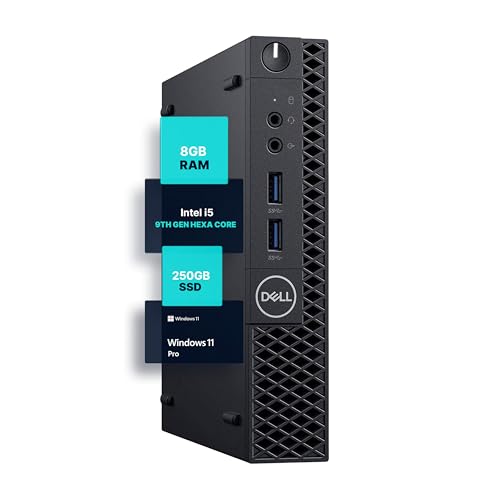
The Dell OptiPlex 3070 Micro is the enterprise-grade mini for a second desk: a full Core i5-9500 hexa-core in a chassis Dell built for offices, sold renewed.
Best for: a second desk, a home lab node or a reception workstation Skip it if: you want a machine covered for longer than a month
The OptiPlex 3070 Micro pairs a 9th-generation Intel Core i5-9500 hexa-core CPU with 8GB DDR4 and a 250GB SSD. That is a proper business-class CPU in a chassis engineers used to have under office desks by the pallet, and it is the reason this pick belongs on a shortlist for engineers even though it is a renewed unit. Dell publishes the dimensions as 4 x 12.1 x 13.3 in and 621.62 cubic in, which puts the actual footprint larger than the newer picks but still small enough to mount behind a monitor. Windows 11 Pro is preinstalled, and there is a Wi-Fi and Bluetooth adapter for wireless.
Two things pull it down the ranking. The RAM is thin at 8GB and DDR4 rather than DDR5, which is fine for browser and Office work but tight for a modern IDE. The bigger issue is the 30-day warranty, the shortest in this set by a wide margin. Renewed hardware is genuinely good value for a second workstation or a home lab node, but it is a poor first machine for anyone whose income depends on it. Treat this as the "extra desk" pick, not the "only PC" pick.
Pros:
- 6-core Intel i5-9500, real business-class CPU
- Windows 11 Pro preinstalled with Wi-Fi and Bluetooth
- Published external dimensions and volume figure
- Enterprise chassis designed for long office duty cycles
Cons:
- 30-day warranty, the shortest in this shortlist
- Renewed unit, so cosmetic wear and unknown component history
- Only 8GB DDR4, tight for engineering workloads without an upgrade
- Larger volume than the newer AMD picks here
5. HP EliteDesk 800 G4 Mini — Best budget pick
The HP EliteDesk 800 G4 Mini is the cheapest way onto this shortlist and the smallest pick by every measure, but the CPU is two generations older than the OptiPlex it competes with.

Best for: a very small under-desk machine for terminals and remote sessions Skip it if: you plan to render, compile large projects or edit video locally
HP publishes the 800 G4 Mini at 1.25 x 7 x 7 in and 2.93 lb, which makes it the smallest and lightest pick here by a clear margin. The CPU is an Intel Core i5-8500T hexa-core, up to 3.5GHz, an 8th-generation part that trades peak clock speed for the low "T" thermal envelope enterprise micros need. Memory is 16GB DDR4, which is the same count as the Getorli and the KAMRUI, and storage is a 256GB NVMe SSD. Dual monitor output is supported over HDMI and DisplayPort.
This is the cheapest of the five, and the specification list backs it up honestly: enterprise chassis, renewed condition, 90-day warranty. That warranty is three times longer than the Dell above it, which is a fair reason to prefer this one for a working desk if you are set on a renewed enterprise micro. What it cannot do is match the AMD picks on threads-per-watt or storage interface, and the i5-8500T runs at a lower sustained clock than the desktop-class i5-9500 in the Dell. If your work sits inside a browser and an SSH session, that gap does not matter. If it does not, spend the extra.
Pros:
- Cheapest pick in this shortlist by a clear margin
- Smallest chassis here at 1.25 x 7 x 7 in and 2.93 lb
- 16GB DDR4, the same memory count as the two premium picks
- 90-day warranty, three times the Dell's coverage
Cons:
- 8th-generation Intel CPU, the oldest silicon in this shortlist
- Renewed unit with possible cosmetic wear
- Lower-power "T" CPU trades sustained clock speed for thermals
- No published sustained TDP figure to compare against the Ryzen picks
Does 'for engineers' really change the shortlist?
Amazon's search does not filter by "engineer". It matches keywords, and none of these listings claims to be certified for engineering software. So take the qualifier as your own constraint, not a promise the marketplace kept.
What that means in practice: no product here is ISV-certified for SolidWorks, AutoCAD or MATLAB, and none carries a Quadro or Radeon Pro GPU. What the shortlist does give you is a set of small machines with enough CPU, memory and storage headroom for the everyday side of engineering work, which is documents, code, remote sessions, moderate CAD, VMs and containers. Heavy simulation, GPU rendering and finite-element analysis belong on a workstation with a discrete GPU, not on any mini PC in this category.
Judge each pick against your own tools. If your daily driver is Fusion 360 with modest assemblies, the Getorli will run it. If it is Ansys with a 20-million-cell mesh, none of these will.
New silicon or renewed enterprise: which risk do you take?
The shortlist splits neatly. Three picks are new AMD Ryzen builds from smaller brands. Two are renewed enterprise micros from Dell and HP. The choice is between two different risks.
- New AMD, unknown brand. You get current silicon, DDR5 or LPDDR4X, PCIe 4.0 storage and Wi-Fi 6. The risk sits with brand support: shorter track record, fewer serviceable parts, and warranty service that depends on the seller answering email.
- Renewed enterprise, known brand. You get a chassis Dell or HP shipped by the pallet, driver support that will exist in five years, and parts you can source from anywhere. The risk is cosmetic wear, an unknown service history, and warranty windows measured in days rather than years.
For a primary work machine, new silicon with a longer warranty is the safer bet, which is why the top two picks are AMD and the two renewed units sit lower. For a second desk, a lab node or a specific renewed-only budget, the enterprise micros are the smarter buy.
How do these picks compare on ports and displays?
Cable count decides the desk. Here is the port picture based only on what each listing publishes:
- Getorli GT105. 2x USB4 with PD 3.0, 2x USB 3.2, 2x USB 2.0, dual 2.5G LAN, HDMI, DisplayPort.
- KAMRUI E3B. Full-function Type-C for power, 10Gbps data and 4K/60Hz output, plus triple 4K display support per the listing.
- Beelink SER3. Dual HDMI at 4K, USB 3.2, Gigabit LAN, Wi-Fi 5, Bluetooth 5.0.
- Dell OptiPlex 3070 Micro. Windows 11 Pro preinstalled, HDMI, DisplayPort and Wi-Fi/Bluetooth per the listing. The renewed listings publish less port detail than the new AMD boxes.
- HP EliteDesk 800 G4 Mini. HDMI, DisplayPort, dual monitor support, Wi-Fi and Bluetooth per the listing.
Two takeaways for a small desk. The Getorli is the only pick with two 2.5G LAN ports, which matters if you run a home lab. The KAMRUI is the only pick promising triple 4K, though the third display route in that claim depends on the port you use.
What the listings do not tell you
Every pick here is a mini PC, and mini PCs share three unknowns Amazon does not publish and you should assume until proven otherwise.
Fan noise is the first. A small chassis with a hot CPU spins a small fan quickly, and no listing quotes a decibel figure. The Getorli's 8745HS at 65W in a compact box will make more noise under load than the 15W KAMRUI. If your desk is in a shared room, factor that in.
Thermal throttling is the second. Sustained load on a 65W chip in a mini chassis often means the CPU drops below its rated boost clock after a few minutes. The published peak clocks are peaks, not averages, and none of these listings quotes a sustained figure.
Renewed history is the third. The Dell and HP picks are sold renewed. That covers battery-free desktops well, because there is no battery to age, but it does not tell you how many hours the drive has already turned. Buying a spare SSD to clone into on day one is cheap insurance.
The verdict
The best compact mini PC for engineers is the Getorli GT105. It is the only pick in this shortlist with an 8-core, 16-thread Ryzen 7 8745HS, DDR5 memory, a 1TB PCIe 4.0 NVMe SSD and dual 2.5G LAN in one small chassis. Every other pick trades away one or two of those to hit a different point on the price ladder. If your work touches CAD, VMs, containers or parallel builds, the Getorli is the machine that will still feel quick in three years.
Two conditions flip the choice. First, if a longer warranty matters more than peak CPU performance, take the KAMRUI E3B: 2 years of coverage, a 6-core Ryzen 5 7530U, a full-function Type-C port and 16GB LPDDR4X. Second, if you are furnishing a second desk or a lab node rather than a primary workstation, the renewed Dell OptiPlex 3070 Micro gives you a real business-class Intel i5-9500 and Windows 11 Pro, with the sole caveat that the warranty is 30 days.
The Beelink SER3 and HP EliteDesk 800 G4 Mini stay on the shortlist for narrower cases: the Beelink for a light-office dual 4K desk, the HP for the smallest, cheapest way onto renewed enterprise hardware.
FAQ
Is a mini PC actually good enough for engineering work?
A mini PC is good enough for a large slice of engineering work: coding, documents, remote sessions, VMs, containers and moderate CAD. The Getorli's 8-core, 16-thread Ryzen 7 8745HS with 16GB DDR5 and a 1TB PCIe 4.0 SSD will handle those loads without complaint. What a mini PC cannot do is match a workstation with a discrete GPU on heavy simulation or GPU rendering.
Is the Getorli GT105 worth it over the KAMRUI E3B?
The Getorli GT105 is worth it over the KAMRUI E3B if you need the extra two cores, the DDR5 memory subsystem or the PCIe 4.0 storage interface. That is most engineers running current tooling. If your workload sits comfortably in six cores and you value the KAMRUI's 2-year warranty and full-function Type-C port more than raw CPU headroom, the KAMRUI is the smarter buy.
How much RAM does a mini PC for engineers really need?
For engineering work, 16GB of RAM is the practical floor and 32GB is the comfortable target. Three picks here ship with 16GB: the Getorli, the KAMRUI and the HP EliteDesk. The Getorli's DDR5 has a second slot free for expansion. The KAMRUI's LPDDR4X is soldered and cannot be upgraded. Choose accordingly if you plan to run VMs or large IDEs.
What is the difference between the Dell OptiPlex and the HP EliteDesk here?
The Dell OptiPlex 3070 Micro carries a desktop-class Intel i5-9500 hexa-core, and the HP EliteDesk 800 G4 Mini carries a lower-power i5-8500T. The Dell is one Intel generation newer and runs a higher sustained clock. The HP is smaller at 1.25 x 7 x 7 in and 2.93 lb, cheaper, and has a longer 90-day warranty against the Dell's 30 days.
What is the biggest mistake buyers make with compact mini PCs?
The biggest mistake buyers make with compact mini PCs is chasing peak clock speed and ignoring thermals. A 4.9GHz boost in a small chassis is a peak, not an average. Under sustained load the CPU throttles back, and the fan gets loud. Read the TDP figure, not the peak clock, and add a second monitor and a proper cooling gap around the chassis before you judge performance.
The right way to buy from this shortlist is to name your workload first and match the machine to it, not the other way around. If your day involves compilers, containers or CAD, put the Getorli GT105 in the cart. If you want the extra warranty and a single-cable desk, take the KAMRUI E3B. If you are building out a second position or a home lab and know what renewed hardware looks like, the OptiPlex earns its slot for the price of a real business-class Intel hexa-core. Whichever way you go, pair it with a decent monitor and a proper keyboard; that is where the small desk actually pays back.