Best Beginner Drawing Tablet for CAD: HUION H640P

A pen tablet won't run CAD software on its own, and none of these listings claim CAD support. Here's how six beginner drawing tablets compare on the specs that actually affect a drafting workflow.

By Lamar CalhounUpdated 17 min read
On this page
- Best beginner drawing tablet for CAD at a glance
- Does a drawing tablet actually help with CAD work?
- How I screened these six down and what got cut
- Which specs decide a beginner drawing tablet for CAD?
- 1. HUION Inspiroy H640P 6x4 inch Drawing Tablet — Best overall
- 2. Wacom Intuos Small — Best minimal setup
- 3. GAOMON PD1161 Drawing Tablet with Screen — Best for beginners
- 4. Frunsi RubensTab T11 Pro standalone Drawing Tablet — Runner-up
- 5. PicassoTab 11" Standalone Drawing Tablet — Best for pros
- 6. HUION Kamvas 13 (Gen 3) Drawing Tablet with Screen — Best premium
- Standalone or tethered: which one fits your setup?
- What more money buys across these six
- The verdict
- FAQ
The best beginner drawing tablet for CAD is the HUION Inspiroy H640P, a 0.6 lb pen tablet with six customizable press keys and a battery-free stylus that plugs into the computer already running your drafting software. If you'd rather see your linework directly under the nib, the GAOMON PD1161 puts an 11.6-inch full HD screen in front of you instead. Neither listing claims CAD compatibility, and that matters more than any spec on this page.
Here's the 30-second shortlist. Buy the H640P if you want the cheapest reliable way to trade a mouse for a pen. Buy the PD1161 if a screen under your hand is worth the extra cables. Buy the HUION Kamvas 13 (Gen 3) if colour accuracy is part of your job.
Best beginner drawing tablet for CAD at a glance
| Pick | Active surface | Needs a computer? | Price |
|---|---|---|---|
Best overall HUION Inspiroy H640P |
6x4 in pad no screen |
Yes | Check Price |
Best minimal setup Wacom Intuos Small |
Small pad no screen |
Yes | Check Price |
Best for beginners GAOMON PD1161 |
11.6 in FHD screen | Yes | Check Price |
Runner-up Frunsi RubensTab T11 Pro |
10 in screen | No | Check Price |
Best for pros PicassoTab X11 |
11 in 2K screen | No | Check Price |
Best premium HUION Kamvas 13 (Gen 3) |
13.3 in laminated | Yes | Check Price |



Does a drawing tablet actually help with CAD work?
Partly. This needs saying plainly before you spend anything, because none of these six listings mentions CAD, AutoCAD, SolidWorks, Fusion, Revit or any drafting package by name.
What the listings do say is broader. Wacom's copy claims the Intuos "can be used in any software program". HUION says the H640P "works seamlessly with Mac, Windows, Linux PCs, and Android smartphones/tablets (OS version 6.0 or later)". Those are compatibility claims about the operating system, not about your drafting application. A pen tablet presents itself to Windows or macOS as a pointing device, so in most cases the CAD program simply sees a cursor. Whether pressure, tilt and the side buttons do anything useful inside that program is a question for the software vendor, not the tablet box.
So set your expectations here:
- A pen tablet replaces the mouse for cursor work. HUION describes the H640P as "a pen tablet that replaces your mouse for more natural, precise control."
- Programmable keys can hold whatever shortcut your CAD app already accepts from the keyboard.
- Precise parametric input still comes from typed coordinates and dimension fields.
- Freehand sketching, markup, redlines and concept work are where the pen earns its place.
The practical read: if your day involves annotating drawings, sketching before you model, or marking up PDFs of plan sets, a tablet helps immediately. If your day is constraint-driven solid modelling, the pen is a comfort upgrade rather than a speed upgrade. Check your software's own input documentation before you commit.
How I screened these six down and what got cut
I set three criteria and weighted them for someone new to pen input who already owns a drafting machine.
- Documented compatibility, weighted heaviest. A tablet you can't confirm works with your OS is a return waiting to happen, so listings naming their supported systems scored above listings that stayed vague.
- A battery-free stylus, weighted second. Four of the six state one: the H640P's PW100, the Intuos EMR pen, the GAOMON AP50, and the Frunsi pressure pen. A pen you have to charge is a pen that dies mid-session.
- Programmable keys, weighted third. CAD leans on shortcuts more than almost any other software category. The GAOMON PD1161 publishes 8 press keys plus 2 pen buttons, the H640P publishes 6, and the Kamvas 13 (Gen 3) publishes a dual dial and 3 pen side buttons.
Why those three and in that order? Because a beginner's first tablet fails for boring reasons. Wrong driver, dead pen, no shortcuts, so the mouse comes back out of the drawer within a week.
What that screening cut: anything I couldn't tie to a published dimension or weight, and anything where the pen's power source wasn't stated. It also demoted the two standalone Android-style tablets, the Frunsi RubensTab T11 Pro and the PicassoTab X11, because neither can open a desktop CAD file on its own. They're still here, ranked, because sketching away from the desk is a real use. They just aren't the default answer to this question.
Which specs decide a beginner drawing tablet for CAD?
Screen size is what most guides compare. It isn't what decides the best beginner drawing tablet for CAD.
Two things decide it. First, whether the device runs your drafting software or merely feeds a cursor to a machine that does. Second, how many shortcuts you can reach without letting go of the pen. Everything else is comfort.
Here's what to weigh, in the order I'd weigh it:
- Tether requirement. The Kamvas 13 (Gen 3) listing is blunt: "this device must be connected to a computer/laptop to work." So is the GAOMON: "not a standalone tablet, It must be connected to a laptop or computer to work." That's a feature, not a flaw, when your files live on a workstation.
- Key count. 8 on the PD1161, 6 on the H640P. The Intuos Small listing publishes no key count at all.
- Desk footprint. The Intuos Small measures 0.1 x 6.3 x 7.87 in and weighs 0.51 lb. The Kamvas 13 measures 0.1 x 14.2 x 7.98 in at 1.96 lb. That's nearly four times the weight and roughly double the width.
- Colour data. Only two listings publish gamut figures: 99% sRGB and average ΔE under 1.5 for the Kamvas 13, 100% sRGB and 72% NTSC for the PD1161.
- Warranty. All six state one year, so this column doesn't separate anything.
Pressure levels are the specification that misleads most. The H640P claims 8192 levels, the PD1161 claims 8192, the Kamvas 13 claims 16384. In drafting work, pressure mostly controls line weight in sketch mode. Doubling the resolution of something your CAD program may not read at all is not where your money should go.
1. HUION Inspiroy H640P 6x4 inch Drawing Tablet — Best overall
A 0.6 lb pen pad with six programmable keys and the broadest published OS support here, at the lowest price position of the six.
Best for: a first pen tablet beside an existing CAD workstation Skip it if: you want to see your strokes under the pen tip
What makes the H640P the default is the combination nothing else here matches: the cheapest of the six, and the only one whose listing names Windows, Mac, Linux and Android 6.0 or later together. If you draft on Linux, that sentence alone narrows the field to one.
The pad measures 0.31 x 10 x 5.98 in and weighs 0.6 lb, with a 6x4 inch active area. That's a shape you can park to the left of a keyboard without moving the mouse to another county. HUION says the six customizable press keys let you assign commands like undo, zoom, brush switch or save, which maps neatly onto the shortcut-heavy way CAD gets used. The bundled PW100 stylus is battery-free, so there's nothing to charge before a session.
Model number is H640P, and it carries a 1 year warranty. Two sellers list it, which is more choice than four of the other picks offer.
The trade-off is the one every pen pad makes. You look at the monitor while your hand works a blank surface, and that hand-eye separation takes practice. The Kamvas 13 and PD1161 remove that learning curve by putting the image under the nib, and both cost more for the privilege.
Pros:
- Lowest price position of all six picks
- Only listing naming Windows, Mac, Linux and Android
- 6 customizable press keys for CAD shortcuts
- Battery-free PW100 stylus included
- Just 0.6 lb and 0.31 in thick
Cons:
- No screen, so hand-eye separation takes adjustment
- Smallest published active area at 6x4 in
- No colour gamut figures published
- Listing never mentions CAD software of any kind
2. Wacom Intuos Small — Best minimal setup
The thinnest and lightest pick here at 0.1 in and 0.51 lb, with software bundled on registration.
Best for: a cramped desk next to a keyboard and mouse Skip it if: you rely on lots of one-touch shortcuts
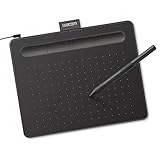
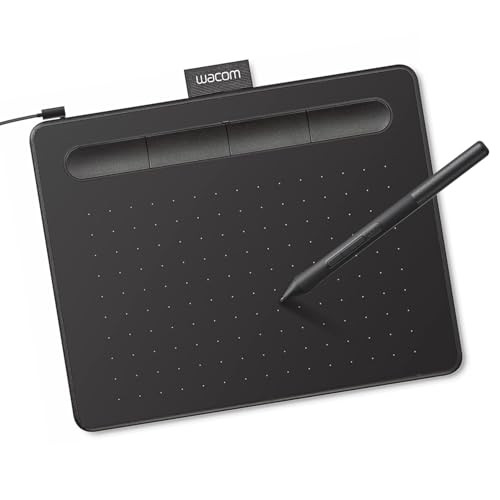
At 0.1 x 6.3 x 7.87 in and 0.51 lb, the Intuos Small is the smallest and lightest thing in this roundup. If your desk already holds two monitors, a keyboard, a mouse and a mug, that footprint is the argument. Model CTL4100, released in 2018, second-cheapest of the six.
Wacom's copy leans on its EMR battery-free pen technology and claims the tablet "can be used in any software program". That broad phrasing is worth reading carefully. It's a statement about the tablet behaving as a standard input device, not a promise that any particular drafting package supports pressure or tilt. Wacom also says registering the tablet unlocks creative software and online training, which is a genuine extra for someone learning digital drawing rather than only drafting.
The wired connection is a plus in a CAD context. No pairing, no charging, no dropouts mid-command.
Where it loses to the H640P is shortcuts. The listing publishes no key count, while HUION states six on a cheaper unit. For software driven by keyboard shortcuts, that's the wrong thing to be missing. It's also the second-lightest reason to buy: portability without a screen.
Pros:
- Thinnest pick at 0.1 in and lightest at 0.51 lb
- Battery-free EMR pen, no charging
- Wired connection avoids pairing and dropouts
- Bundled software and training on registration
Cons:
- Listing publishes no shortcut key count
- No screen, same hand-eye separation as the H640P
- Model dates to 2018, the oldest here
- No dimensions given for the active drawing area
3. GAOMON PD1161 Drawing Tablet with Screen — Best for beginners
The highest published key count of the six, at 8 press keys plus 2 pen buttons, behind an 11.6 in full HD screen.
Best for: beginners who need to see the line under the nib Skip it if: your laptop has no spare ports
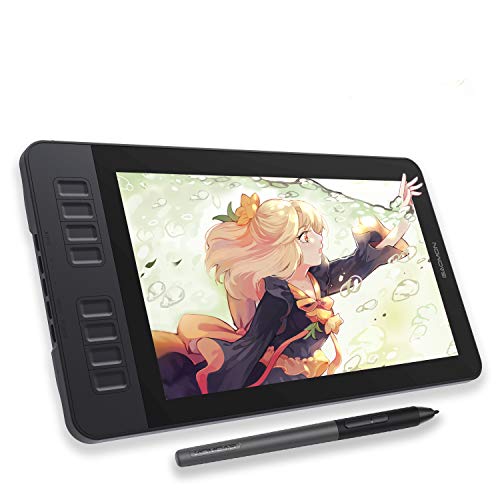
If hand-eye separation is what worries you about a pen pad, this is the fix at a mid-range price position. The PD1161 puts an 11.6-inch full HD IPS screen under the pen so you draw directly onto the image. The listing states 72% NTSC coverage, which it equates to 100% sRGB, plus 16.7 million display colours.
It also wins on shortcuts outright. GAOMON publishes 8 press keys on the side of the display and 2 programmable pen buttons, all configurable in the driver. That's the most one-touch commands of anything here, and in shortcut-driven software those keys are the difference between fluid and fumbling. The AP50 stylus is battery-free with 8192 pressure levels and tilt.
The unit measures 0.1 x 14.2 x 7.9 in and weighs 1.9 lb. GAOMON is explicit that it "is not a standalone tablet, It must be connected to a laptop or computer to work."
Two honest costs. The warranty text specifically excludes accident damage and missing accessories, which is narrower wording than the plain "1 year" the others publish. And a pen display needs display plus data plus power from your machine, so a thin laptop with two ports gets crowded fast.
Pros:
- Most shortcut keys here: 8 press keys, 2 pen buttons
- 11.6 in full HD IPS screen removes hand-eye separation
- Published 100% sRGB and 16.7 million colours
- Battery-free AP50 stylus with tilt support
Cons:
- Warranty explicitly excludes accident damage
- Needs several ports on the host computer
- 1.9 lb and 14.2 in wide, not a travel item
- Only one seller lists it
4. Frunsi RubensTab T11 Pro standalone Drawing Tablet — Runner-up
A self-contained 10 in tablet with drawing apps pre-installed, so nothing needs to be plugged in.

Best for: sketching away from the workstation entirely Skip it if: your files have to open in desktop CAD software
The RubensTab T11 Pro takes the opposite approach to every tethered pick above. Frunsi's copy is direct: "No need for a computer! Frunsi T11 is designed to be completely independent, allowing you to create, sketch, and design anywhere, anytime." It ships with a suite of drawing apps already installed and a battery-free pressure-sensitive pen.
The body measures 0.39 x 7.87 x 6.69 in with a 10 in screen and a 1 year warranty, at a mid-range price position that undercuts both the PD1161's screen size and the two premium picks. Frunsi also pitches it for note-taking in meetings and lectures, which is a fair description of what a standalone slate is genuinely good at.
For a drafting reader, place it carefully. This is a sketching and markup companion, not a CAD machine. Concept sketches, site notes and annotated screenshots move to it easily. A parametric assembly does not.
Two real limits. No weight is published, so you can't compare portability against the 1.9 lb PD1161 or the 1.96 lb Kamvas. And at 0.39 in it's the thickest pick here, nearly four times the 0.1 in of the Wacom and the two pen displays. Only one seller lists it.
Pros:
- Fully standalone, no computer or cables needed
- Drawing apps pre-installed out of the box
- Battery-free pressure-sensitive pen included
- Mid-range price for a 10 in screen
Cons:
- Cannot run desktop CAD software
- Thickest pick at 0.39 in
- No published weight to compare portability
- No shortcut key count or colour figures listed
5. PicassoTab 11" Standalone Drawing Tablet — Best for pros
The only pick publishing its processor and storage: octa-core, 6GB RAM, 128GB expandable to 1TB.

Best for: someone who wants one device for sketching and study Skip it if: you already own a capable computer
The X11 is the most complete package here in the literal sense: it's the only pick that tells you what's inside. Octa-core processor, 6GB RAM, 128GB storage expandable to 1TB. The screen is a fully laminated 11" 2K panel that PicassoTab says "reduces parallax and glare, delivering a smooth, realistic, paper-like drawing feel."
The bundle is unusual too. Six bonus items, including a lifetime Pro upgrade for the Concepts drawing app and a lifetime VIP upgrade for the Artixo tutorials app, plus four accessories. PicassoTab frames Artixo as "step-by-step lessons, guided practice, and beginner-friendly exercises", which is the most explicit learning support in this set. Concepts is a vector-based sketching app, which is a closer relative to technical drawing than most raster paint programs.
The unit measures 0.04 x 11 x 11 in with a 1 year warranty. It sits in the premium price band and only one seller lists it.
The trade-off is duplication. If you already own the workstation your CAD software runs on, you're paying for a second computer you didn't need, and the H640P gets you pen input on the machine you have for a fraction of the outlay. No weight is published either.
Pros:
- Only pick publishing processor, RAM and storage
- Laminated 11 in 2K screen, low parallax and glare
- Storage expandable to 1TB
- Lifetime app and tutorial upgrades bundled
Cons:
- Duplicates hardware you likely already own
- Cannot run desktop CAD applications
- Premium price with no published weight
- Only one seller lists it
6. HUION Kamvas 13 (Gen 3) Drawing Tablet with Screen — Best premium
The largest screen here at 13.3 in, and the only pick shipping with a factory colour calibration report.

Best for: colour-critical work on a 13.3 in screen Skip it if: you need something you can slip into a jacket pocket
This is the most expensive pick here, and the colour data explains why. HUION publishes average ΔE under 1.5, 16.7 million display colours and 99% sRGB coverage, and states that each unit "includes a factory calibration report for added assurance of color consistency." Nothing else in this set ships with per-unit calibration paperwork.
The screen is a fully laminated 13.3-inch panel with anti-sparkle Canvas Glass 2.0, the largest drawing surface of the six. PenTech 4.0 brings 16384 pressure levels and 2g initial activation force, double the pressure resolution of the H640P and PD1161, plus 3 customizable pen side buttons and a dual dial on the body. Model GS1333, 1 year warranty.
HUION is clear that it "is not a standalone product, this device must be connected to a computer/laptop to work."
Where it loses is bulk and cost. At 1.96 lb and 0.1 x 14.2 x 7.98 in, it's the heaviest pick, more than three times the Intuos Small's 0.51 lb. And for a drafting workflow specifically, the calibration report and doubled pressure resolution are refinements aimed at illustration and colour work, not at dimensioned drawings. You're paying for capability a CAD program may never call on.
Pros:
- Largest screen here at 13.3 in, fully laminated
- Published 99% sRGB and average ΔE under 1.5
- Factory calibration report per unit
- Dual dial plus 3 customizable pen side buttons
- Highest stated pressure resolution at 16384 levels
Cons:
- Heaviest pick at 1.96 lb
- Highest price position of the six
- Colour accuracy adds little to dimensioned drafting
- Requires a tethered computer to function
Standalone or tethered: which one fits your setup?
This single question sorts all six picks into two piles, and it's worth answering before you compare anything else.
Tethered pen input covers four picks: the H640P, the Intuos Small, the PD1161 and the Kamvas 13. Your CAD software stays where it already runs. The tablet adds a pen. Two of those listings say so explicitly, GAOMON and HUION both warning the display "must be connected to a laptop or computer to work."
Standalone slates covers two: the RubensTab T11 Pro and the PicassoTab X11. Both run their own apps, both need no computer, and neither can open a desktop CAD file.
Use these thresholds:
- Your drawings live in desktop software on a workstation? Go tethered. Start with the H640P.
- You want the image under the nib on that workstation? Tethered with a screen. The PD1161 at 11.6 in, or the Kamvas 13 at 13.3 in.
- You sketch on site and model later? A standalone slate earns its keep as a second device.
- Desk space is the binding constraint? The Intuos Small at 0.1 x 6.3 x 7.87 in is the smallest footprint here.
- Colour proofing is part of your deliverable? Only the Kamvas 13 publishes a calibration report.
Mixing the two piles is where beginners waste money. A standalone tablet bought expecting CAD is a return; a pen pad bought expecting a screen is a disappointment.
What more money buys across these six
Moving up the range in this set buys screens and published data, in that order.
At the entry positions sit the two pen pads, the H640P and the Intuos Small. Both are under 0.65 lb, both use a battery-free pen, and neither has a display. What you're buying is pen input on hardware you already own, and the H640P adds six programmable keys the Wacom listing doesn't match.
The middle positions buy you a screen. The RubensTab T11 Pro spends it on independence with a 10 in standalone display, while the PD1161 spends it on an 11.6 in full HD panel plus the highest key count here. Different bets on the same money.
At the premium positions, the PicassoTab X11 buys a complete computer, octa-core with 128GB expandable to 1TB, plus lifetime app upgrades. The Kamvas 13 buys measurement instead: 99% sRGB, ΔE under 1.5, a factory calibration report and 16384 pressure levels on the largest 13.3 in surface.
For CAD specifically, the honest read is that the premium tier buys colour and processing capability that dimensioned drafting rarely uses. Spend up if illustration, rendering or client-facing colour work sits alongside your drawings. Otherwise the money buys comfort.
The verdict
The HUION Inspiroy H640P is the best beginner drawing tablet for CAD for most readers, and it wins on fit rather than firepower. It's the cheapest of the six, it weighs 0.6 lb, it publishes six programmable keys for the shortcuts CAD software leans on, and its listing is the only one naming Windows, Mac, Linux and Android 6.0 or later together. It adds pen input to the machine your drafting software already runs on, which is precisely the job.
Two conditions flip that. First, if hand-eye separation is a dealbreaker, buy the GAOMON PD1161 instead. Its 11.6 in full HD screen puts the line under the nib and its 8 press keys plus 2 pen buttons beat the H640P's six outright, at a mid-range price. Second, if colour accuracy is a deliverable, the HUION Kamvas 13 (Gen 3) is the only pick publishing 99% sRGB, average ΔE under 1.5 and a per-unit factory calibration report on a 13.3 in laminated panel.
One caveat stands over all of it. Not one of these six listings claims support for any CAD application by name, so confirm your software's pen and tablet handling in its own documentation before you buy. That check costs nothing and prevents the only mistake that really hurts here.
FAQ
Is a beginner drawing tablet for CAD worth buying at all?
A beginner drawing tablet for CAD is worth buying if your work involves sketching, markup or redlining, because a pen beats a mouse for freehand strokes. It's less compelling for pure parametric modelling, where typed coordinates and dimension fields still do the precision work. Start cheap with the H640P and see whether the pen sticks before spending on a screen.
What's the cheapest way to try pen input for drafting?
The cheapest way to try pen input here is the HUION Inspiroy H640P, the lowest price position of these six. It's a 0.6 lb pad measuring 0.31 x 10 x 5.98 in with a battery-free PW100 stylus, so there's no charging routine and nothing extra to buy. If pen input doesn't suit your workflow, you've risked the least possible outlay.
Do these tablets work with AutoCAD, SolidWorks or Fusion?
Whether these tablets work with those specific packages isn't something the listings answer. None of the six names any CAD application. HUION states OS support for Windows, Mac, Linux and Android 6.0 or later on the H640P, and Wacom claims the Intuos works "in any software program". Those are operating-system claims. Check your CAD vendor's input documentation for pressure and tilt support.
HUION H640P or GAOMON PD1161: which should a beginner pick?
Between the HUION H640P and the GAOMON PD1161, the deciding factor is whether you want a screen. The H640P is cheaper, weighs 0.6 lb and has 6 press keys. The PD1161 adds an 11.6 in full HD display plus 8 press keys and 2 pen buttons, but weighs 1.9 lb and needs several ports on your computer.
What mistake do first-time tablet buyers make most often?
The mistake first-time tablet buyers make most often is buying a standalone slate expecting it to run desktop CAD software. The PicassoTab X11 and Frunsi RubensTab T11 Pro are genuinely computer-free, which means they run their own apps and nothing else. If your drawings must open in a desktop application, you need a tethered pick instead.
Start with the H640P beside your existing workstation, spend a week reassigning its six keys to the commands you actually use, and you'll know within days whether pen input belongs in your workflow. That's a small, reversible test rather than a commitment. What makes the H640P the sensible default isn't any single number on its spec sheet, it's that the tablet asks nothing of your setup: no second computer, no port juggling, no charging cable, no OS you have to hope is supported. Everything above it in this list is an upgrade you can justify later, once the pen has earned its spot on the desk.