Best All-in-One Desktop for Programmers: HP Leads
Six all-in-ones lined up by RAM, storage and CPU. The HP 24 OmniStudio wins on memory and disk, but the deciding spec for coders is not the one the listings push hardest.
The best all in one desktop computer for programmers is the HP 24" OmniStudio, because it pairs 16GB of RAM with a 512GB SSD in one white 11 lb chassis, the most balanced memory-and-storage combination in this group. If you keep a dozen tabs and a full IDE open all day, the Lenovo 24" with 16GB RAM and a 256GB PCIe SSD is the better long-session pick. Here is the misconception worth clearing first: most guides compare processor clock speed, and for coding that is rarely what slows you down.
Best all in one desktop computer for programmers at a glance
| Pick | RAM & Storage | CPU (claimed) | Price |
|---|---|---|---|
| Best overall HP 24" OmniStudio |
16GB / 512GB SSD | Intel Core, 4 cores to 3.8GHz | Check Price |
| Best for heavy use Lenovo 24" AIO |
16GB / 256GB PCIe SSD | Intel N100, 4 cores | Check Price |
| Best premium Lenovo IdeaCentre 24" |
16GB / 512GB SSD | Intel N100 quad-core | Check Price |
| Best budget pick Cybrimax 24" AIO |
8GB / 256GB SSD | Intel Core i5 (claim) | Check Price |
| Best for small spaces Core Innovations 24" |
4GB / 128GB | Intel Celeron N5095 | Check Price |
| Best for families HP 22" AIO |
8GB / 128GB + 512GB ext. | Intel Core, 4 cores to 3.8GHz | Check Price |
A quick word on the word "programmers." Amazon's search treated it loosely, and none of these listings is marketed as a developer workstation. So read the modifier as a lens, not a promise: I judged each machine on the specs that matter to writing and running code, and I flagged where a listing simply does not tell you enough to trust it for that job.
How I cut six listings down to a ranking
Three things got picks demoted fast, and they map to how coding actually stresses a machine.
- Too little RAM. A 4GB machine cannot hold a modern IDE, a browser and a container without swapping to disk. That knocked the Core Innovations 24" out of contention for anything but the lightest editing.
- Fake or thin storage. The HP 22" pairs 128GB internal with "512GB External Storage" per its listing. External is not the same as an internal SSD you install tools onto, so it dropped.
- Missing specs. The Lenovo IdeaCentre 24" and the Cybrimax publish no weight and no dimensions. You cannot plan a desk around a mystery, so both lost ground even where their memory numbers were strong.
What survived leans on two figures every time: installed RAM and internal SSD size. The best all in one desktop computer for programmers in this group is the one that scores well on both without hiding the rest of its spec sheet. That is the HP 24" OmniStudio, and the reasoning runs through every section below.
Why RAM decides this more than clock speed
Clock speed sells listings. The HP units advertise an Intel Core chip hitting 3.8GHz, and it reads impressive. But a compiler waiting on memory does not care about a headline frequency.
Here is the practical order for a coding machine:
- RAM first. Editors, language servers, browsers and containers all live in memory at once. 16GB is the floor that keeps you off the swap file; 8GB works for a single light project; 4GB struggles.
- Internal SSD second. Dependency folders and build caches balloon fast. A 512GB internal drive gives room; 128GB fills within a few projects.
- CPU third. All six run 4-core Intel parts. The gap between an N100 and a "Core" chip matters for big compiles, but far less than the memory gap above it.
By that order, the two 16GB / 512GB machines lead: the HP OmniStudio and the Lenovo IdeaCentre. The best all in one desktop computer for programmers is chosen on this ladder, not on a single GHz number.
1. HP 24" OmniStudio All-in-One Desktop Computer — Best overall
The HP OmniStudio wins because it is the only pick here that pairs 16GB of RAM with a 512GB internal SSD and still publishes its full weight and size.

Best for: coders who want the most memory and disk in one box Skip it if: you need to add RAM or swap the drive later
What sets this one apart in the group is the complete, believable spec sheet. It lists 16GB RAM and a 512GB SSD, weighs 11 lb, and measures 17.6 x 21.3 x 7.28 in, so you can plan a desk before it arrives. That transparency is rare here; two rivals skip weight and size entirely.
HP describes the processor as an Intel Core chip with 4 cores reaching 3.8GHz, which handles the everyday load of an editor, a browser and a test runner. HP also claims WiFi 6 and Bluetooth 5.2, plus an HD webcam and a mono microphone for calls. Note the mono mic. It is fine for stand-ups, less so for anything you want to sound polished.
There is a wrinkle in the listing. It carries both an "8GB DDR5 RAM, 128GB UFS" title and a 16GB / 512GB spec line. I ranked on the fuller spec set, but confirm the configuration on the live listing before you buy. The trade-off against the Lenovo picks is a shorter, unstated warranty position, where Lenovo names a one-year term.
Pros:
- 16GB RAM and 512GB SSD, the strongest pairing here
- Full weight and dimensions published, 11 lb
- WiFi 6 and Bluetooth 5.2 claimed
- Sells faster than most of this set
- Space-saving white chassis with tilt stand
Cons:
- Listing shows conflicting RAM and storage figures
- Mono microphone only, per the listing
- No stated warranty length
- Memory and drive not described as user-upgradeable
2. Lenovo 24" FHD All-in-One Desktop Computer — Best for heavy use
The Lenovo 24" earns the heavy-use nod because it backs 16GB of RAM with a fast PCIe SSD and states a one-year manufacturer warranty in plain language.
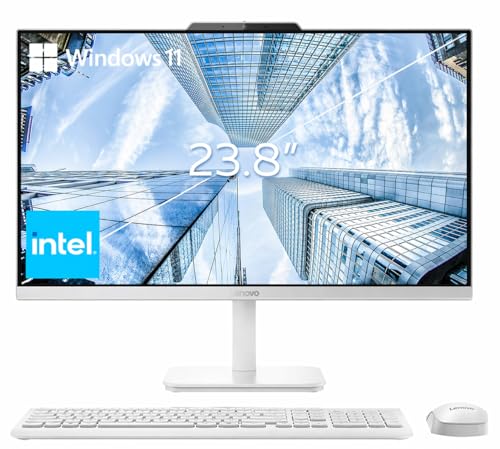
Best for: long sessions with many tabs and a full IDE open Skip it if: desk depth is tight or you want the lightest unit
Lenovo lists 16GB DDR4 RAM and a 256GB PCIe SSD, and the PCIe interface is the detail worth pausing on. It moves data faster than a plain SATA drive, which shows up when your build cache is churning. The panel is a 23.8" FHD IPS anti-glare screen that Lenovo rates at 250 nits and 99% sRGB, a genuinely useful pairing for reading code at length without glare.
This is the heaviest unit here at 15.2 lb, and it is deep, measuring 16.7 x 7.3 x 21.2 in. Lenovo claims Intel Wi-Fi 6 AX203 and Bluetooth 5.2, ships a wireless keyboard and mouse, and preinstalls Windows 11 Pro, which matters if you need Pro features like remote desktop.
The compromise is storage size. At 256GB it is half the disk of the HP winner, so a coder with large repositories will fill it sooner. You trade capacity for a faster interface and a clearly stated warranty.
Pros:
- 16GB RAM with a faster PCIe SSD
- One-year manufacturer warranty stated plainly
- Windows 11 Pro preinstalled
- Wireless keyboard and mouse included
- IPS panel with 250 nits, 99% sRGB claim
Cons:
- 256GB is the smaller drive versus the HP winner
- Heaviest unit here at 15.2 lb
- Deep footprint at 21.2 in
- Listing colour field reads "Intel N100", a data slip
3. Lenovo IdeaCentre 24" FHD All-in-One Desktop — Best premium
The IdeaCentre matches the winner on 16GB RAM and a 512GB SSD, then adds bundled Office access, but its listing hides the physical specs a buyer needs.

Best for: someone who wants a large SSD and bundled software Skip it if: you need published weight and size before buying
On the two specs that decide this category, the IdeaCentre ties the leader: 16GB DDR4 RAM and a 512GB SSD, per Lenovo's own copy. That is enough memory and disk for real project work, and the 512GB drive edges past the other Lenovo's 256GB.
Lenovo describes an Intel N100 quad-core processor, a 23.8" Full HD screen with a 99% sRGB and anti-glare claim, WiFi 6, Bluetooth 5.1, an HD webcam and dual microphones. Those dual mics are a small upgrade over the HP's single mono mic on calls. The listing also touts a wired keyboard, mouse and what it calls lifetime Office 365 access, plus Windows 11 Home.
The problem is the blank spec sheet. There is no published weight, and no usable dimensions, since the model field just reads "24". For a machine at the top of the price positions here, that is a lot to take on trust. That gap is exactly why it sits behind the two picks that show their full numbers.
Pros:
- 16GB RAM and 512GB SSD, ties the leader
- Dual microphones claimed for clearer calls
- Bundled keyboard, mouse and Office access
- N100 quad-core with 99% sRGB screen claim
Cons:
- No published weight or dimensions
- The most expensive pick here for no extra core spec
- Only one seller lists it
- Windows 11 Home, not Pro
4. Cybrimax 24" Full HD All-in-One Desktop Computer — Best budget pick
The Cybrimax is the cheapest of the six and the only entry-tier machine that claims an Intel Core i5, which is why it beats the other budget options for coding.

Best for: a first coding machine on the tightest budget Skip it if: you compile large projects or run several VMs
For a first machine, the Cybrimax makes a stronger case than its position at the bottom of the price ladder suggests. Cybrimax claims an i5 CPU with 8GB of dual-channel RAM and a 256GB SSD, a step up in processor class over the Celeron-based small-space pick. 8GB is the working floor for a single project with a browser open.
Cybrimax lists a 24" 1920x1080 display, a privacy-shutter webcam, WiFi 6 and Bluetooth 5.3, with Windows 11 Home preloaded. The privacy shutter is a nice touch that pricier picks here skip.
The catch is what the listing does not show. There is no published weight, no dimensions and no stated warranty, and the "i5 CPU" claim carries no generation or model, so you cannot judge whether it is a recent chip or an older one. Against the 16GB machines above, 8GB is the real limit for a coder: fine today, tight the moment you add containers. Buy it as a starter, not a machine to grow into.
Pros:
- Cheapest of the six here
- i5 CPU claim beats other entry-tier picks
- 256GB SSD, double the small-space pick's disk
- Privacy-shutter webcam, WiFi 6, Bluetooth 5.3
Cons:
- 8GB RAM limits heavier coding
- No weight, dimensions or warranty published
- i5 claim lists no generation or model
- Only one seller stocks it
5. Core Innovations 24" All-in-One Desktop PC — Best for small spaces
The Core Innovations wins on slimness alone, with a 2.38 in depth that no other pick here approaches, but its 4GB RAM rules it out for real coding.

Best for: a thin unit for a shelf or narrow desk Skip it if: you do anything beyond a browser and a light editor
The single reason to consider this one is its footprint. At 2.38 x 21.5 x 12.6 in, it is by far the thinnest machine in the group, and it tucks onto a shelf where the deeper Lenovo units will not fit. It also carries the clearest warranty language here: a 90-day term plus one year for parts and labor, and it was released in 2024.
Core Innovations lists a 2.9GHz Intel Celeron N5095, a 24" 1920x1080 FHD IPS display, 4GB RAM and 128GB storage, with dual-band Wi-Fi. That screen is decent. The rest is where a coder hits a wall.
4GB of RAM cannot hold a modern IDE alongside a browser without constant swapping, and 128GB of storage fills quickly once tools and dependencies land. This is a machine for email, documents and a light text editor. As a coding workstation it is outmatched by every 8GB and 16GB pick above, and that is the honest trade-off for the slim body.
Pros:
- Thinnest chassis here at 2.38 in deep
- Clear warranty: 90 days plus one year parts and labor
- FHD IPS display listed
- Two sellers stock it
Cons:
- 4GB RAM is too little for coding
- 128GB storage fills fast
- Celeron N5095 is the weakest CPU here
- Slowest seller of the six
6. HP 22" All-in-One Desktop Computer — Best for families
The HP 22" is the compact family option, but its 128GB internal drive and 8GB RAM make it a light-duty machine, not a coding one.

Best for: a shared 22-inch machine for light home tasks Skip it if: you want a real internal drive and more RAM
The 22" screen is the smallest here, which is the point: it suits a kitchen counter or a kid's desk better than the 24" units. HP lists 8GB DDR5 RAM, a tilt stand, WiFi 6 and Bluetooth 5.2, an HD webcam and a mono mic, and a one-year seller's warranty. It sells at a mid position among these six.
The storage line is where it stumbles for a developer. HP pairs 128GB internal with 512GB described as external, and external storage is not where you install a toolchain. That leaves a small internal drive to work from, which fills fast under any real project.
For a shared family computer running a browser, homework and video calls, it is a tidy, space-saving choice. For writing and building code it lands behind the 16GB / 512GB machines and behind the i5 budget pick, because 8GB plus a 128GB internal drive is the tightest usable spec here for that job. Buy it for the family, not the codebase.
Pros:
- Smallest 22" footprint for tight spaces
- 8GB DDR5 RAM, WiFi 6, Bluetooth 5.2
- One-year seller's warranty stated
- Tilt-stand white design
Cons:
- Only 128GB internal, rest is external storage
- 8GB RAM limits heavier work
- Mono microphone only
- No published weight or dimensions
Does an all-in-one make sense for coding at all?
An all-in-one puts the computer inside the monitor. That saves desk space and cuts cable clutter, which is why every pick here is a single tidy unit. But there is a cost, and coders should know it before buying.
- Limited upgrades. Most all-in-ones make RAM and storage hard to change. Pick the memory and disk you will need in two years, now.
- One screen. Many developers want dual monitors. Check for a spare HDMI or video-out; the Lenovo 24" lists HDMI, for example.
- Integrated graphics. These are office chips, fine for editors and browsers, not for GPU-heavy compute.
If you write web, scripting or general application code, an all-in-one is a reasonable home for it. If you build large native projects or run heavy virtual machines all day, a tower with upgrade room serves you longer. Match the machine to the workload, not the marketing.
What the listings leave out
Read these listings closely and the gaps matter more than the headlines. A few things to verify on the live page before you commit:
- Exact CPU model. "Intel Core" and "i5 CPU" tell you a class, not a generation. An older i5 and a recent one behave very differently under a compile.
- Whether storage is internal. The two HP units count external storage in their totals. For coding you want internal SSD space.
- RAM configuration. The HP OmniStudio listing shows two different memory figures. Confirm which you are actually buying.
- Weight and size. The IdeaCentre and Cybrimax publish neither. Measure your desk against the picks that do state dimensions.
None of these are dealbreakers on their own. Together they explain the ranking: the machines that show their full spec sheet, like the HP OmniStudio at 11 lb and the Lenovo 24" at 15.2 lb, earned the trust to sit at the top.
When a different pick wins
The winner is not universal. Three concrete conditions flip it.
- If your desk is under 13 inches deep, the Core Innovations at 2.38 in deep is the only pick that fits comfortably, even though its 4GB RAM limits it to light work.
- If you keep dozens of tabs and a full IDE open all day, the Lenovo 24" and its faster PCIe SSD, plus Windows 11 Pro, handle the sustained load better than the HP.
- If budget is the hard limit, the Cybrimax is the cheapest here and still claims an i5 with a 256GB SSD, a better coding starter than the other entry-tier machine.
The threshold that decides most buyers is memory: at or above 16GB, choose on storage and warranty; below it, you are buying a light-use machine and should price accordingly.
The verdict
The best all in one desktop computer for programmers is the HP 24" OmniStudio. It is the only pick that combines 16GB of RAM, a 512GB internal SSD and a full, published spec sheet, right down to its 11 lb weight and 17.6 x 21.3 x 7.28 in footprint. For writing and running code, that memory-and-storage pairing is what keeps you productive, and no other machine here delivers both without hiding something.
Two conditions flip the choice. First, if you run long, tab-heavy sessions and want Windows 11 Pro with a faster PCIe drive, the Lenovo 24" is the better buy, even at 256GB and 15.2 lb. Its clearly stated one-year warranty is a real edge over the HP's silence on warranty length. Second, if money is tight, the Cybrimax is the cheapest here and still claims an i5 with a 256GB SSD, enough for a first coding machine.
Confirm the HP's RAM configuration on the live listing before ordering, since the page shows conflicting figures. Get the 16GB / 512GB build and it is the machine I would set up first.
FAQ
Is an all-in-one desktop computer for programmers worth it?
An all-in-one desktop computer is worth it for programmers doing web, scripting or general application work, where 16GB of RAM and a 512GB SSD like the HP OmniStudio's cover the load. It saves desk space and cabling. It is not worth it if you compile large native projects or run several virtual machines, since upgrade room is limited.
How much RAM does a programmer really need in one of these?
How much RAM you need starts at 16GB for comfortable coding, which lets an IDE, a browser and light containers run without swapping to disk. The HP OmniStudio and both Lenovo picks hit that mark. 8GB, as on the Cybrimax, works for a single project. The 4GB Core Innovations is too tight for real development.
What is the best budget all in one desktop computer for programmers here?
The best budget all in one desktop computer for programmers in this group is the Cybrimax, the cheapest of the six. It claims an Intel Core i5 with 8GB of RAM and a 256GB SSD, plus a privacy webcam and WiFi 6. It has no published weight, size or warranty, so treat it as a capable starter rather than a machine to grow into.
HP OmniStudio or Lenovo 24: which suits coding better?
HP OmniStudio or Lenovo suits coding better depending on session length. The HP gives you a larger 512GB SSD and full published dimensions at 11 lb. The Lenovo 24" offers a faster PCIe drive at 256GB, Windows 11 Pro, and a stated one-year warranty. Choose the HP for storage headroom, the Lenovo for sustained heavy use and warranty clarity.
What is the biggest mistake buying an all-in-one for code?
The biggest mistake buying an all-in-one is trusting a headline storage total that counts external drives. Both HP units here pad their figures with 512GB of external storage while the internal drive is only 128GB. For coding you install tools onto the internal SSD, so check that number, and confirm the RAM configuration, before you buy.
Start by deciding your memory floor: if you want a machine that still copes in two years, buy at 16GB and choose on storage. That points straight to the HP 24" OmniStudio, whose 16GB RAM, 512GB SSD and fully published dimensions make it the safest default for a coder who wants one tidy unit and no surprises. Confirm the configuration on the live page, match the depth to your desk, and you have a machine that handles editors, browsers and everyday builds without the guesswork the thinner spec sheets here leave behind.
Last updated: September 7, 2026. Product availability re-checked.
This page contains affiliate links. As an Amazon Associate we earn from qualifying purchases, at no extra cost to you.